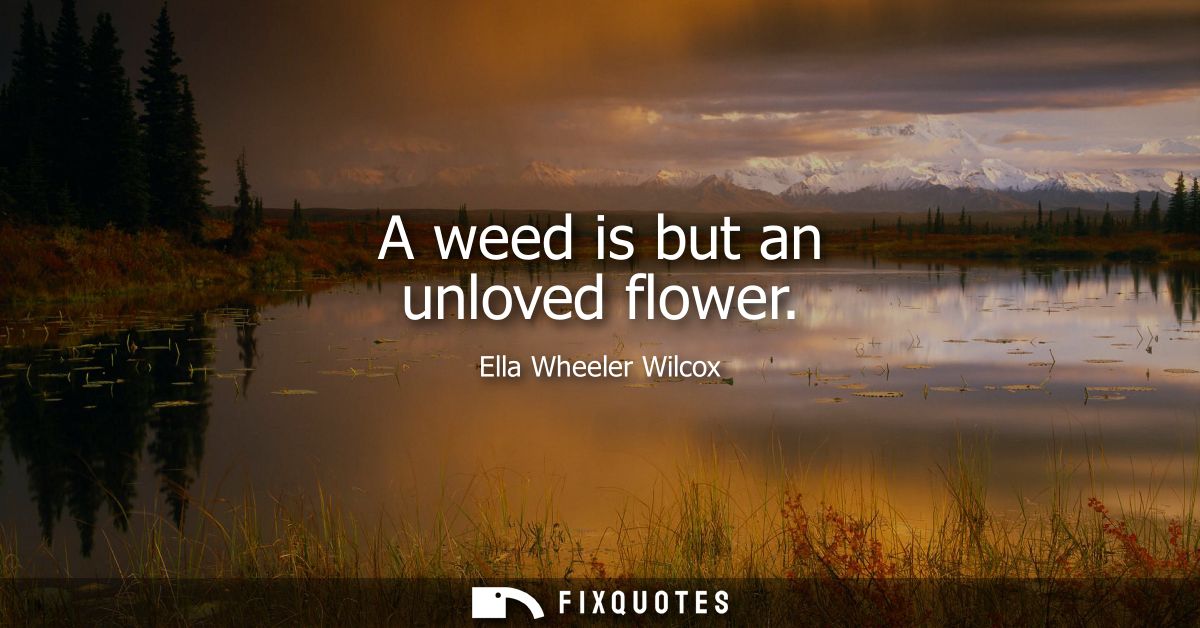
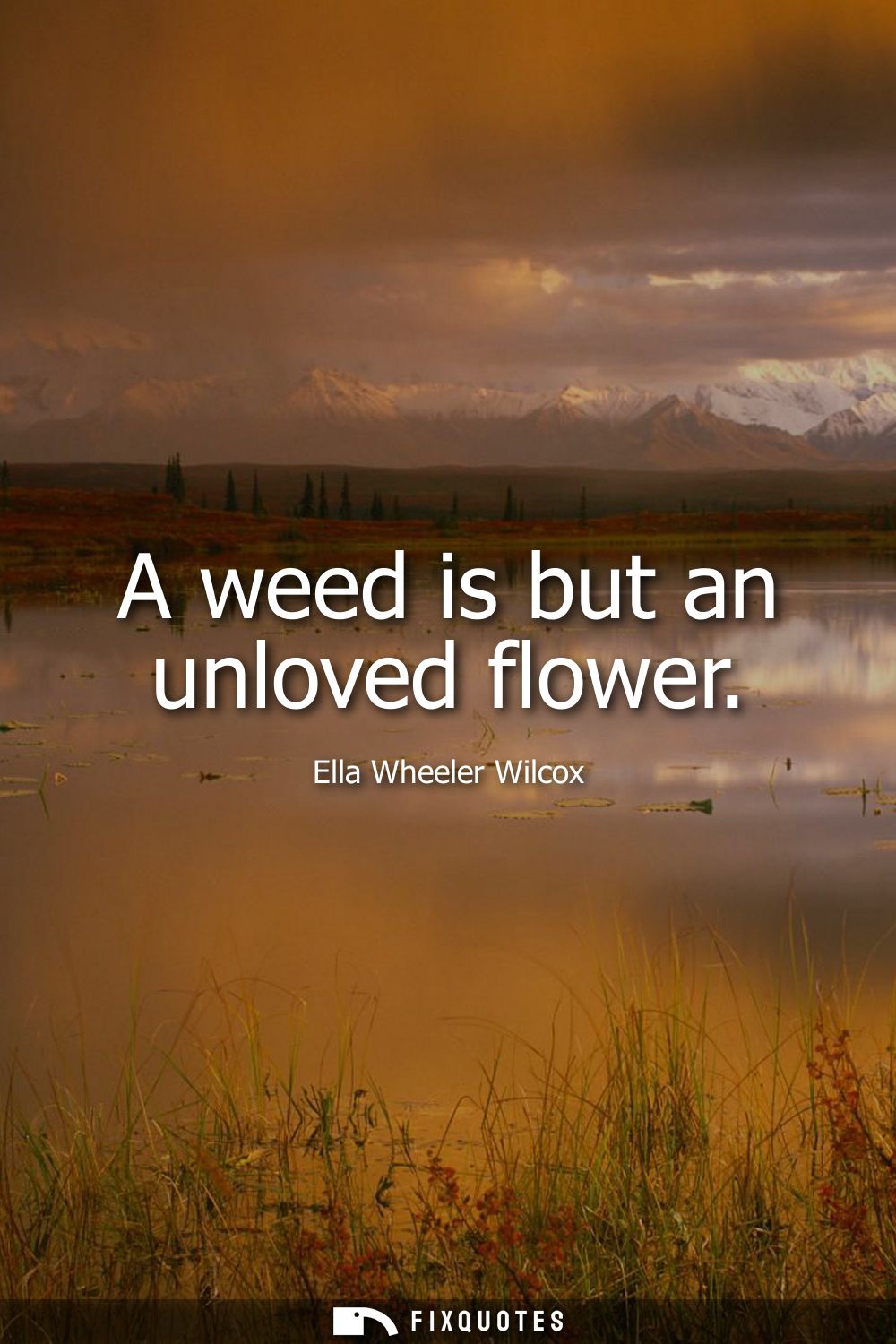
"A weed is but an unloved flower"
About this Quote
“A weed is but an unloved flower” is Wilcox at her most deceptively simple: a moral argument smuggled in as a garden proverb. The line flips a hard-edged category (weed) into a relationship problem (unloved), insisting that what we condemn in nature is often just what we’ve refused to value. It works because it makes judgment look petty. “Weed” isn’t a botanical fact; it’s a social verdict. Wilcox turns that verdict into something embarrassingly contingent: not “ugly,” not “useless,” just excluded from affection and attention.
The intent is reformist, but not political in the ballot-box sense. Wilcox, a hugely popular poet of late-19th-century American optimism, traded in maxims that could travel: across parlor rooms, newspaper columns, and the self-improvement circuits of her day. Her era loved classification and cultivation - proper gardens, proper manners, proper people - and that’s the context that gives the metaphor its bite. If a weed is merely an “unloved” flower, then “undesirable” people and traits start to look like products of neglect, poverty, or prejudice rather than inherent defects.
Subtextually, the quote also flatters the reader into generosity. It suggests that a shift in perception - choosing to love, choosing to tend - can redeem what was dismissed. That promise is the engine of Wilcox’s appeal: she offers ethical uplift without scolding, a way to feel both kinder and wiser. The softness is strategic. By framing stigma as a failure of love, she makes cruelty seem not only wrong, but small-minded.
The intent is reformist, but not political in the ballot-box sense. Wilcox, a hugely popular poet of late-19th-century American optimism, traded in maxims that could travel: across parlor rooms, newspaper columns, and the self-improvement circuits of her day. Her era loved classification and cultivation - proper gardens, proper manners, proper people - and that’s the context that gives the metaphor its bite. If a weed is merely an “unloved” flower, then “undesirable” people and traits start to look like products of neglect, poverty, or prejudice rather than inherent defects.
Subtextually, the quote also flatters the reader into generosity. It suggests that a shift in perception - choosing to love, choosing to tend - can redeem what was dismissed. That promise is the engine of Wilcox’s appeal: she offers ethical uplift without scolding, a way to feel both kinder and wiser. The softness is strategic. By framing stigma as a failure of love, she makes cruelty seem not only wrong, but small-minded.
Quote Details
| Topic | Wisdom |
|---|---|
| Source | Help us find the source |
| Cite |
Citation Formats
APA Style (7th ed.)
Wilcox, Ella Wheeler. (2026, January 17). A weed is but an unloved flower. FixQuotes. https://fixquotes.com/quotes/a-weed-is-but-an-unloved-flower-54008/
Chicago Style
Wilcox, Ella Wheeler. "A weed is but an unloved flower." FixQuotes. January 17, 2026. https://fixquotes.com/quotes/a-weed-is-but-an-unloved-flower-54008/.
MLA Style (9th ed.)
"A weed is but an unloved flower." FixQuotes, 17 Jan. 2026, https://fixquotes.com/quotes/a-weed-is-but-an-unloved-flower-54008/. Accessed 22 Mar. 2026.
More Quotes by Ella
Add to List