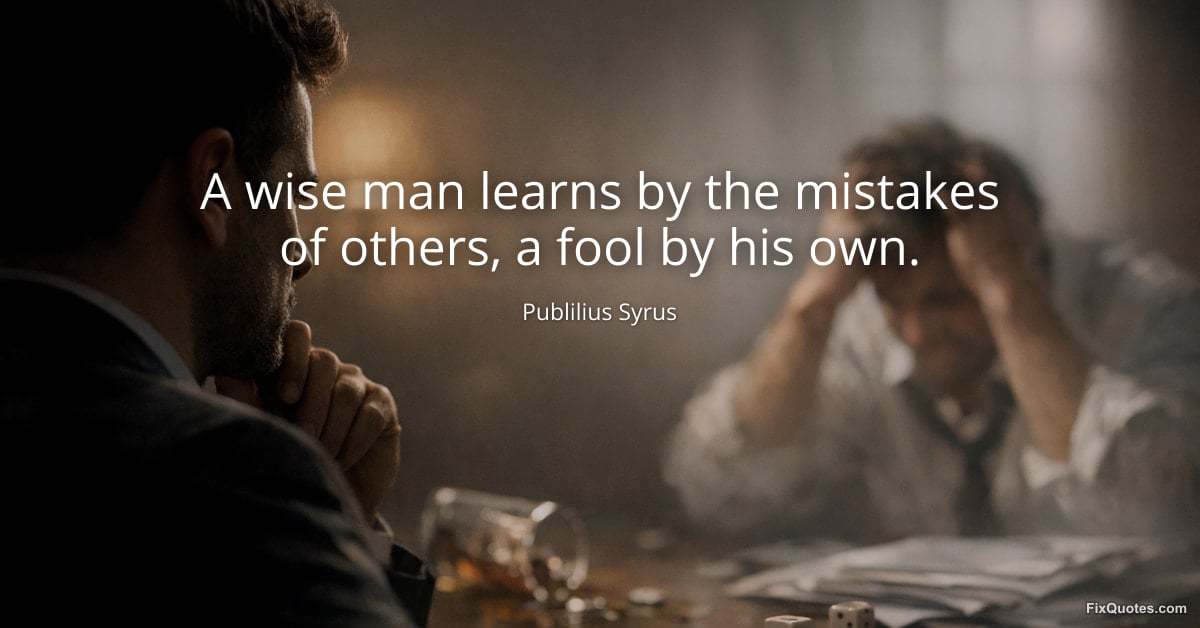
"A wise man learns by the mistakes of others, a fool by his own"
About this Quote
Wisdom here isn’t haloed virtue; it’s thrift. Publilius Syrus, a Roman writer of razor-edged maxims, frames intelligence as a kind of moral and practical economy: the wise man refuses to pay full price for knowledge when the world is already littered with receipts. The line is built like a courtroom contrast, “wise” versus “fool,” with the punchy cadence of a verdict. It flatters the listener into choosing the “wise” category while quietly scolding them for the universal habit of believing we’re the exception.
The subtext is darker than the motivational-poster version. “Learns by the mistakes of others” isn’t just about humility; it’s about attention, social awareness, and the ability to extract patterns from public failure. That’s a political skill in Rome, where reputations were currency and a misstep could be fatal. To learn only by your own mistakes is cast as not merely inefficient but antisocial: it implies you ignored warning signs everyone else could see, forcing others to endure the fallout of your education.
Context matters: Syrus trafficked in sententiae, compact lines designed to travel, stick, and instruct across class lines. The form is the message. In a culture that prized exempla (historical “examples” used to teach civic virtue), he compresses an entire Roman worldview into a single binary: civilization advances when people treat experience as communal data, not private prophecy. The irony is that even this maxim can become a mistake of its own if it turns into smug spectatorship. Learning from others demands empathy as much as distance.
The subtext is darker than the motivational-poster version. “Learns by the mistakes of others” isn’t just about humility; it’s about attention, social awareness, and the ability to extract patterns from public failure. That’s a political skill in Rome, where reputations were currency and a misstep could be fatal. To learn only by your own mistakes is cast as not merely inefficient but antisocial: it implies you ignored warning signs everyone else could see, forcing others to endure the fallout of your education.
Context matters: Syrus trafficked in sententiae, compact lines designed to travel, stick, and instruct across class lines. The form is the message. In a culture that prized exempla (historical “examples” used to teach civic virtue), he compresses an entire Roman worldview into a single binary: civilization advances when people treat experience as communal data, not private prophecy. The irony is that even this maxim can become a mistake of its own if it turns into smug spectatorship. Learning from others demands empathy as much as distance.
Quote Details
| Topic | Learning from Mistakes |
|---|---|
| Source | Help us find the source |
| Cite |
Citation Formats
APA Style (7th ed.)
Syrus, Publilius. (2026, February 2). A wise man learns by the mistakes of others, a fool by his own. FixQuotes. https://fixquotes.com/quotes/a-wise-man-learns-by-the-mistakes-of-others-a-171383/
Chicago Style
Syrus, Publilius. "A wise man learns by the mistakes of others, a fool by his own." FixQuotes. February 2, 2026. https://fixquotes.com/quotes/a-wise-man-learns-by-the-mistakes-of-others-a-171383/.
MLA Style (9th ed.)
"A wise man learns by the mistakes of others, a fool by his own." FixQuotes, 2 Feb. 2026, https://fixquotes.com/quotes/a-wise-man-learns-by-the-mistakes-of-others-a-171383/. Accessed 24 Mar. 2026.
More Quotes by Publilius
Add to List