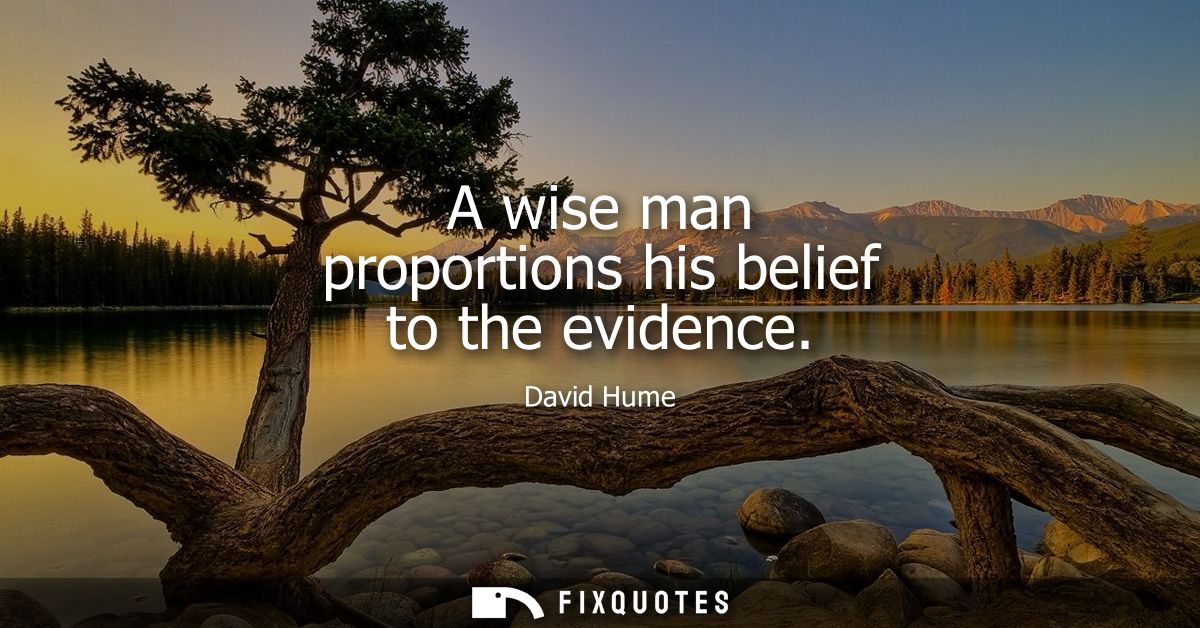
"A wise man proportions his belief to the evidence"
About this Quote
Hume’s line is a scalpel aimed at the era’s favorite indulgence: believing too much, too quickly, and then dressing it up as virtue. “Proportions” is the key word. He’s not demanding cold skepticism for its own sake; he’s proposing an ethic of calibration. Belief isn’t a badge you wear, it’s a quantity you adjust. The wise person doesn’t pick a team and defend it with bravado. He treats conviction like a measurement that should expand or contract depending on what the world actually hands you.
The subtext is quietly radical: most of what passes for certainty is a social habit, not an intellectual achievement. Hume wrote in the Enlightenment, when science was beginning to outmuscle inherited authority, but theology, superstition, and political loyalty still claimed automatic deference. His philosophy is famous for puncturing the idea that reason rules us; we’re driven by custom, feeling, and convenience. So this sentence doubles as a self-diagnostic: if your belief is fixed while your evidence shifts, you’re not reasoning, you’re performing.
It also anticipates modern fights over misinformation without sounding like a TED Talk. Hume isn’t saying “trust experts” or “follow the science” as slogans. He’s describing a discipline: demand receipts, weigh them, and let uncertainty remain when the evidence is thin. Wisdom, in his frame, looks less like having the right answers and more like resisting the human urge to turn hunches into holy writ.
The subtext is quietly radical: most of what passes for certainty is a social habit, not an intellectual achievement. Hume wrote in the Enlightenment, when science was beginning to outmuscle inherited authority, but theology, superstition, and political loyalty still claimed automatic deference. His philosophy is famous for puncturing the idea that reason rules us; we’re driven by custom, feeling, and convenience. So this sentence doubles as a self-diagnostic: if your belief is fixed while your evidence shifts, you’re not reasoning, you’re performing.
It also anticipates modern fights over misinformation without sounding like a TED Talk. Hume isn’t saying “trust experts” or “follow the science” as slogans. He’s describing a discipline: demand receipts, weigh them, and let uncertainty remain when the evidence is thin. Wisdom, in his frame, looks less like having the right answers and more like resisting the human urge to turn hunches into holy writ.
Quote Details
| Topic | Reason & Logic |
|---|---|
| Source | Verified source: An Enquiry Concerning Human Understanding (David Hume, 1748)
Evidence: A wise man, therefore, proportions his belief to the evidence. (Section X (“Of Miracles”), Part I). This line appears in Hume’s own work (primary source) in Section X, “Of Miracles,” Part I. The commonly repeated version drops “therefore,” but the original sentence includes it. The Project Gutenberg text is not the 1748 printing itself, but it reproduces the wording and location within the work. First publication of the work is commonly dated 1748 (as An Enquiry Concerning Human Understanding). Other candidates (1) Believing Against the Evidence (Miriam Schleifer McCormick, 2014) compilation95.0% ... David Hume is one of the historical figures most commonly invoked in defending evidentialism . Hume's statement ,... |
| Cite |
Citation Formats
APA Style (7th ed.)
Hume, David. (2026, February 24). A wise man proportions his belief to the evidence. FixQuotes. https://fixquotes.com/quotes/a-wise-man-proportions-his-belief-to-the-evidence-67615/
Chicago Style
Hume, David. "A wise man proportions his belief to the evidence." FixQuotes. February 24, 2026. https://fixquotes.com/quotes/a-wise-man-proportions-his-belief-to-the-evidence-67615/.
MLA Style (9th ed.)
"A wise man proportions his belief to the evidence." FixQuotes, 24 Feb. 2026, https://fixquotes.com/quotes/a-wise-man-proportions-his-belief-to-the-evidence-67615/. Accessed 4 Apr. 2026.
More Quotes by David
Add to List