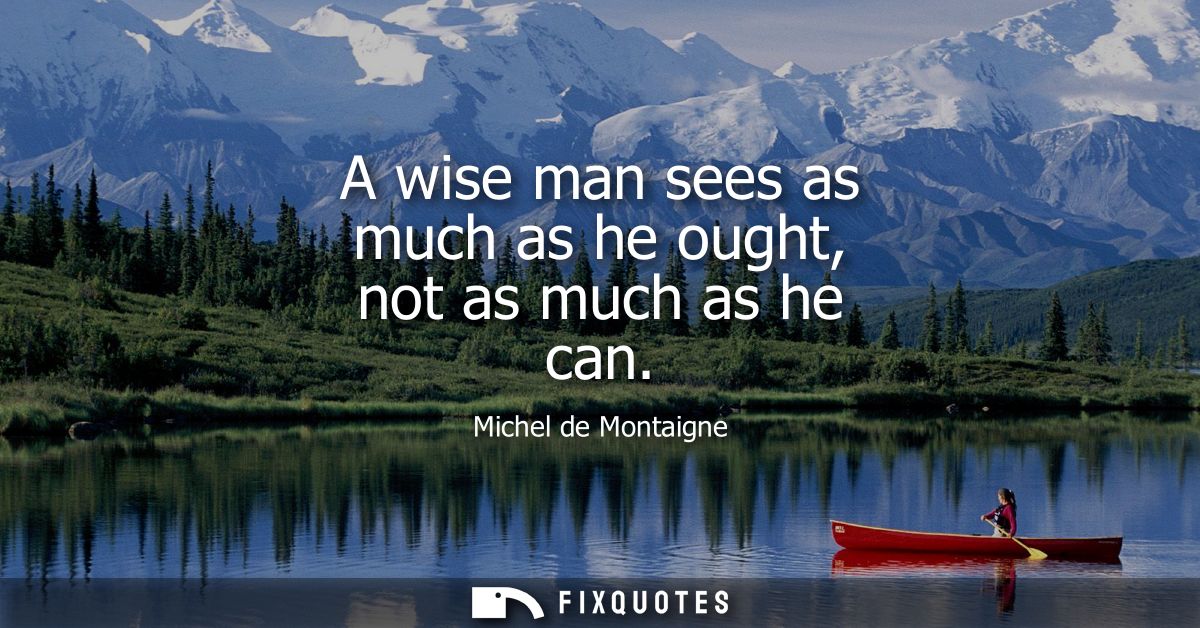
"A wise man sees as much as he ought, not as much as he can"
About this Quote
Restraint is the flex Montaigne is praising, and it lands like a quiet rebuke to every era that confuses capacity with virtue. "A wise man sees as much as he ought, not as much as he can" hinges on an almost legalistic distinction: can is power, ought is judgment. The line suggests that wisdom is not an expanded aperture but a disciplined one. Seeing, here, is more than eyesight; it’s curiosity, scrutiny, interpretation, even intrusion. Montaigne implies that the unfiltered pursuit of total knowledge can be a kind of moral negligence.
The subtext is characteristically skeptical. As an essayist who built a philosophy out of self-interrogation and doubt, Montaigne mistrusted certainty and the ego that comes with it. He’d watched religious wars and ideological zeal turn "knowing" into a weapon. So he offers a counter-ethic: limit your gaze not because you’re weak, but because you’re responsible. It’s an argument against voyeurism, against pedantry, against the impulse to reduce people (or politics, or God) into things that can be mastered by observation.
Context matters: Montaigne writes in the wake of Renaissance confidence, when new learning and new worlds made it tempting to believe that more information automatically meant more enlightenment. He answers with a scalpel. Wisdom isn’t omniscience; it’s proportion. The wise person doesn’t try to see everything. He chooses what deserves his attention, and what does not deserve his certainty.
The subtext is characteristically skeptical. As an essayist who built a philosophy out of self-interrogation and doubt, Montaigne mistrusted certainty and the ego that comes with it. He’d watched religious wars and ideological zeal turn "knowing" into a weapon. So he offers a counter-ethic: limit your gaze not because you’re weak, but because you’re responsible. It’s an argument against voyeurism, against pedantry, against the impulse to reduce people (or politics, or God) into things that can be mastered by observation.
Context matters: Montaigne writes in the wake of Renaissance confidence, when new learning and new worlds made it tempting to believe that more information automatically meant more enlightenment. He answers with a scalpel. Wisdom isn’t omniscience; it’s proportion. The wise person doesn’t try to see everything. He chooses what deserves his attention, and what does not deserve his certainty.
Quote Details
| Topic | Wisdom |
|---|---|
| Source | Help us find the source |
| Cite |
Citation Formats
APA Style (7th ed.)
Montaigne, Michel de. (2026, January 15). A wise man sees as much as he ought, not as much as he can. FixQuotes. https://fixquotes.com/quotes/a-wise-man-sees-as-much-as-he-ought-not-as-much-864/
Chicago Style
Montaigne, Michel de. "A wise man sees as much as he ought, not as much as he can." FixQuotes. January 15, 2026. https://fixquotes.com/quotes/a-wise-man-sees-as-much-as-he-ought-not-as-much-864/.
MLA Style (9th ed.)
"A wise man sees as much as he ought, not as much as he can." FixQuotes, 15 Jan. 2026, https://fixquotes.com/quotes/a-wise-man-sees-as-much-as-he-ought-not-as-much-864/. Accessed 26 Mar. 2026.
More Quotes by Michel
Add to List