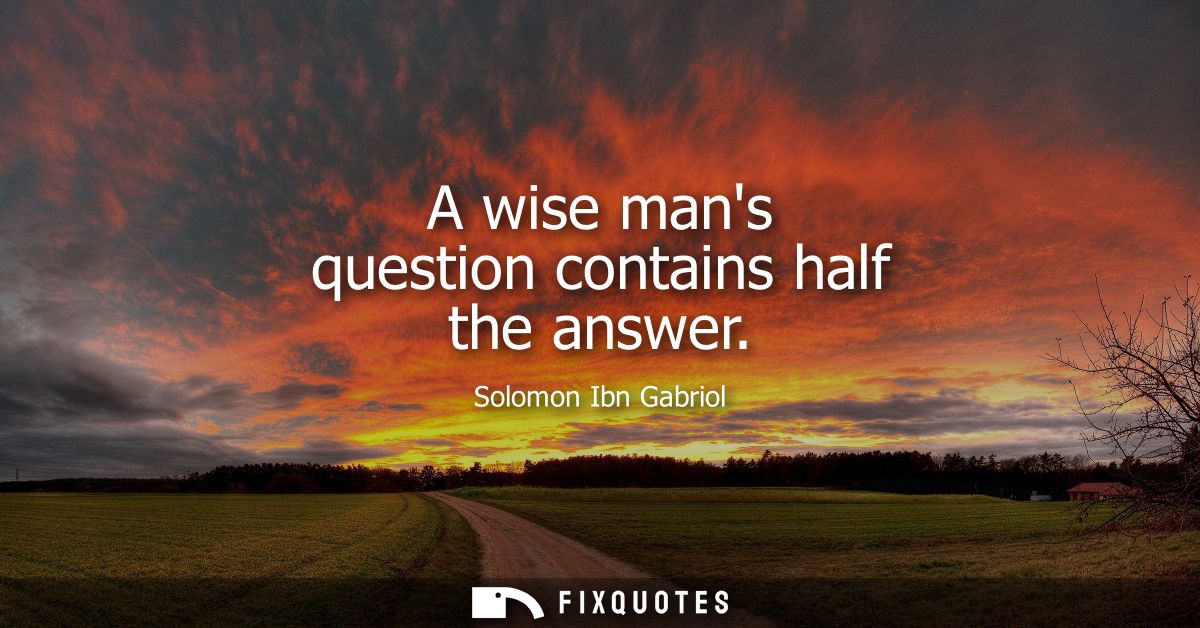
"A wise man's question contains half the answer"
About this Quote
A good question is a form of authorship, not a request for rescue. Ibn Gabirol’s line flatters curiosity while quietly issuing a standard: wisdom isn’t only what you know, it’s how you aim your attention. The “half the answer” isn’t mystical; it’s structural. Ask poorly and you force the world to guess what you mean. Ask well and you’ve already mapped the problem, named the stakes, narrowed the variables, and revealed what kind of truth you’re willing to accept.
As a poet-philosopher in medieval al-Andalus, Ibn Gabirol writes from a culture that prized disciplined inquiry: religious debate, philosophy, law, and poetry all depended on precision. In that ecosystem, questions weren’t idle. They were instruments of argument and self-formation. The subtext is almost ascetic: wisdom shows up before the solution, in the restraint of the framing. You can hear a critique of performative “asking” too - the kind that seeks status or spectacle rather than understanding. The wise man’s question isn’t a trap; it’s a lantern.
There’s also a social ethic tucked inside the aphorism. A well-shaped question respects other people’s time and intelligence; it invites collaboration instead of outsourcing thinking. In an age of endless information, the line lands as a rebuke: answers are cheap, but the ability to formulate a meaningful question remains a scarce skill, and a quiet measure of the mind.
As a poet-philosopher in medieval al-Andalus, Ibn Gabirol writes from a culture that prized disciplined inquiry: religious debate, philosophy, law, and poetry all depended on precision. In that ecosystem, questions weren’t idle. They were instruments of argument and self-formation. The subtext is almost ascetic: wisdom shows up before the solution, in the restraint of the framing. You can hear a critique of performative “asking” too - the kind that seeks status or spectacle rather than understanding. The wise man’s question isn’t a trap; it’s a lantern.
There’s also a social ethic tucked inside the aphorism. A well-shaped question respects other people’s time and intelligence; it invites collaboration instead of outsourcing thinking. In an age of endless information, the line lands as a rebuke: answers are cheap, but the ability to formulate a meaningful question remains a scarce skill, and a quiet measure of the mind.
Quote Details
| Topic | Wisdom |
|---|---|
| Source | Later attribution: The Great Conversation (NORMAN. MORROW MELCHERT (DAVID.), Dav..., 2023) modern compilationISBN: 9780197669389 · ID: S6igEAAAQBAJ
Evidence:
... A wise man's question contains half the answer.” Solomon Ibn Gabirol (c. 1021–c. 1058) Perhaps it would be better to say that Aristotle takes existence for granted. Remember that when he is pursuing what he calls “first” philosophy, he ... |
| Cite |
Citation Formats
APA Style (7th ed.)
Gabriol, Solomon Ibn. (2026, February 20). A wise man's question contains half the answer. FixQuotes. https://fixquotes.com/quotes/a-wise-mans-question-contains-half-the-answer-145153/
Chicago Style
Gabriol, Solomon Ibn. "A wise man's question contains half the answer." FixQuotes. February 20, 2026. https://fixquotes.com/quotes/a-wise-mans-question-contains-half-the-answer-145153/.
MLA Style (9th ed.)
"A wise man's question contains half the answer." FixQuotes, 20 Feb. 2026, https://fixquotes.com/quotes/a-wise-mans-question-contains-half-the-answer-145153/. Accessed 24 Mar. 2026.
More Quotes by Solomon
Add to List