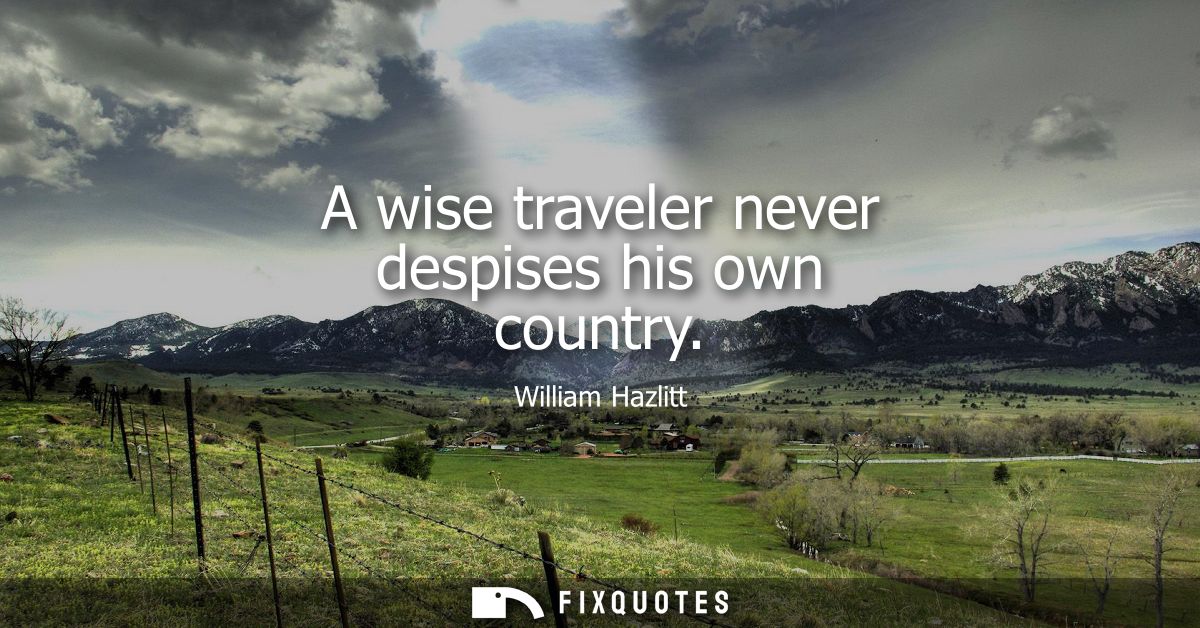
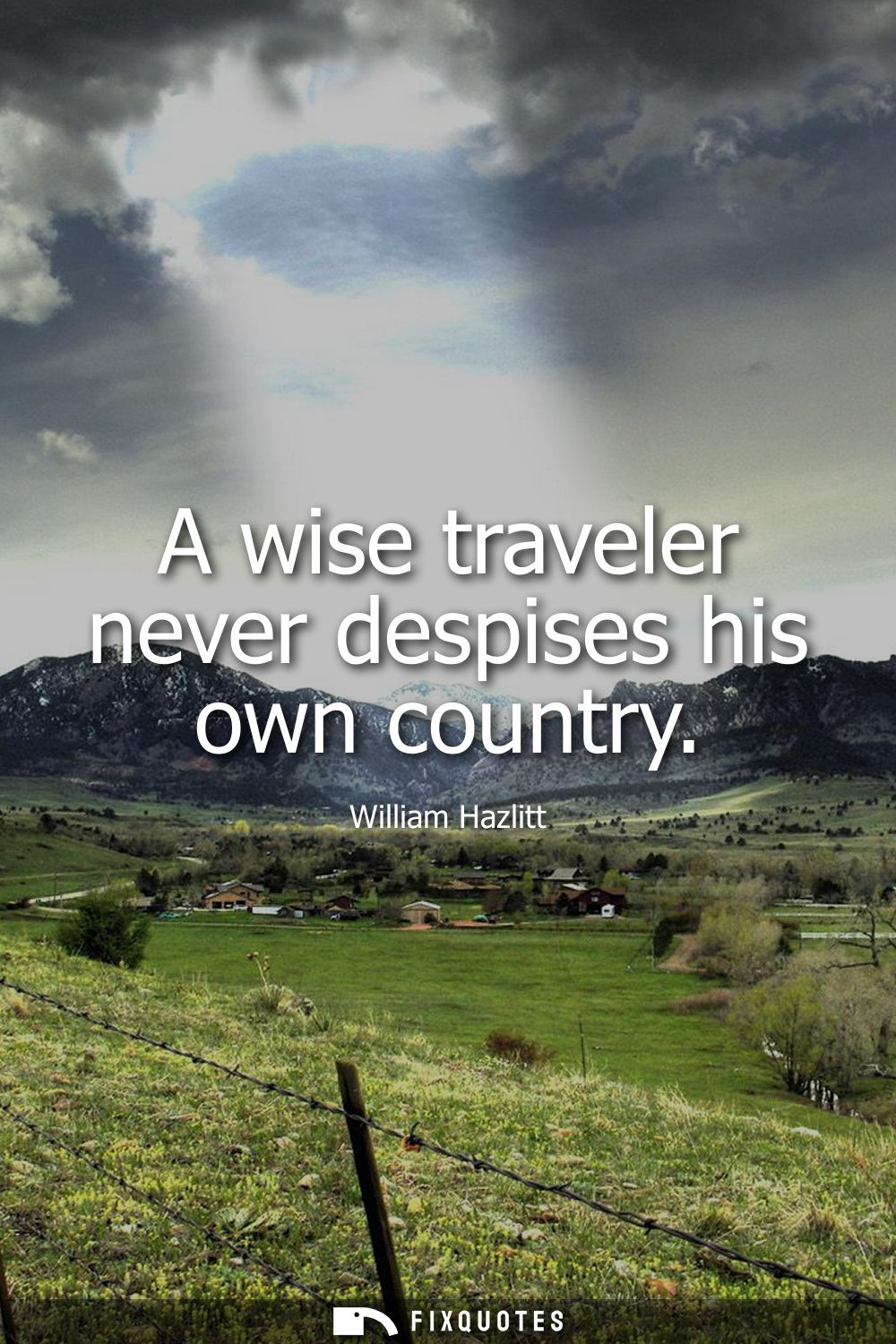
"A wise traveler never despises his own country"
About this Quote
Hazlitt’s “wise traveler” is less a passport stamp than a moral stress test. Written in an era when the Grand Tour was equal parts education, social flex, and imperial networking, the line needles a fashionable pose: the Briton who returns from Paris or Rome fluent in condescension, mistaking cosmopolitan taste for moral superiority. Hazlitt’s target isn’t travel; it’s the smugness that can ride shotgun with it.
The sentence works because it refuses two easy national fantasies at once. On one side, it rejects provincial complacency: a traveler, by definition, has seen alternatives and can no longer pretend his country is the only workable arrangement. On the other, it skewers imported cynicism, the reflex to treat one’s homeland as an embarrassing relative once you’ve learned the correct foreign manners. “Never despises” is doing the heavy lifting. Hazlitt isn’t asking for flag-waving loyalty; he’s warning against contempt, the corrosive emotion that turns critique into performance and reform into sneering.
Subtext: maturity means holding contrast without collapsing into self-hatred or superiority. The wise traveler learns scale. Other cultures reveal your country’s blind spots, but also its strengths; perspective should sharpen judgment, not flatten it into mockery. For Hazlitt the critic, this is also a credo about criticism itself: the point is discrimination, not disdain. A nation, like a work of art, can be rigorously assessed only if you keep enough attachment to care whether it improves.
The sentence works because it refuses two easy national fantasies at once. On one side, it rejects provincial complacency: a traveler, by definition, has seen alternatives and can no longer pretend his country is the only workable arrangement. On the other, it skewers imported cynicism, the reflex to treat one’s homeland as an embarrassing relative once you’ve learned the correct foreign manners. “Never despises” is doing the heavy lifting. Hazlitt isn’t asking for flag-waving loyalty; he’s warning against contempt, the corrosive emotion that turns critique into performance and reform into sneering.
Subtext: maturity means holding contrast without collapsing into self-hatred or superiority. The wise traveler learns scale. Other cultures reveal your country’s blind spots, but also its strengths; perspective should sharpen judgment, not flatten it into mockery. For Hazlitt the critic, this is also a credo about criticism itself: the point is discrimination, not disdain. A nation, like a work of art, can be rigorously assessed only if you keep enough attachment to care whether it improves.
Quote Details
| Topic | Travel |
|---|---|
| Source | Help us find the source |
| Cite |
Citation Formats
APA Style (7th ed.)
Hazlitt, William. (2026, January 16). A wise traveler never despises his own country. FixQuotes. https://fixquotes.com/quotes/a-wise-traveler-never-despises-his-own-country-137390/
Chicago Style
Hazlitt, William. "A wise traveler never despises his own country." FixQuotes. January 16, 2026. https://fixquotes.com/quotes/a-wise-traveler-never-despises-his-own-country-137390/.
MLA Style (9th ed.)
"A wise traveler never despises his own country." FixQuotes, 16 Jan. 2026, https://fixquotes.com/quotes/a-wise-traveler-never-despises-his-own-country-137390/. Accessed 1 Apr. 2026.
More Quotes by William
Add to List