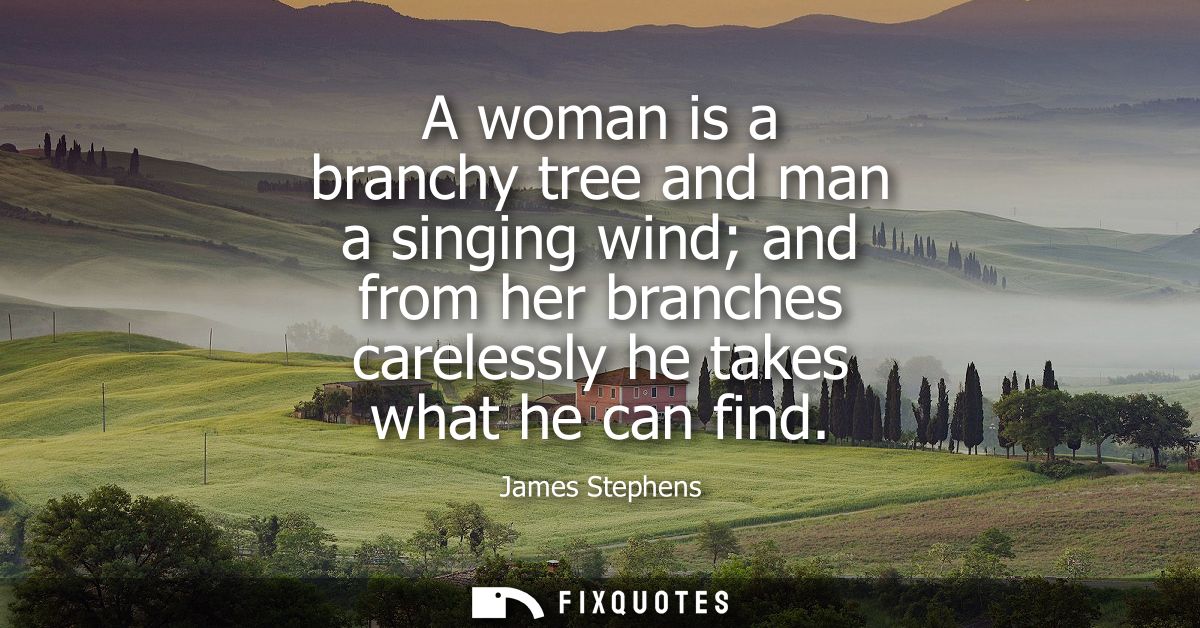
"A woman is a branchy tree and man a singing wind; and from her branches carelessly he takes what he can find"
About this Quote
The sting is in "carelessly". He doesn’t harvest with reverence; he takes "what he can find", as if her offerings are incidental, unguarded, almost public. Stephens is too good a poet to make the line purely accusatory; "singing" makes the wind alluring. The male figure isn’t a villain so much as a force of nature - which is exactly the subtextual trick. By naturalizing the act of taking, the poem flirts with excusing it. Desire becomes weather, not choice.
Context matters: Stephens, writing out of the Irish Literary Revival’s pastoral-symbolist mood, leans on mythic nature metaphors where land, woman, and nation often blur. That tradition routinely turns femininity into landscape - beautiful, enduring, available - while masculinity gets to be the roaming spirit that animates and exploits. The line works because it’s gorgeous and unsettling at once: it makes extraction sound like romance, then slips in the word that exposes the cost.
Quote Details
| Topic | Love |
|---|---|
| Source | Help us find the source |
| Cite |
Citation Formats
APA Style (7th ed.)
Stephens, James. (2026, January 18). A woman is a branchy tree and man a singing wind; and from her branches carelessly he takes what he can find. FixQuotes. https://fixquotes.com/quotes/a-woman-is-a-branchy-tree-and-man-a-singing-wind-11149/
Chicago Style
Stephens, James. "A woman is a branchy tree and man a singing wind; and from her branches carelessly he takes what he can find." FixQuotes. January 18, 2026. https://fixquotes.com/quotes/a-woman-is-a-branchy-tree-and-man-a-singing-wind-11149/.
MLA Style (9th ed.)
"A woman is a branchy tree and man a singing wind; and from her branches carelessly he takes what he can find." FixQuotes, 18 Jan. 2026, https://fixquotes.com/quotes/a-woman-is-a-branchy-tree-and-man-a-singing-wind-11149/. Accessed 8 Apr. 2026.