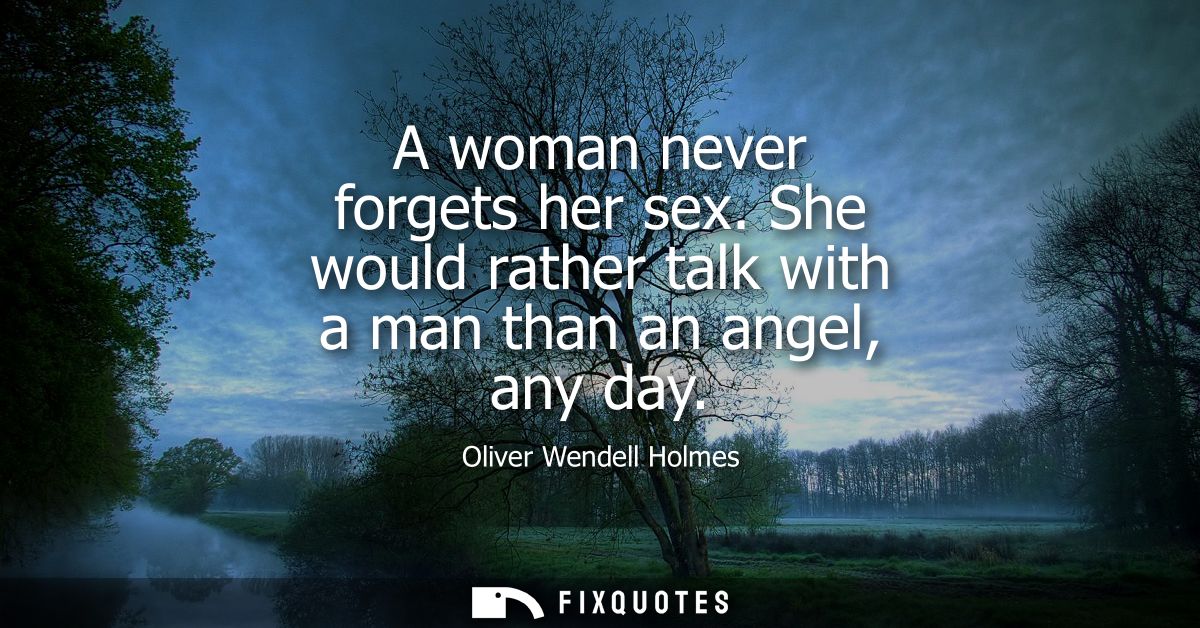
"A woman never forgets her sex. She would rather talk with a man than an angel, any day"
About this Quote
That’s the subtext doing double work. It winks at male readers: women are “really” interested in men, not virtue; don’t be intimidated by their piety. It also disciplines female readers: your attention naturally belongs to men, so any aspiration toward the “angelic” is either performance or self-deception. Even the phrasing “any day” has the rhythm of a club-room certainty, the kind of sociable absolutism that passes as insight because it’s delivered with confidence and charm.
Context matters: Holmes wrote in a 19th-century culture busy sorting women into archetypes (angel, mother, temptress) while limiting their actual agency. The quote’s wit is its camouflage; it packages gender essentialism as amused observation, making the bias feel like common sense rather than an argument.
Quote Details
| Topic | Witty One-Liners |
|---|---|
| Source | Help us find the source |
| Cite |
Citation Formats
APA Style (7th ed.)
Sr., Oliver Wendell Holmes. (2026, January 18). A woman never forgets her sex. She would rather talk with a man than an angel, any day. FixQuotes. https://fixquotes.com/quotes/a-woman-never-forgets-her-sex-she-would-rather-1108/
Chicago Style
Sr., Oliver Wendell Holmes. "A woman never forgets her sex. She would rather talk with a man than an angel, any day." FixQuotes. January 18, 2026. https://fixquotes.com/quotes/a-woman-never-forgets-her-sex-she-would-rather-1108/.
MLA Style (9th ed.)
"A woman never forgets her sex. She would rather talk with a man than an angel, any day." FixQuotes, 18 Jan. 2026, https://fixquotes.com/quotes/a-woman-never-forgets-her-sex-she-would-rather-1108/. Accessed 15 Mar. 2026.