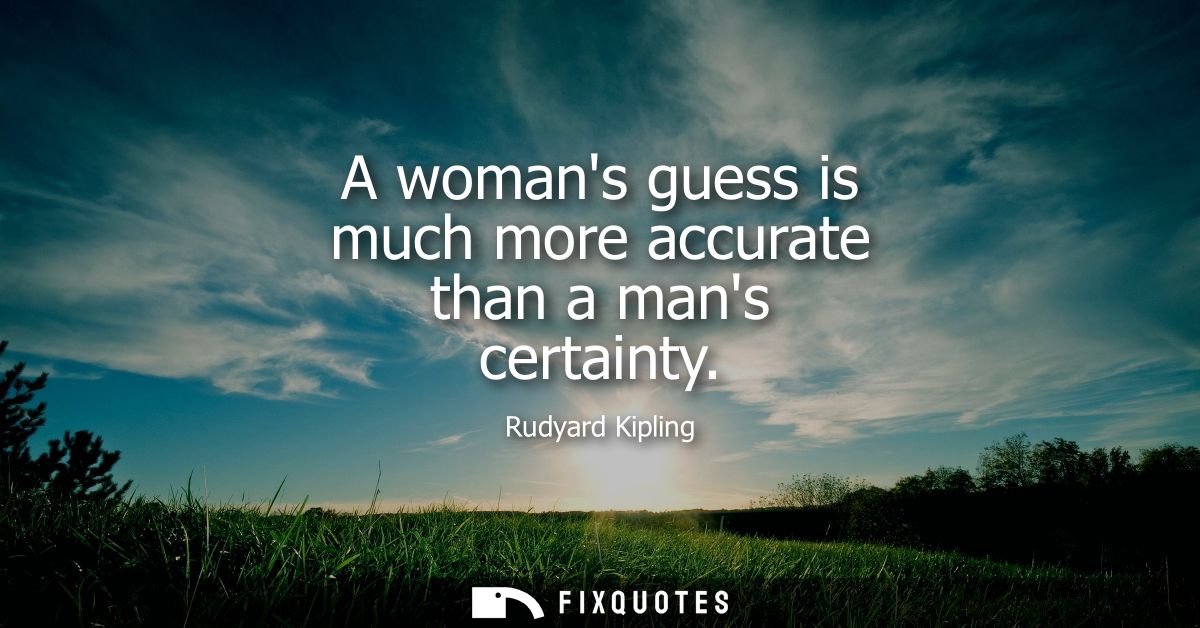
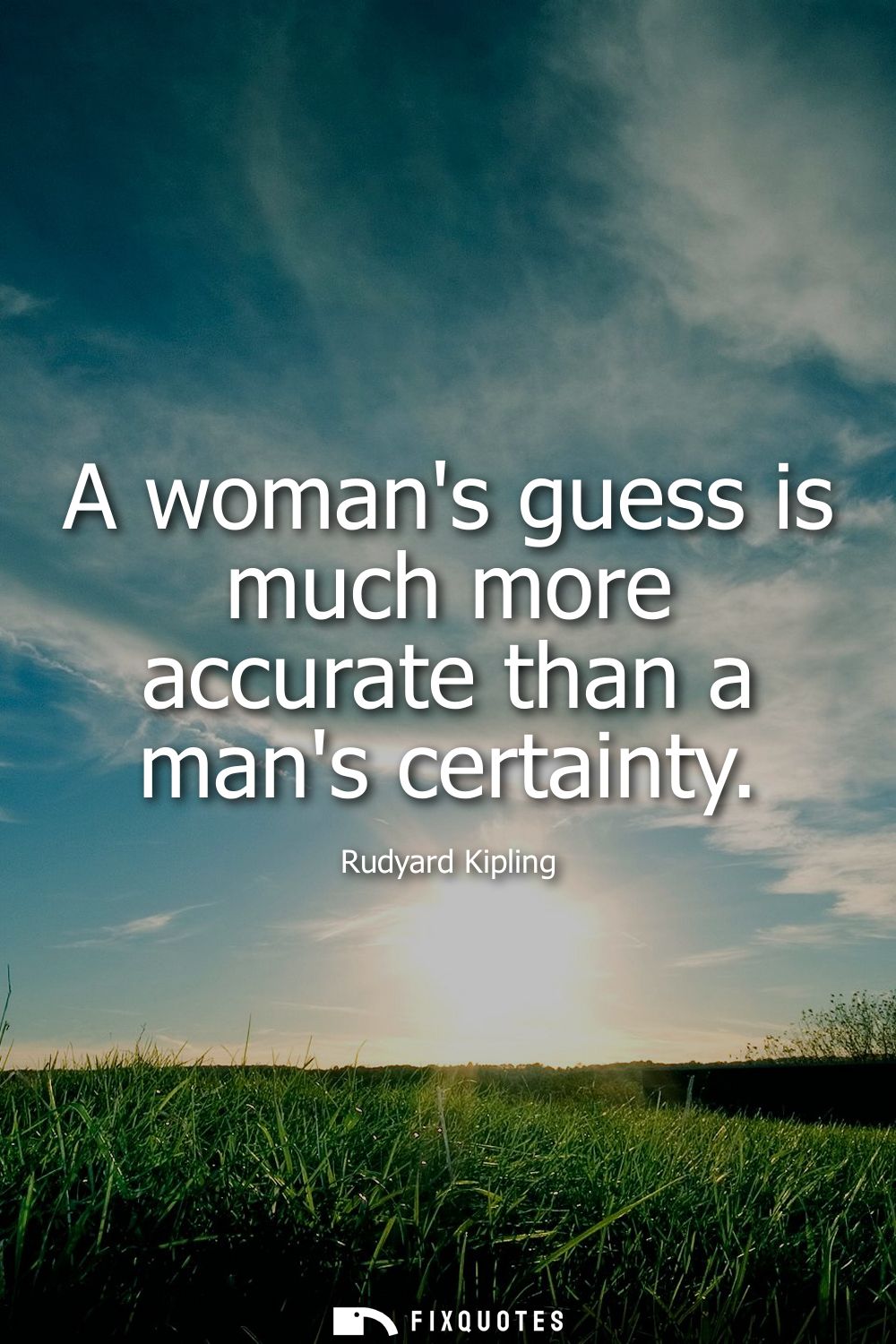
"A woman's guess is much more accurate than a man's certainty"
About this Quote
Kipling lands the punch by yoking two words that are supposed to live on opposite ends of the credibility scale: "guess" (soft, provisional) and "certainty" (hard, authoritative). The line works because it flatters women while quietly indicting men, not for ignorance but for overconfidence. It treats "certainty" less as knowledge than as performance - a social posture men are trained to adopt and rewarded for projecting. In that light, the joke is also a diagnosis: the loudest conviction in the room is often the least tested.
The subtext is double-edged. On one side, it reads like a sly corrective to Victorian-era masculinity, where decisiveness and command were packaged as virtue. A "woman's guess" becomes shorthand for intuition, pattern-recognition, or attentiveness to social cues - forms of intelligence historically dismissed because they weren't credentialed or institutional. On the other side, it risks smuggling in a familiar essentialism: women as naturally intuitive, men as naturally bullheaded. Compliment and stereotype share a border.
Context matters because Kipling wrote in an imperial, hierarchical world obsessed with authority - who gets to speak, who gets believed, who gets to be "certain". The line pricks that balloon of authority without fully puncturing the system behind it. Its staying power comes from that ambivalence: it's progressive enough to feel like a rebuke, conservative enough to be safely repeatable as a wry dinner-table truth.
The subtext is double-edged. On one side, it reads like a sly corrective to Victorian-era masculinity, where decisiveness and command were packaged as virtue. A "woman's guess" becomes shorthand for intuition, pattern-recognition, or attentiveness to social cues - forms of intelligence historically dismissed because they weren't credentialed or institutional. On the other side, it risks smuggling in a familiar essentialism: women as naturally intuitive, men as naturally bullheaded. Compliment and stereotype share a border.
Context matters because Kipling wrote in an imperial, hierarchical world obsessed with authority - who gets to speak, who gets believed, who gets to be "certain". The line pricks that balloon of authority without fully puncturing the system behind it. Its staying power comes from that ambivalence: it's progressive enough to feel like a rebuke, conservative enough to be safely repeatable as a wry dinner-table truth.
Quote Details
| Topic | Witty One-Liners |
|---|---|
| Source | Attributed to Rudyard Kipling — commonly cited; see Wikiquote entry 'Rudyard Kipling' for this attribution. |
| Cite |
Citation Formats
APA Style (7th ed.)
Kipling, Rudyard. (2026, January 15). A woman's guess is much more accurate than a man's certainty. FixQuotes. https://fixquotes.com/quotes/a-womans-guess-is-much-more-accurate-than-a-mans-15607/
Chicago Style
Kipling, Rudyard. "A woman's guess is much more accurate than a man's certainty." FixQuotes. January 15, 2026. https://fixquotes.com/quotes/a-womans-guess-is-much-more-accurate-than-a-mans-15607/.
MLA Style (9th ed.)
"A woman's guess is much more accurate than a man's certainty." FixQuotes, 15 Jan. 2026, https://fixquotes.com/quotes/a-womans-guess-is-much-more-accurate-than-a-mans-15607/. Accessed 29 Mar. 2026.
More Quotes by Rudyard
Add to List