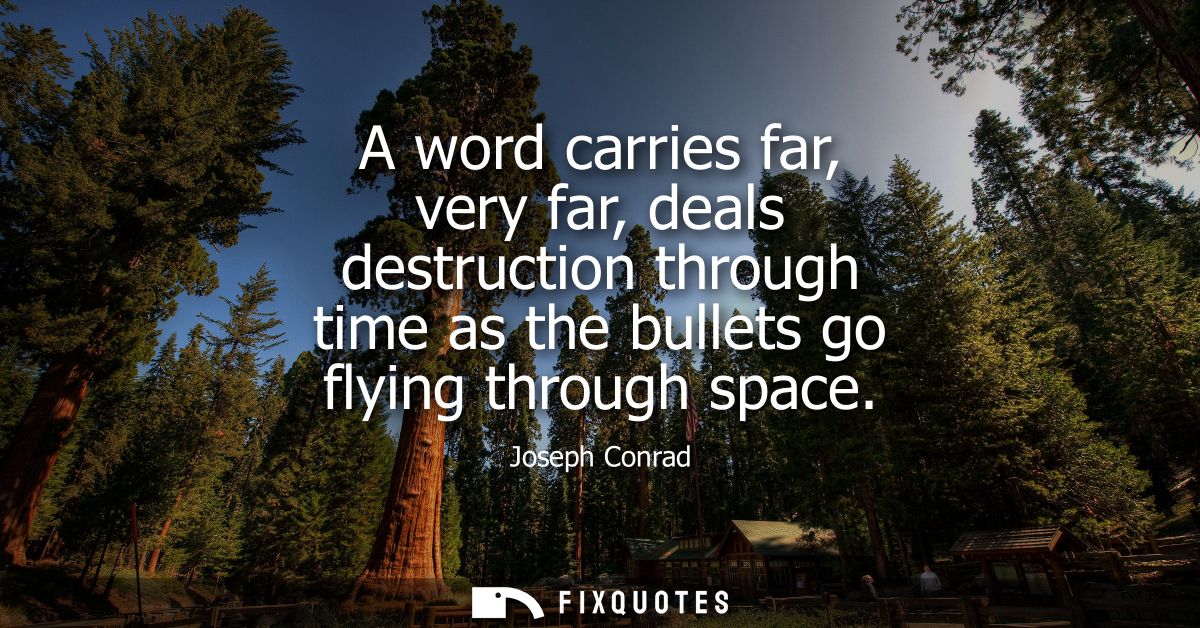
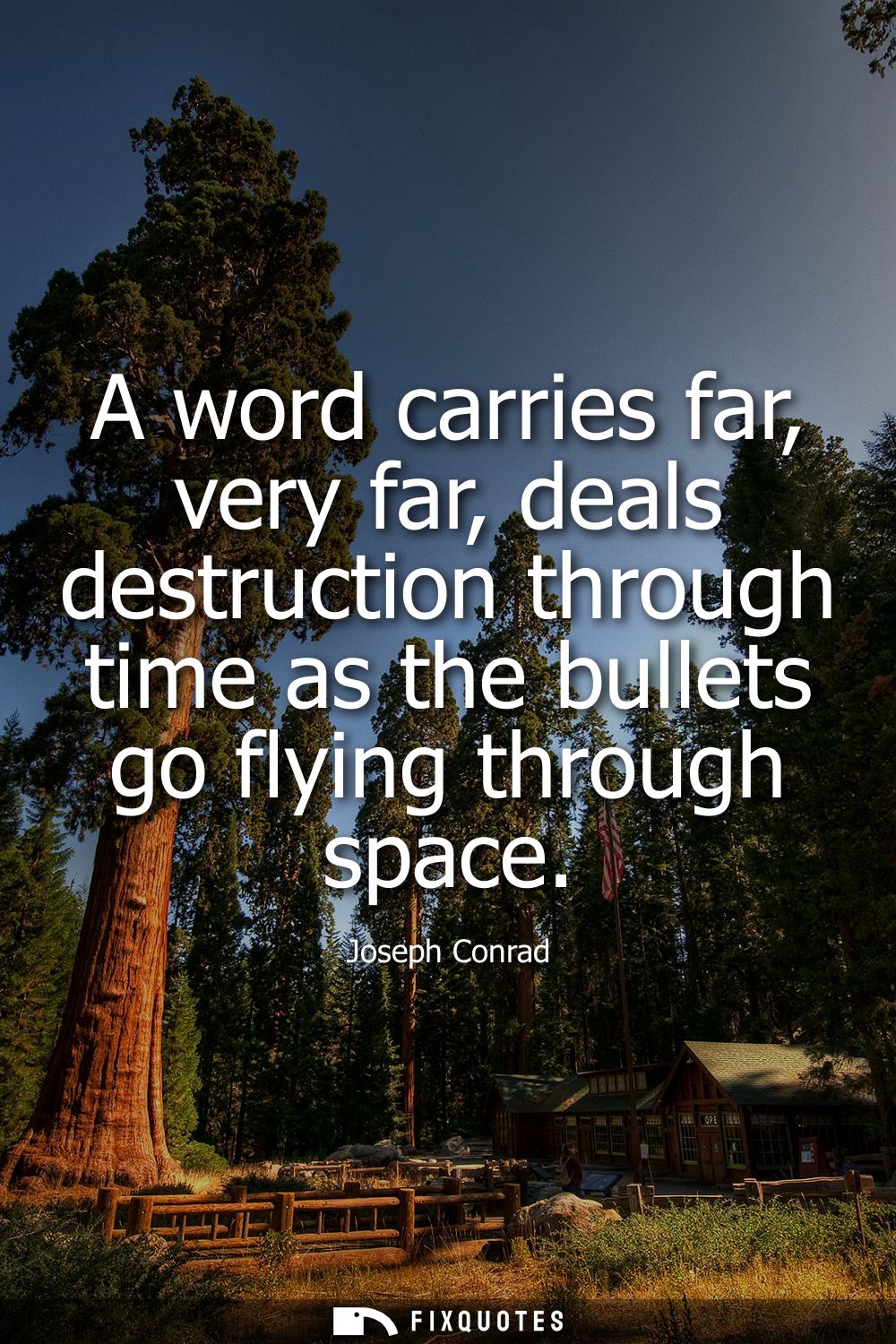
"A word carries far, very far, deals destruction through time as the bullets go flying through space"
About this Quote
That emphasis on “very far” isn’t decorative. It’s a warning about distance and deniability: the speaker can be nowhere near the wreckage. In an imperial world Conrad knew intimately, destruction is often administered at remove, via orders, labels, and narratives that make exploitation sound like duty. Words turn people into categories, turn greed into mission, turn cruelty into administration. A bullet requires proximity; an ideology just needs repetition.
The sentence also carries Conrad’s signature moral bleakness: time doesn’t heal, it disseminates. Once launched, language doesn’t stay owned; it mutates as it’s retold, weaponized by strangers, filed into the public record. The terror here is that speech feels airy and reversible, while its consequences are stubbornly material. Conrad isn’t romanticizing eloquence; he’s locating the true horror in how easily a phrase can become history.
Quote Details
| Topic | Deep |
|---|---|
| Source | Help us find the source |
| Cite |
Citation Formats
APA Style (7th ed.)
Conrad, Joseph. (2026, January 16). A word carries far, very far, deals destruction through time as the bullets go flying through space. FixQuotes. https://fixquotes.com/quotes/a-word-carries-far-very-far-deals-destruction-96316/
Chicago Style
Conrad, Joseph. "A word carries far, very far, deals destruction through time as the bullets go flying through space." FixQuotes. January 16, 2026. https://fixquotes.com/quotes/a-word-carries-far-very-far-deals-destruction-96316/.
MLA Style (9th ed.)
"A word carries far, very far, deals destruction through time as the bullets go flying through space." FixQuotes, 16 Jan. 2026, https://fixquotes.com/quotes/a-word-carries-far-very-far-deals-destruction-96316/. Accessed 16 Mar. 2026.