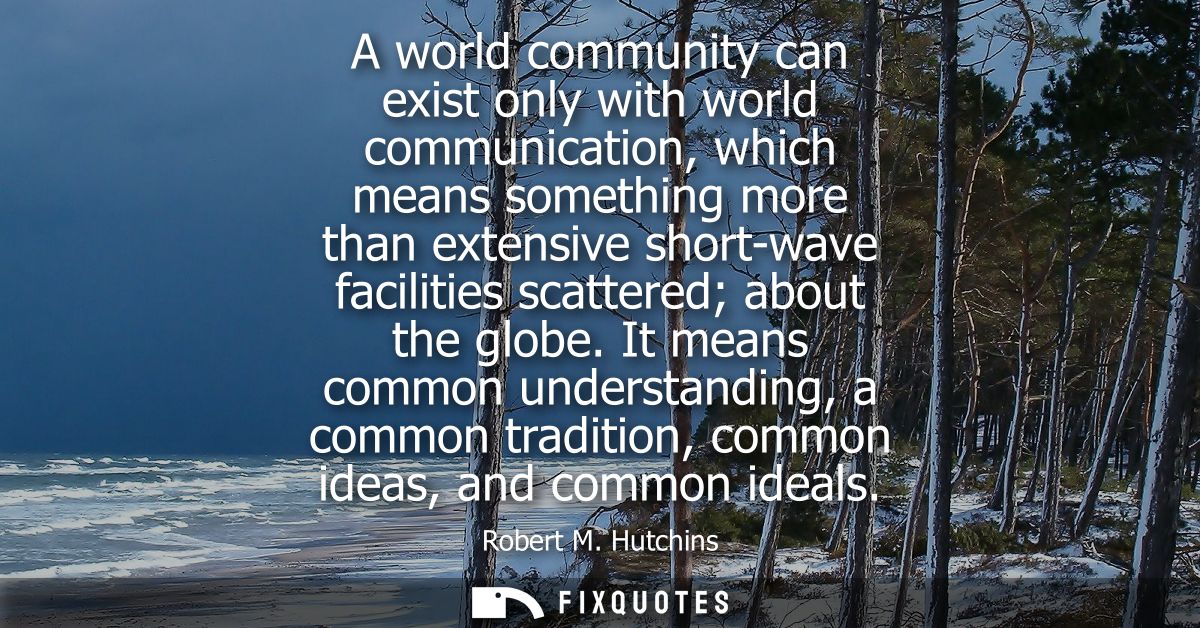
"A world community can exist only with world communication, which means something more than extensive short-wave facilities scattered; about the globe. It means common understanding, a common tradition, common ideas, and common ideals"
About this Quote
Hutchins isn’t praising better antennas; he’s warning that wiring the planet won’t automatically produce solidarity. Written in the long shadow of two world wars and in the early glow of UN-style internationalism, the line carries an educator’s impatience with technocratic optimism. “World communication” sounds like infrastructure, but he quickly strips the phrase of its gadgetry and turns it into curriculum: shared literacy, shared civic habits, shared moral vocabulary. The jab at “short-wave facilities scattered about the globe” is pointed because it targets a recurring modern delusion: that connectivity equals community.
The subtext is a defense of liberal education as global policy. Hutchins, famous for championing a common core of ideas (often the Western “Great Books”), is arguing that a functioning world order requires more than diplomacy and broadcast reach; it requires a public capable of interpreting, debating, and restraining power across borders. “Common understanding” is doing heavy lifting here: it implies translation, but also trust, reciprocity, and a willingness to be persuaded rather than merely informed.
There’s a quiet tension in the phrase “common tradition.” It can read as aspirational - a shared democratic ethic - or as a homogenizing demand that risks flattening difference under one canon. That ambiguity is part of why the quote still lands. It captures a problem we haven’t solved: global media can synchronize attention while polarizing meaning. Hutchins is insisting that without a shared set of ideals and interpretive tools, “communication” becomes noise at scale, and the “world community” remains a slogan looking for citizens.
The subtext is a defense of liberal education as global policy. Hutchins, famous for championing a common core of ideas (often the Western “Great Books”), is arguing that a functioning world order requires more than diplomacy and broadcast reach; it requires a public capable of interpreting, debating, and restraining power across borders. “Common understanding” is doing heavy lifting here: it implies translation, but also trust, reciprocity, and a willingness to be persuaded rather than merely informed.
There’s a quiet tension in the phrase “common tradition.” It can read as aspirational - a shared democratic ethic - or as a homogenizing demand that risks flattening difference under one canon. That ambiguity is part of why the quote still lands. It captures a problem we haven’t solved: global media can synchronize attention while polarizing meaning. Hutchins is insisting that without a shared set of ideals and interpretive tools, “communication” becomes noise at scale, and the “world community” remains a slogan looking for citizens.
Quote Details
| Topic | Peace |
|---|
More Quotes by Robert
Add to List