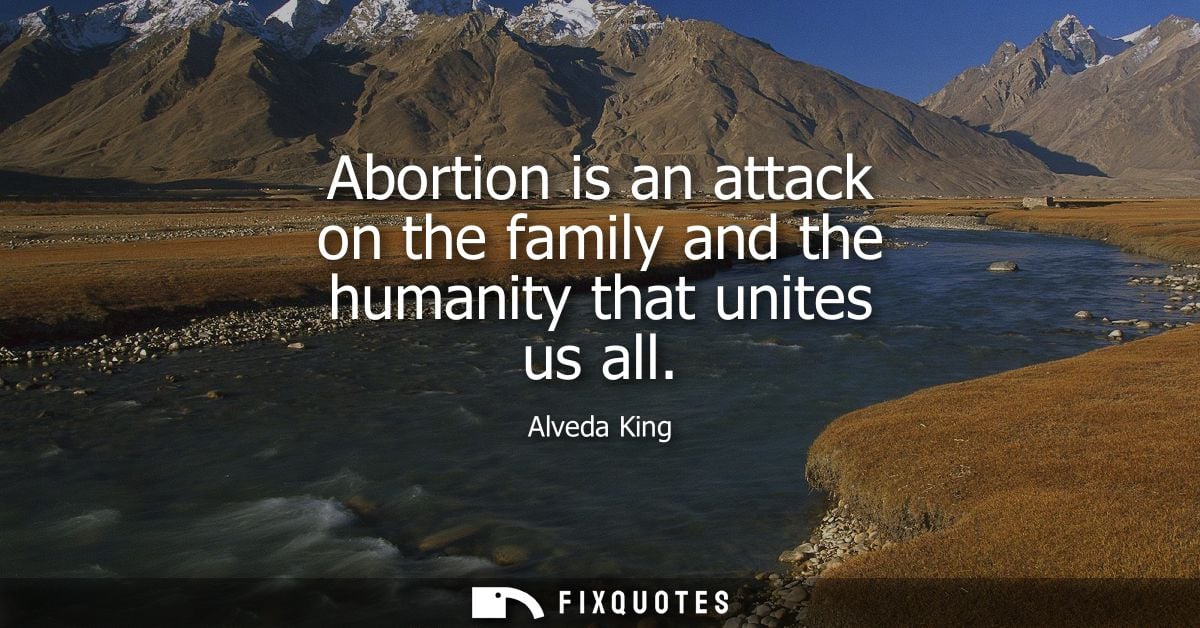
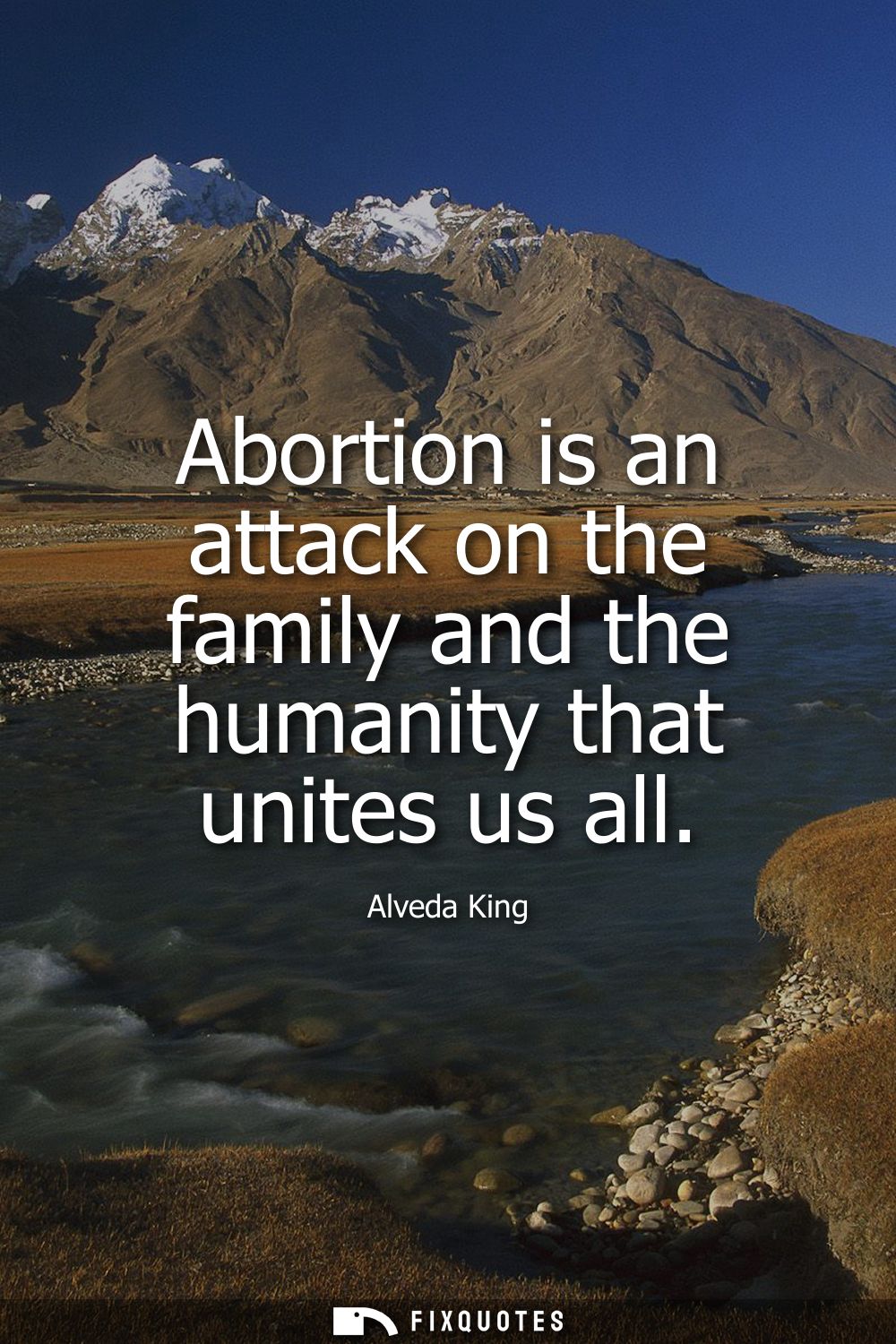
"Abortion is an attack on the family and the humanity that unites us all"
About this Quote
“Abortion is an attack on the family and the humanity that unites us all” is engineered to shift the debate from individual choice to collective threat. Alveda King, speaking as a clergy figure with a famous civil-rights lineage, frames abortion not as a contested medical procedure but as a moral assault on the social fabric. The verb “attack” is doing the heavy lifting: it implies an aggressor, victims, and a battlefield, inviting solidarity and defensive posture rather than deliberation.
The pairing of “family” with “humanity” widens the blast radius. “Family” evokes intimacy, obligation, and continuity; “humanity” claims a universal moral baseline. Put together, the line suggests abortion doesn’t just end a pregnancy; it corrodes our capacity to recognize one another as fully human. That’s a powerful move in religious rhetoric because it bypasses technical arguments about fetal development or law and instead makes the listener feel implicated: if you tolerate abortion, you’re complicit in a broader dehumanization.
The subtext is also political. By presenting abortion as something that fractures “what unites us,” the quote borrows the language of civil rights and communal belonging, implicitly aligning anti-abortion activism with social justice rather than partisan culture war. It’s an attempt to recast the pro-life position as the truly inclusive one: protecting the unborn becomes the litmus test for whether society honors human dignity at all.
What makes it effective is its moral compression: one sentence turns a complex policy fight into a question of who we are, and whether we still recognize kinship as a sacred bond.
The pairing of “family” with “humanity” widens the blast radius. “Family” evokes intimacy, obligation, and continuity; “humanity” claims a universal moral baseline. Put together, the line suggests abortion doesn’t just end a pregnancy; it corrodes our capacity to recognize one another as fully human. That’s a powerful move in religious rhetoric because it bypasses technical arguments about fetal development or law and instead makes the listener feel implicated: if you tolerate abortion, you’re complicit in a broader dehumanization.
The subtext is also political. By presenting abortion as something that fractures “what unites us,” the quote borrows the language of civil rights and communal belonging, implicitly aligning anti-abortion activism with social justice rather than partisan culture war. It’s an attempt to recast the pro-life position as the truly inclusive one: protecting the unborn becomes the litmus test for whether society honors human dignity at all.
What makes it effective is its moral compression: one sentence turns a complex policy fight into a question of who we are, and whether we still recognize kinship as a sacred bond.
Quote Details
| Topic | Family |
|---|---|
| Source | Help us find the source |
| Cite |
Citation Formats
APA Style (7th ed.)
King, Alveda. (2026, January 17). Abortion is an attack on the family and the humanity that unites us all. FixQuotes. https://fixquotes.com/quotes/abortion-is-an-attack-on-the-family-and-the-69656/
Chicago Style
King, Alveda. "Abortion is an attack on the family and the humanity that unites us all." FixQuotes. January 17, 2026. https://fixquotes.com/quotes/abortion-is-an-attack-on-the-family-and-the-69656/.
MLA Style (9th ed.)
"Abortion is an attack on the family and the humanity that unites us all." FixQuotes, 17 Jan. 2026, https://fixquotes.com/quotes/abortion-is-an-attack-on-the-family-and-the-69656/. Accessed 11 Mar. 2026.
More Quotes by Alveda
Add to List