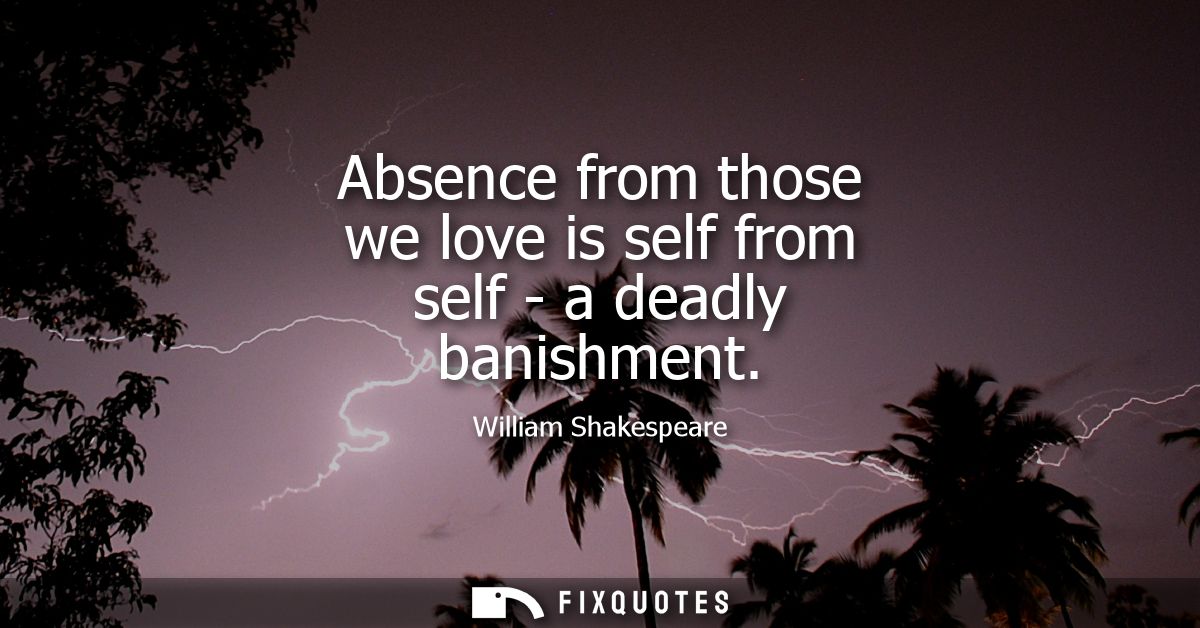
"Absence from those we love is self from self - a deadly banishment"
About this Quote
Love, in Shakespeare, is never just sentiment; it is identity work. "Absence from those we love is self from self" lands like a paradox because it treats separation not as a circumstance but as an ontological injury. The syntax performs the experience: "self from self" is a verbal stutter, a mind trying to locate its center and finding only a split. He isn’t describing loneliness as sadness; he’s naming it as dismemberment.
The subtext is relational and unsettlingly modern. We like to think of the self as a sealed unit with optional attachments. Shakespeare flips that: the beloved is not an accessory but a constitutive part of the person you are. Remove them and you don’t merely miss someone; you become a stranger to yourself, forced to inhabit a version of life that no longer fits. The phrase "deadly banishment" sharpens the claim with legal and political menace. Banishment is a punishment imposed by authority, and "deadly" suggests not only emotional devastation but social death: exile from the world where your name, role, and meaning made sense.
Contextually, this is prime Shakespearean logic: private feeling is staged in the vocabulary of state power. His plays are full of forced departures, estrangements, and lovers turned refugees by feud, war, or court intrigue. By framing absence as exile, he makes desire a civic condition and turns romance into a question of survival. The line works because it refuses consolation. It insists that love rewires the self so completely that distance becomes a kind of internal civil war.
The subtext is relational and unsettlingly modern. We like to think of the self as a sealed unit with optional attachments. Shakespeare flips that: the beloved is not an accessory but a constitutive part of the person you are. Remove them and you don’t merely miss someone; you become a stranger to yourself, forced to inhabit a version of life that no longer fits. The phrase "deadly banishment" sharpens the claim with legal and political menace. Banishment is a punishment imposed by authority, and "deadly" suggests not only emotional devastation but social death: exile from the world where your name, role, and meaning made sense.
Contextually, this is prime Shakespearean logic: private feeling is staged in the vocabulary of state power. His plays are full of forced departures, estrangements, and lovers turned refugees by feud, war, or court intrigue. By framing absence as exile, he makes desire a civic condition and turns romance into a question of survival. The line works because it refuses consolation. It insists that love rewires the self so completely that distance becomes a kind of internal civil war.
Quote Details
| Topic | Long-Distance Relationship |
|---|---|
| Source | Help us find the source |
| Cite |
Citation Formats
APA Style (7th ed.)
Shakespeare, William. (2026, January 15). Absence from those we love is self from self - a deadly banishment. FixQuotes. https://fixquotes.com/quotes/absence-from-those-we-love-is-self-from-self-a-25046/
Chicago Style
Shakespeare, William. "Absence from those we love is self from self - a deadly banishment." FixQuotes. January 15, 2026. https://fixquotes.com/quotes/absence-from-those-we-love-is-self-from-self-a-25046/.
MLA Style (9th ed.)
"Absence from those we love is self from self - a deadly banishment." FixQuotes, 15 Jan. 2026, https://fixquotes.com/quotes/absence-from-those-we-love-is-self-from-self-a-25046/. Accessed 30 Mar. 2026.
More Quotes by William
Add to List