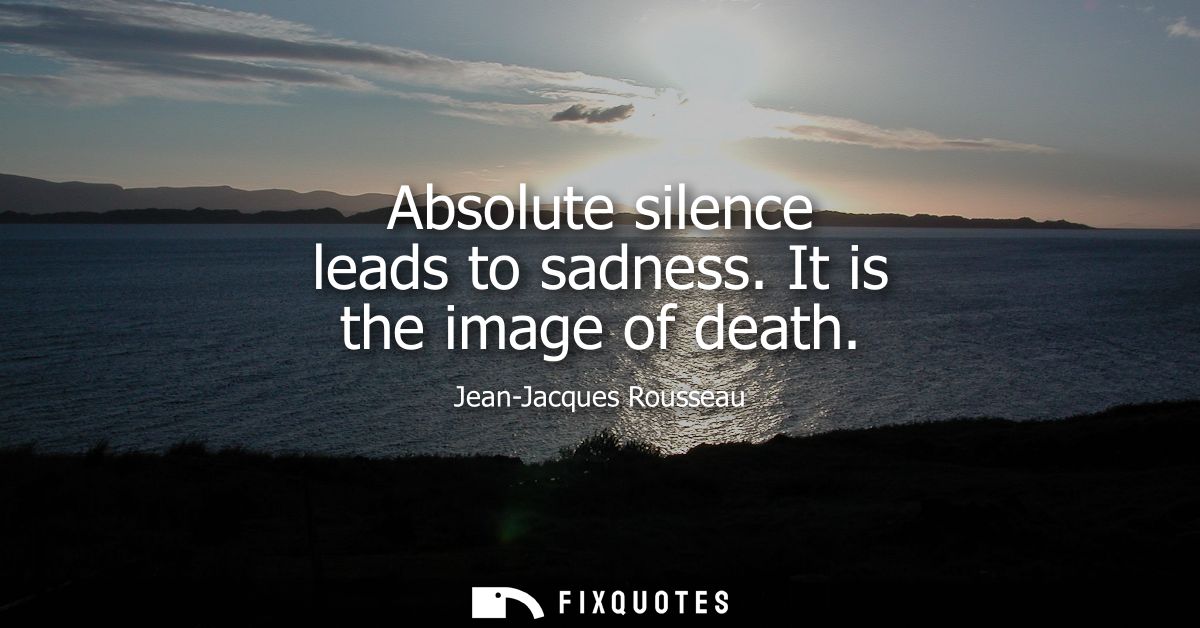
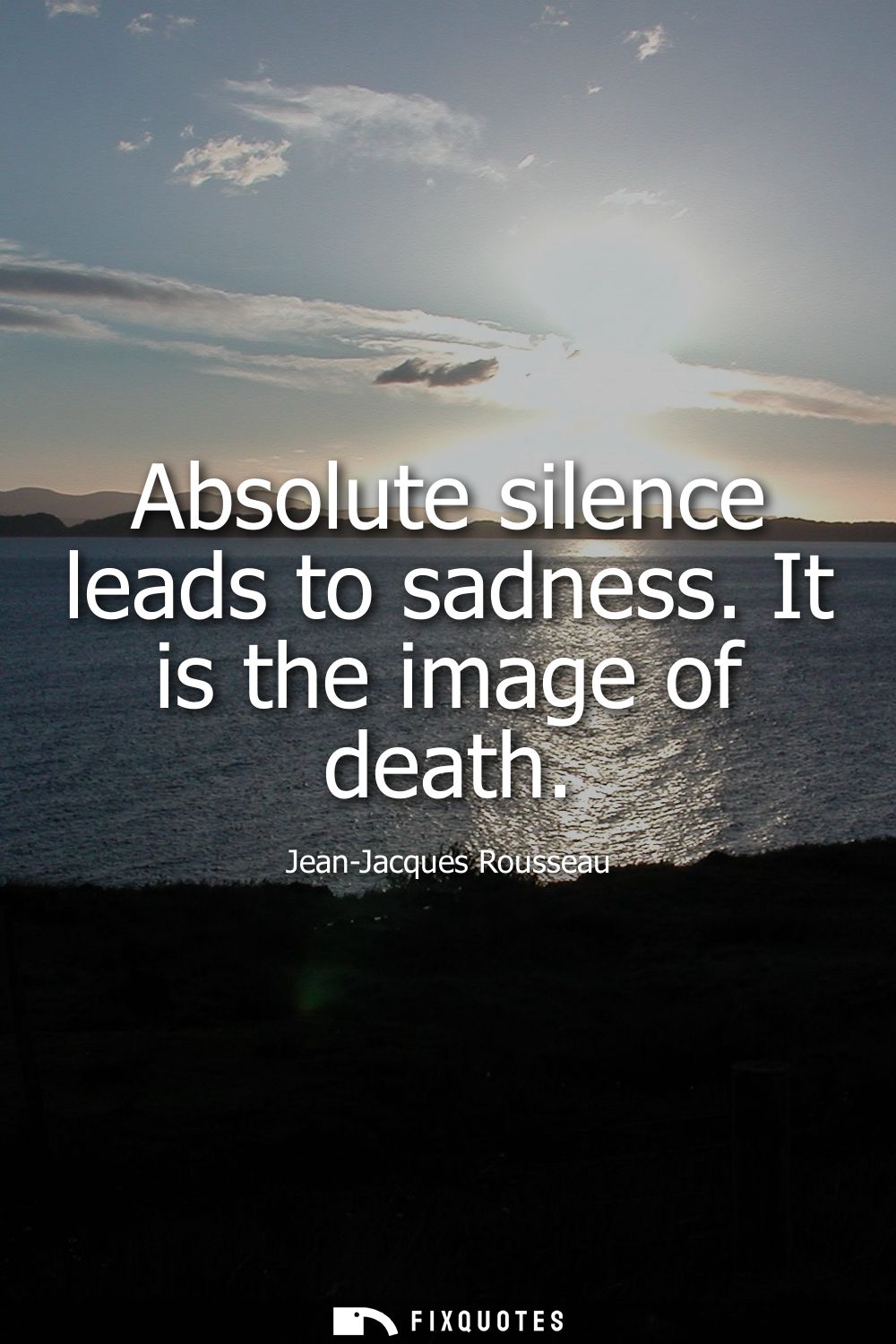
"Absolute silence leads to sadness. It is the image of death"
About this Quote
Rousseau makes silence sound less like peace and more like a room with the air sucked out. “Absolute silence” isn’t the restorative quiet of a walk in the woods; it’s total social and sensory deprivation, the kind that drains meaning from experience. By calling it “the image of death,” he turns an absence (of sound, of exchange) into a moral and psychological warning: humans don’t just prefer company, they require response, friction, and voice to feel alive.
The phrasing matters. “Leads to sadness” is causal, almost clinical, as if melancholy is the predictable symptom of a lifeless environment. Then he escalates to metaphor: not death itself, but its “image.” Rousseau is obsessed with how we live through representations - how society teaches us to perform, to compare, to crave recognition. Silence, here, is the collapse of that relational world. No one to answer you, mirror you, contradict you. Without the social echo, the self starts to dim.
Context sharpens the sting. Rousseau’s life was marked by estrangement and paranoia, a long drift into isolation that shows up in his autobiographical writing and late works. His philosophy often romanticizes nature and solitude, but this line exposes the cost: solitude can curdle into abandonment when it becomes “absolute.” It’s also a quiet rebuke to the Enlightenment fantasy that reason alone can sustain us. Strip away conversation, music, civic life - the public noise of being among others - and what remains isn’t purity. It’s a rehearsal for disappearance.
The phrasing matters. “Leads to sadness” is causal, almost clinical, as if melancholy is the predictable symptom of a lifeless environment. Then he escalates to metaphor: not death itself, but its “image.” Rousseau is obsessed with how we live through representations - how society teaches us to perform, to compare, to crave recognition. Silence, here, is the collapse of that relational world. No one to answer you, mirror you, contradict you. Without the social echo, the self starts to dim.
Context sharpens the sting. Rousseau’s life was marked by estrangement and paranoia, a long drift into isolation that shows up in his autobiographical writing and late works. His philosophy often romanticizes nature and solitude, but this line exposes the cost: solitude can curdle into abandonment when it becomes “absolute.” It’s also a quiet rebuke to the Enlightenment fantasy that reason alone can sustain us. Strip away conversation, music, civic life - the public noise of being among others - and what remains isn’t purity. It’s a rehearsal for disappearance.
Quote Details
| Topic | Sadness |
|---|---|
| Source | Help us find the source |
| Cite |
Citation Formats
APA Style (7th ed.)
Rousseau, Jean-Jacques. (2026, January 18). Absolute silence leads to sadness. It is the image of death. FixQuotes. https://fixquotes.com/quotes/absolute-silence-leads-to-sadness-it-is-the-image-2869/
Chicago Style
Rousseau, Jean-Jacques. "Absolute silence leads to sadness. It is the image of death." FixQuotes. January 18, 2026. https://fixquotes.com/quotes/absolute-silence-leads-to-sadness-it-is-the-image-2869/.
MLA Style (9th ed.)
"Absolute silence leads to sadness. It is the image of death." FixQuotes, 18 Jan. 2026, https://fixquotes.com/quotes/absolute-silence-leads-to-sadness-it-is-the-image-2869/. Accessed 12 Feb. 2026.
More Quotes by Jean-Jacques
Add to List