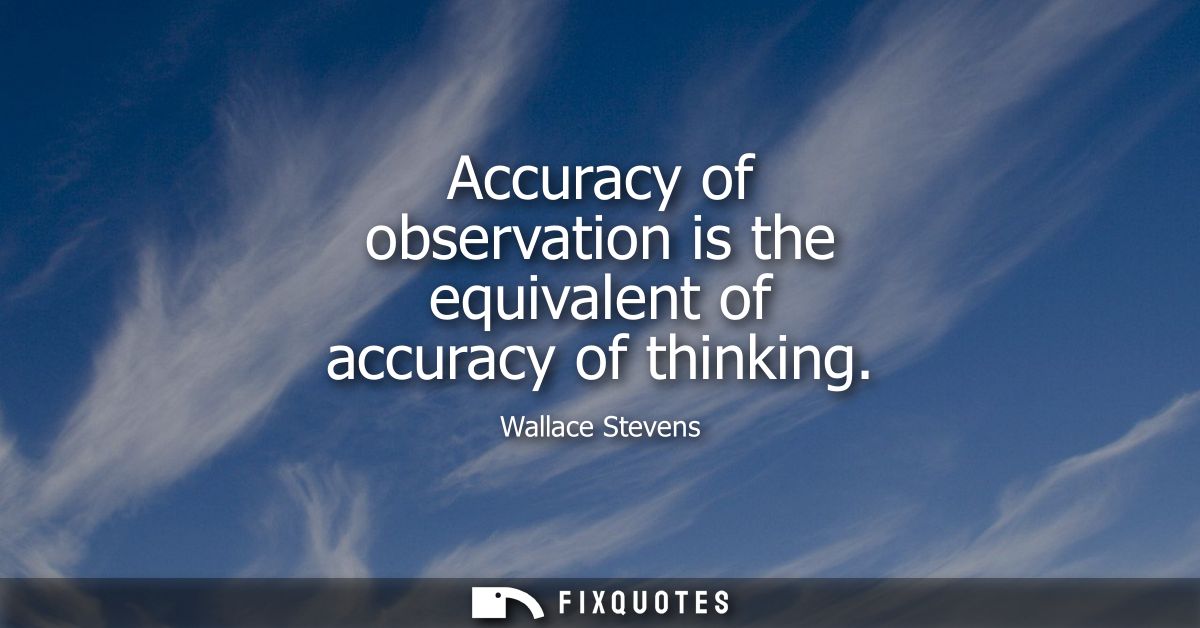
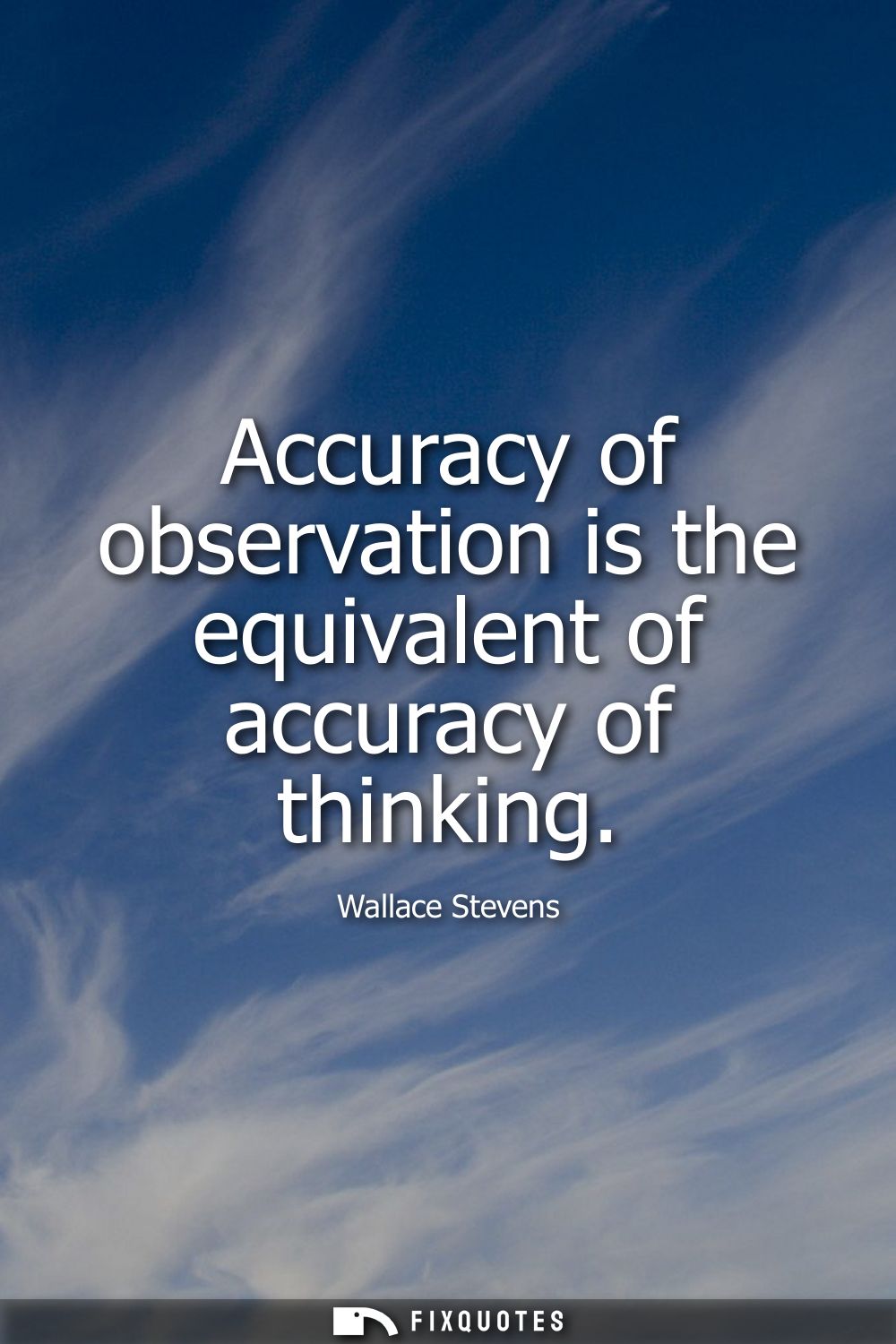
"Accuracy of observation is the equivalent of accuracy of thinking"
About this Quote
Stevens treats the mind less like a factory for ideas than a lens that can be clean or smudged. "Accuracy of observation" sounds modest, almost scientific, but in his hands it’s a provocation: if you want clearer thought, start by looking harder, not by arguing louder. The line is a rebuke to armchair certainty. It insists that sloppy perception produces sloppy philosophy, that the errors we call "bad reasoning" often begin earlier, at the level of what we notice, exclude, or can’t bear to see.
The subtext is distinctly Stevensian: reality is not simply received, it is shaped by attention. Observation isn’t a neutral act; it’s a discipline. He’s pushing back against the romantic myth of the poet as pure imagination, reminding us that imagination without rigor becomes fantasy, and that intellect without sensory fidelity becomes abstraction for its own sake. In Stevens, the world is always being remade by the mind, but the mind is accountable to the world’s textures: weather, color, ordinary objects, the way a moment actually feels.
Context matters. Writing through the churn of modernism, Stevens watched old certainties collapse under industrial life, mass politics, and new sciences. His poetry answers that instability with a tough-minded aesthetic: you can’t control the chaos, but you can refine your seeing. The line quietly collapses the divide between poet and thinker. Good art and good judgment share the same moral technology: precision.
The subtext is distinctly Stevensian: reality is not simply received, it is shaped by attention. Observation isn’t a neutral act; it’s a discipline. He’s pushing back against the romantic myth of the poet as pure imagination, reminding us that imagination without rigor becomes fantasy, and that intellect without sensory fidelity becomes abstraction for its own sake. In Stevens, the world is always being remade by the mind, but the mind is accountable to the world’s textures: weather, color, ordinary objects, the way a moment actually feels.
Context matters. Writing through the churn of modernism, Stevens watched old certainties collapse under industrial life, mass politics, and new sciences. His poetry answers that instability with a tough-minded aesthetic: you can’t control the chaos, but you can refine your seeing. The line quietly collapses the divide between poet and thinker. Good art and good judgment share the same moral technology: precision.
Quote Details
| Topic | Reason & Logic |
|---|---|
| Source | Help us find the source |
More Quotes by Wallace
Add to List