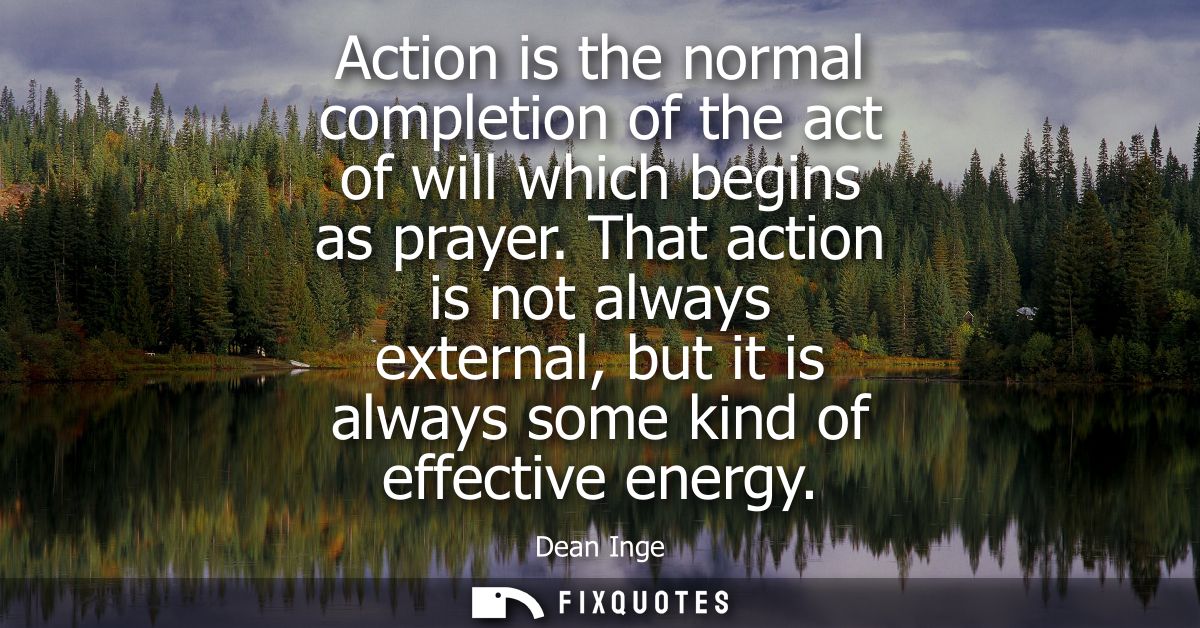
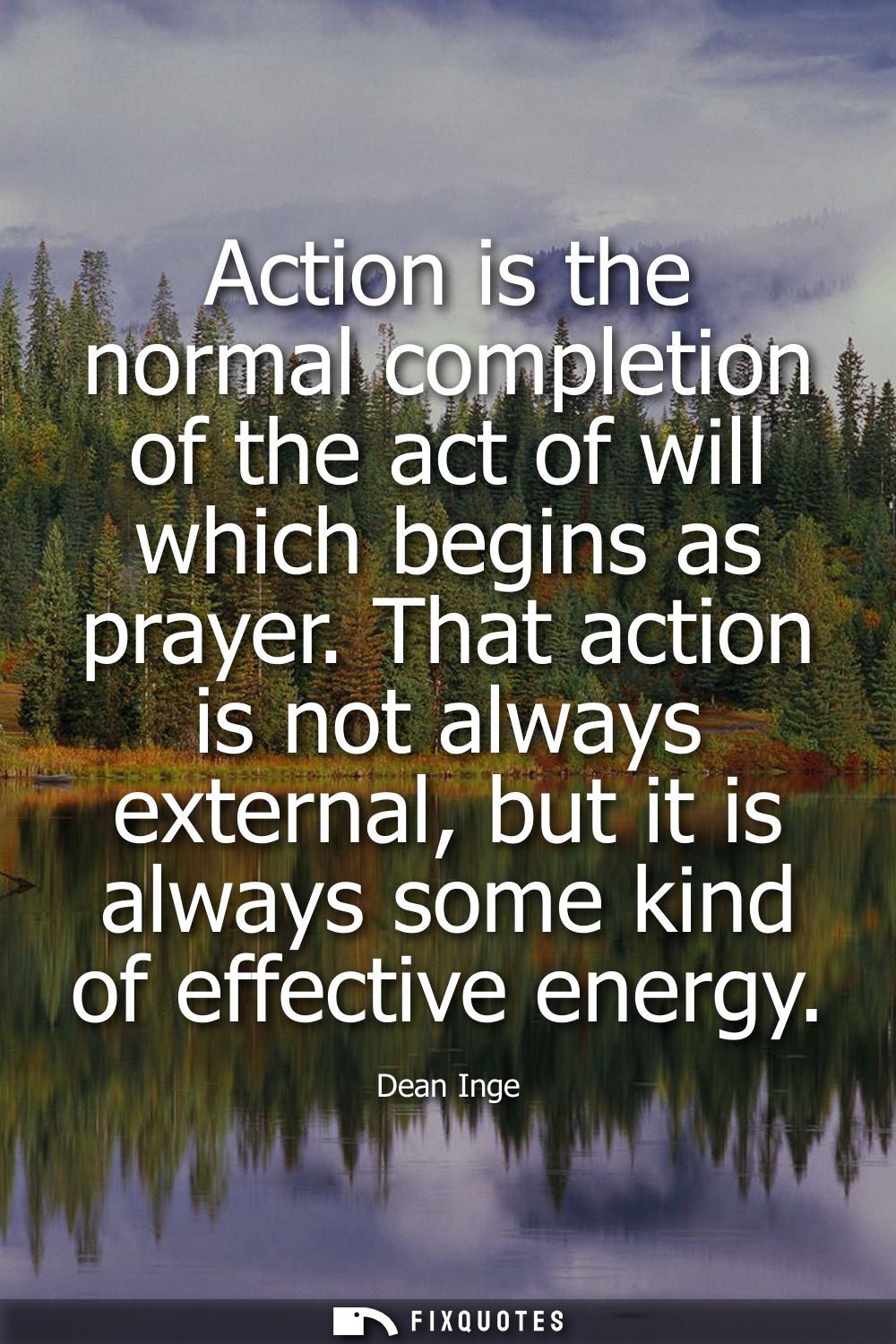
"Action is the normal completion of the act of will which begins as prayer. That action is not always external, but it is always some kind of effective energy"
About this Quote
The sentence is built like a corrective. “Normal completion” sounds clinical, almost bureaucratic, as if he’s diagnosing a spiritual disorder: the will that never cashes out in consequences. The subtext is pointedly anti-sentimental. Prayer isn’t evaluated by its mood, its eloquence, or its private comfort, but by the energy it releases into the world. He’s quietly redefining piety as efficacy.
The second line makes the argument more sophisticated than a simple “get up and do something.” Inge concedes that action needn’t be performative or public. The will can complete itself internally: a decision held, a habit interrupted, a resentment dropped, a discipline adopted. Yet he refuses to let inwardness become an escape hatch. Even interior action must be “effective energy,” not mere rumination.
Contextually, this sits neatly in a modernizing moment when religion was being challenged by science, war, and political upheaval. Inge’s answer isn’t retreat into mysticism; it’s a demand that spiritual life justify itself by producing force - moral, psychological, social - that actually moves something.
Quote Details
| Topic | Prayer |
|---|---|
| Source | Help us find the source |
| Cite |
Citation Formats
APA Style (7th ed.)
Inge, Dean. (2026, January 17). Action is the normal completion of the act of will which begins as prayer. That action is not always external, but it is always some kind of effective energy. FixQuotes. https://fixquotes.com/quotes/action-is-the-normal-completion-of-the-act-of-49556/
Chicago Style
Inge, Dean. "Action is the normal completion of the act of will which begins as prayer. That action is not always external, but it is always some kind of effective energy." FixQuotes. January 17, 2026. https://fixquotes.com/quotes/action-is-the-normal-completion-of-the-act-of-49556/.
MLA Style (9th ed.)
"Action is the normal completion of the act of will which begins as prayer. That action is not always external, but it is always some kind of effective energy." FixQuotes, 17 Jan. 2026, https://fixquotes.com/quotes/action-is-the-normal-completion-of-the-act-of-49556/. Accessed 5 Apr. 2026.