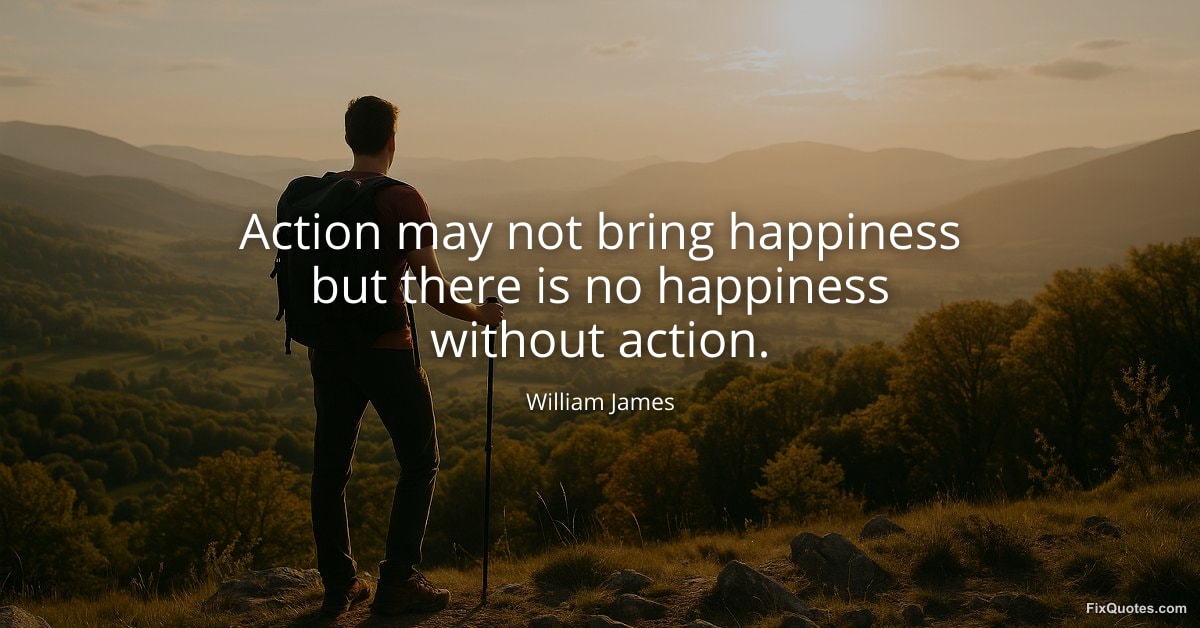
"Action may not bring happiness, but there is no happiness without action"
About this Quote
The subtext is a critique of passive interiority, the fantasy that the mind can think its way into fulfillment while the body stays put. James’s psychology treated feelings as responses to bodily states and habits, not pure, floating sentiments. Happiness, then, isn’t a mood you wait for; it’s an afterimage of engagement: choosing, risking, committing, building routines that give the nervous system something to organize around.
Context matters. Writing in an America intoxicated by self-help religion, industrial acceleration, and moral earnestness, James was wary of both spiritual quietism and simplistic “positive thinking.” His “will to believe” argument isn’t permission to self-delude; it’s a defense of acting under uncertainty when the alternative is paralysis. The line works because it refuses comfort on both ends: no magical promise that effort pays off, no indulgence for spectatorship. It’s a philosophy of dignity in the everyday grind: you can’t guarantee happiness, but you can guarantee the conditions under which it has a chance to appear.
Quote Details
| Topic | Happiness |
|---|---|
| Source | Verified source: Quote Junkie "Words To Live By" Edition (Hagopian Institute, 2008)
Evidence: ... Action may not bring happiness but there is no happiness without action . William James Begin to be now what you will be hereafter . William James Everybody should do at least two things each day that he hates to do , just for practice . Other candidates (2) William James (William James) compilation45.5% arity of religious happiness out the more commonplace happinesses which we get are relie Selected letters (James, William, 1961) primary37.9% the centre of gravity is i think very deep but there is something profoundly alienating |
| Featured | This quote was our Quote of the Day on September 30, 2025 |
| Cite |
Citation Formats
APA Style (7th ed.)
James, William. (2026, February 16). Action may not bring happiness, but there is no happiness without action. FixQuotes. https://fixquotes.com/quotes/action-may-not-bring-happiness-but-there-is-no-22115/
Chicago Style
James, William. "Action may not bring happiness, but there is no happiness without action." FixQuotes. February 16, 2026. https://fixquotes.com/quotes/action-may-not-bring-happiness-but-there-is-no-22115/.
MLA Style (9th ed.)
"Action may not bring happiness, but there is no happiness without action." FixQuotes, 16 Feb. 2026, https://fixquotes.com/quotes/action-may-not-bring-happiness-but-there-is-no-22115/. Accessed 27 Mar. 2026.