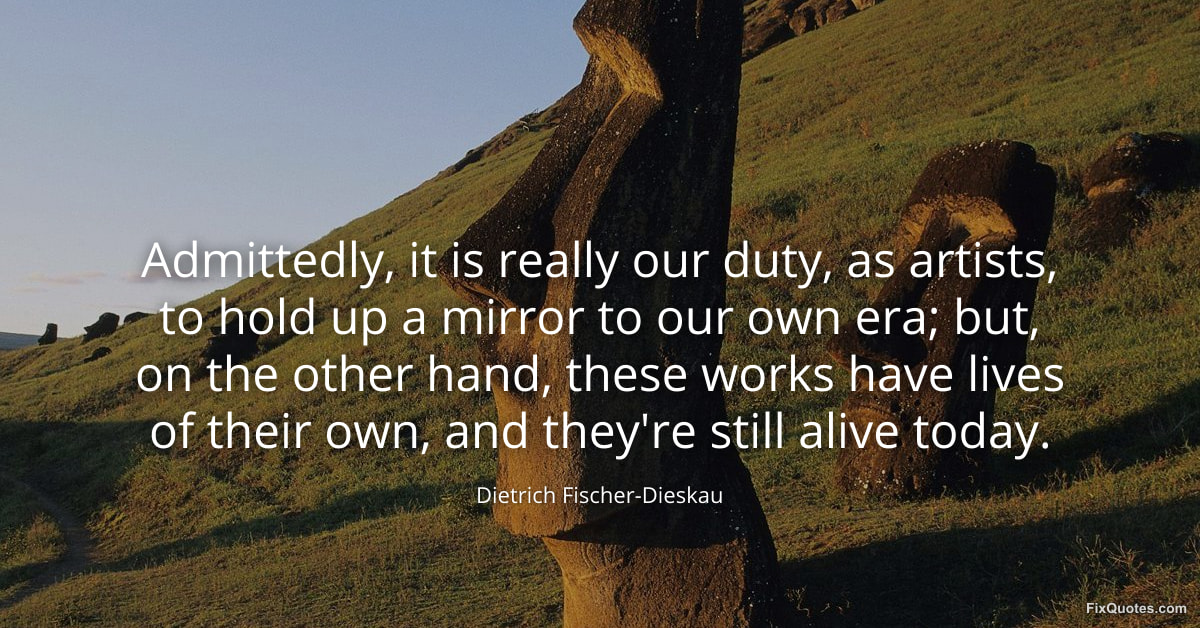
"Admittedly, it is really our duty, as artists, to hold up a mirror to our own era; but, on the other hand, these works have lives of their own, and they're still alive today"
About this Quote
Then he pivots with “but, on the other hand,” and you can hear a performer protecting the repertoire from being reduced to sociological evidence. Schubert and Schumann aren’t museum labels for the 1820s; they’re organisms that keep breathing every time a singer phrases a line differently or a listener hears their own grief in a melody. That’s the subtext: the artist isn’t just an interpreter of a score, but a caretaker of a living thing, responsible to the present without flattening the past.
The quote also quietly argues against the era’s culture-war binaries: “relevance” versus “tradition,” “political art” versus “pure beauty.” Fischer-Dieskau insists on a third position: works are born in a moment, marked by it, yet they outgrow their birth certificates. His genius was to make that sound practical, not mystical. A song cycle survives not because it’s “universal,” but because each generation keeps finding new, specific reasons it hurts.
Quote Details
| Topic | Art |
|---|---|
| Source | Help us find the source |
| Cite |
Citation Formats
APA Style (7th ed.)
Fischer-Dieskau, Dietrich. (2026, January 15). Admittedly, it is really our duty, as artists, to hold up a mirror to our own era; but, on the other hand, these works have lives of their own, and they're still alive today. FixQuotes. https://fixquotes.com/quotes/admittedly-it-is-really-our-duty-as-artists-to-148849/
Chicago Style
Fischer-Dieskau, Dietrich. "Admittedly, it is really our duty, as artists, to hold up a mirror to our own era; but, on the other hand, these works have lives of their own, and they're still alive today." FixQuotes. January 15, 2026. https://fixquotes.com/quotes/admittedly-it-is-really-our-duty-as-artists-to-148849/.
MLA Style (9th ed.)
"Admittedly, it is really our duty, as artists, to hold up a mirror to our own era; but, on the other hand, these works have lives of their own, and they're still alive today." FixQuotes, 15 Jan. 2026, https://fixquotes.com/quotes/admittedly-it-is-really-our-duty-as-artists-to-148849/. Accessed 9 Mar. 2026.