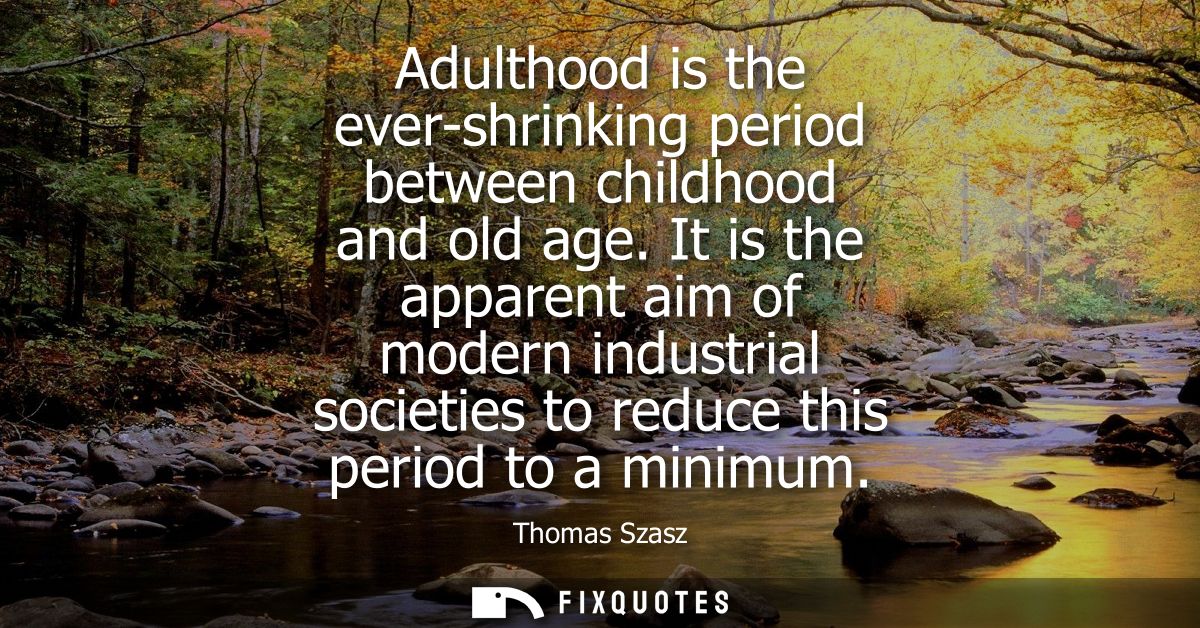
"Adulthood is the ever-shrinking period between childhood and old age. It is the apparent aim of modern industrial societies to reduce this period to a minimum"
About this Quote
Szasz comes in with a scalpel, not a hug: adulthood, he argues, is being squeezed from both ends until it becomes less a life stage than a logistical inconvenience. The first sentence is a sly reframing. “Ever-shrinking” doesn’t just describe a demographic trend; it implies design, a managed contraction. Then he sharpens the accusation by naming the suspect: “modern industrial societies.” The verb “reduce” is key - not “delay,” not “confuse,” but actively minimize, as if adulthood were waste in a production line.
The subtext is classic Szasz: suspicion of institutions that claim to help while quietly expanding control. Read through his broader critique of psychiatric authority and paternalism, “childhood” and “old age” aren’t merely biological realities; they’re socially sanctioned states of dependency. If you can classify more people as not fully responsible - too young, too impaired, too disordered, too vulnerable - you justify more supervision. Childhood becomes longer via extended schooling and credentialing; old age arrives earlier via medicalization, risk rhetoric, and a culture that treats ordinary struggle as pathology.
Context matters. Szasz wrote in a century when the welfare state, corporate bureaucracy, and clinical professions grew in tandem, each with incentives to standardize behavior and outsource judgment to experts. His provocation isn’t nostalgic; it’s political. Adulthood, in his telling, is the space where autonomy lives - and autonomy is inconvenient for systems that run best when people behave like dependents, patients, or consumers.
The subtext is classic Szasz: suspicion of institutions that claim to help while quietly expanding control. Read through his broader critique of psychiatric authority and paternalism, “childhood” and “old age” aren’t merely biological realities; they’re socially sanctioned states of dependency. If you can classify more people as not fully responsible - too young, too impaired, too disordered, too vulnerable - you justify more supervision. Childhood becomes longer via extended schooling and credentialing; old age arrives earlier via medicalization, risk rhetoric, and a culture that treats ordinary struggle as pathology.
Context matters. Szasz wrote in a century when the welfare state, corporate bureaucracy, and clinical professions grew in tandem, each with incentives to standardize behavior and outsource judgment to experts. His provocation isn’t nostalgic; it’s political. Adulthood, in his telling, is the space where autonomy lives - and autonomy is inconvenient for systems that run best when people behave like dependents, patients, or consumers.
Quote Details
| Topic | Aging |
|---|
More Quotes by Thomas
Add to List