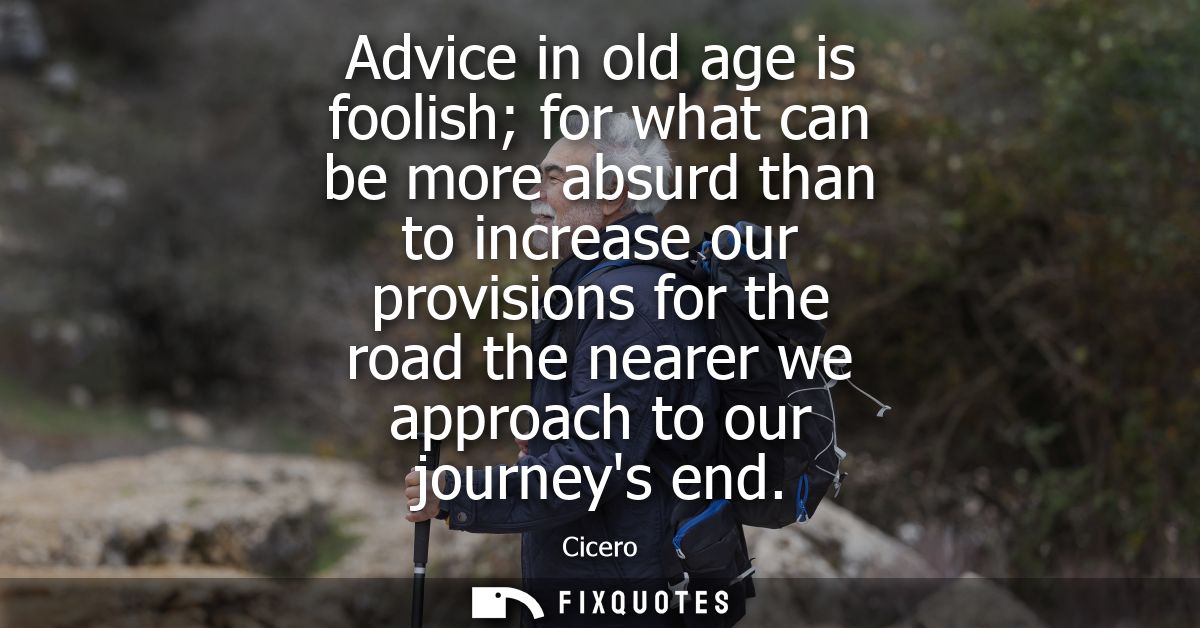
"Advice in old age is foolish; for what can be more absurd than to increase our provisions for the road the nearer we approach to our journey's end?"
About this Quote
The subtext is sharper than the surface pessimism. Cicero isn’t only talking about mortality; he’s targeting the social performance of wisdom. Roman public life rewarded the elder statesman who could still guide the republic, but it also punished anyone who clung to authority past usefulness. In that world, "advice in old age" risks becoming a kind of political clutter: directives issued after the decision has already moved on.
Context matters: Cicero’s writings on aging often argue for dignity, moderation, and continued civic engagement. That makes this sentence feel like a strategic sting, not a blanket dismissal. It cautions against the specific habit of compensating for dwindling time with intensified control. The closer the end, the more tempting it is to lecture, to hoard, to micromanage. Cicero’s irony is that this impulse mistakes quantity for meaning, as if extra supplies could change the destination.
Quote Details
| Topic | Aging |
|---|---|
| Source | Later attribution: Beyond Successful and Active Ageing (Virpi Timonen, 2016) modern compilationISBN: 9781447330189 · ID: bwZpDwAAQBAJ
Evidence: ... Cicero was dismissive of advice regarding good old age : ' Advice in old age is foolish ; for what can be more absurd than to increase our provisions for the road the nearer we approach to our journey's end . ' Notions of successful ... Other candidates (1) Cicero (Cicero) compilation36.7% d with the opinion of the multitude who ask what can be more expedient than the possession of sovereign power on the ... |
| Featured | This quote was our Quote of the Day on March 7, 2023 |
| Cite |
Citation Formats
APA Style (7th ed.)
Cicero. (2026, February 16). Advice in old age is foolish; for what can be more absurd than to increase our provisions for the road the nearer we approach to our journey's end? FixQuotes. https://fixquotes.com/quotes/advice-in-old-age-is-foolish-for-what-can-be-more-14801/
Chicago Style
Cicero. "Advice in old age is foolish; for what can be more absurd than to increase our provisions for the road the nearer we approach to our journey's end?" FixQuotes. February 16, 2026. https://fixquotes.com/quotes/advice-in-old-age-is-foolish-for-what-can-be-more-14801/.
MLA Style (9th ed.)
"Advice in old age is foolish; for what can be more absurd than to increase our provisions for the road the nearer we approach to our journey's end?" FixQuotes, 16 Feb. 2026, https://fixquotes.com/quotes/advice-in-old-age-is-foolish-for-what-can-be-more-14801/. Accessed 31 Mar. 2026.