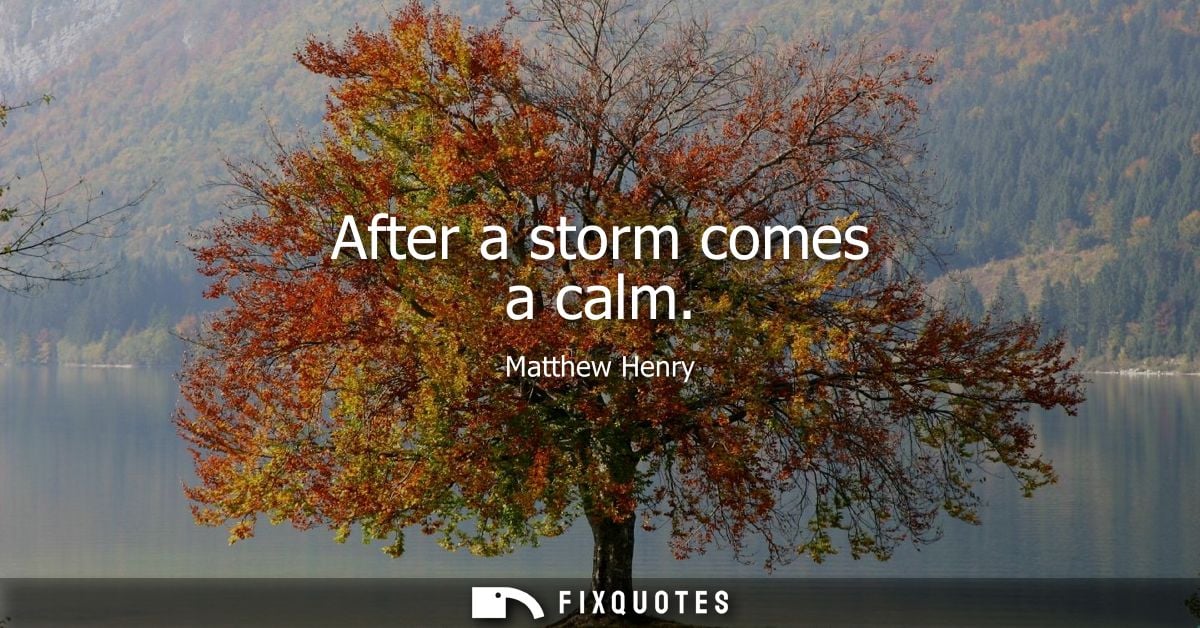
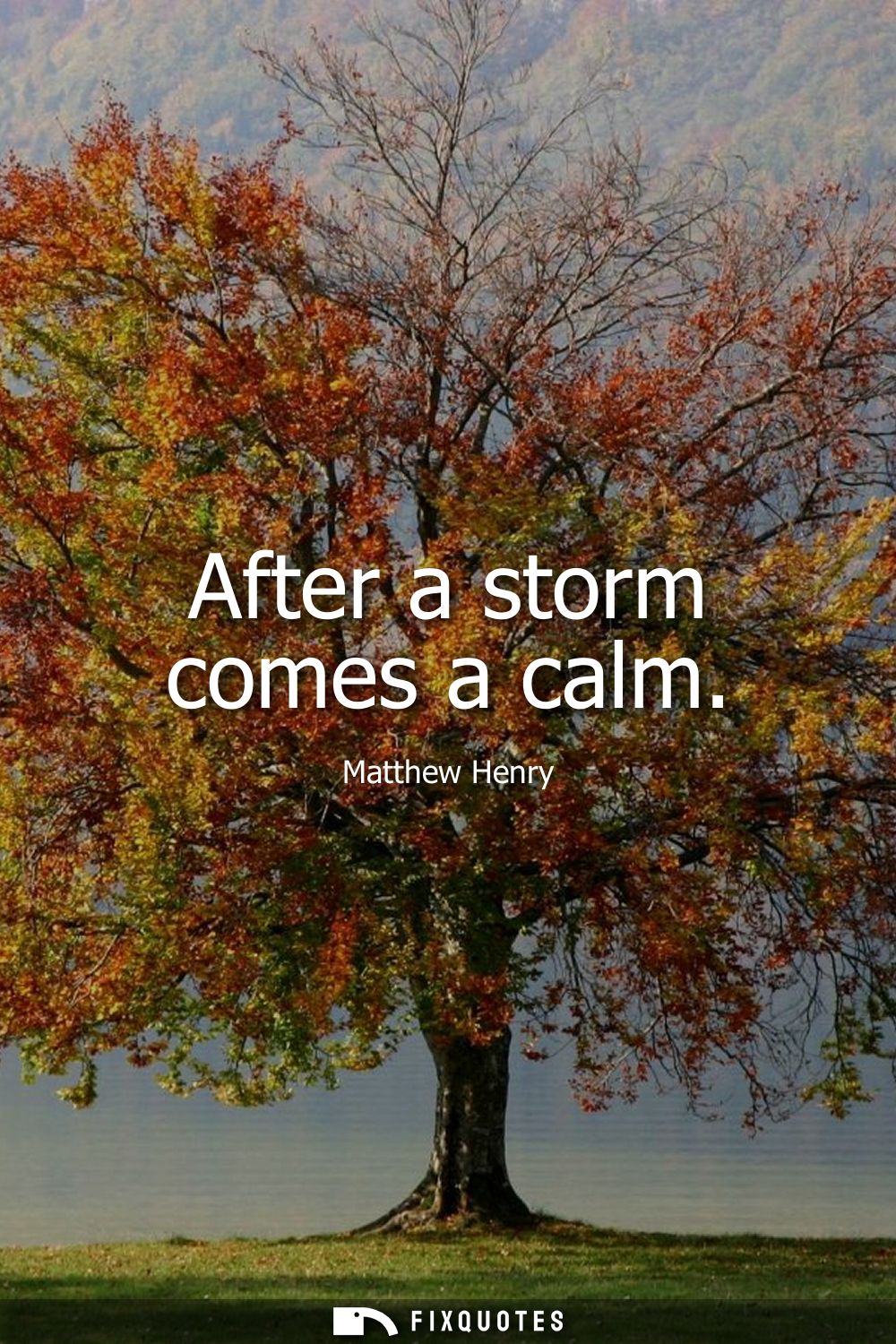
"After a storm comes a calm"
About this Quote
“After a storm comes a calm” works because it borrows authority from weather: an impersonal system that feels bigger than us, but also reliably patterned. Matthew Henry, a dissenting English clergyman writing in an age of political upheaval, disease, and precarious daily life, isn’t offering a cute reassurance. He’s making providence feel as predictable as climate. If the storm is real, the calm isn’t a fantasy; it’s built into the order of things.
The intent is pastoral and disciplinary at once. Pastoral, because it gives exhausted people a way to keep breathing through crisis without needing instant answers. Disciplinary, because it quietly asks for patience and endurance as moral practices. You don’t “fix” the storm; you outlast it. The subtext is less “everything will be fine” than “don’t mistake turbulence for God’s absence.” For Henry’s audience, faith isn’t primarily a private mood but a social technology for surviving instability: bankruptcy, persecution, grief, the churn of history.
What makes the line stick is its simplicity and its time horizon. It doesn’t promise rescue, revenge, or even meaning. It promises sequence. That’s rhetorically shrewd: people can doubt explanations, but it’s harder to argue with cycles. Still, the metaphor contains a quiet warning: calm is not permanent either. If storms and calms alternate, then steadiness must come from the believer, not the forecast. In that sense, Henry’s proverb is consolation with backbone.
The intent is pastoral and disciplinary at once. Pastoral, because it gives exhausted people a way to keep breathing through crisis without needing instant answers. Disciplinary, because it quietly asks for patience and endurance as moral practices. You don’t “fix” the storm; you outlast it. The subtext is less “everything will be fine” than “don’t mistake turbulence for God’s absence.” For Henry’s audience, faith isn’t primarily a private mood but a social technology for surviving instability: bankruptcy, persecution, grief, the churn of history.
What makes the line stick is its simplicity and its time horizon. It doesn’t promise rescue, revenge, or even meaning. It promises sequence. That’s rhetorically shrewd: people can doubt explanations, but it’s harder to argue with cycles. Still, the metaphor contains a quiet warning: calm is not permanent either. If storms and calms alternate, then steadiness must come from the believer, not the forecast. In that sense, Henry’s proverb is consolation with backbone.
Quote Details
| Topic | Hope |
|---|---|
| Source | Help us find the source |
| Cite |
Citation Formats
APA Style (7th ed.)
Henry, Matthew. (2026, January 18). After a storm comes a calm. FixQuotes. https://fixquotes.com/quotes/after-a-storm-comes-a-calm-10383/
Chicago Style
Henry, Matthew. "After a storm comes a calm." FixQuotes. January 18, 2026. https://fixquotes.com/quotes/after-a-storm-comes-a-calm-10383/.
MLA Style (9th ed.)
"After a storm comes a calm." FixQuotes, 18 Jan. 2026, https://fixquotes.com/quotes/after-a-storm-comes-a-calm-10383/. Accessed 6 Mar. 2026.
More Quotes by Matthew
Add to List