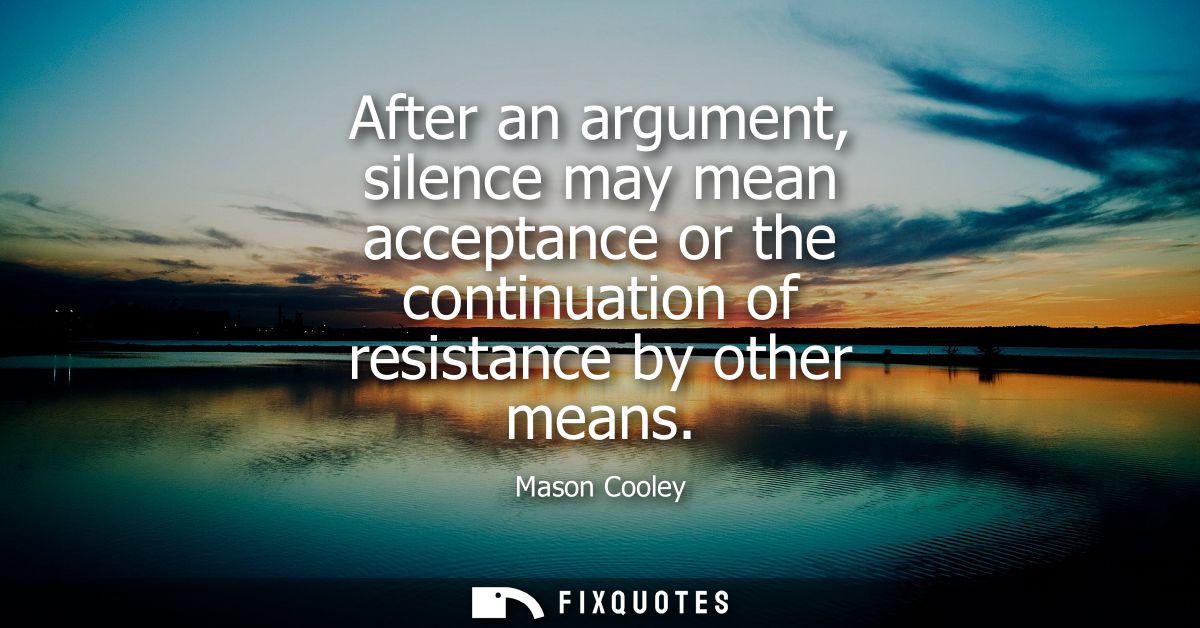
"After an argument, silence may mean acceptance or the continuation of resistance by other means"
About this Quote
“Continuation of resistance by other means” is the tell: it borrows the cadence of political theory (Clausewitz’s “war by other means” echoes in the background), dragging a domestic scene into the logic of power. Cooley suggests that arguments aren’t purely about truth or feelings; they’re contests over control, recognition, status. When words fail - or when words would cost too much - silence becomes an alternate weapon: denial of access, refusal to validate, a tactical pause that forces the other person to fill the vacuum with apologies, second-guessing, or escalation.
The subtext is almost cruelly modern. In a culture that fetishizes “communication,” Cooley points out the darker reality: noncommunication communicates perfectly. Silence can be punishment dressed up as composure. It can be self-protection mislabeled as maturity. The ambiguity is the sentence’s engine; it captures why post-argument quiet feels uncanny. You can’t tell if you’ve been forgiven or simply postponed.
Quote Details
| Topic | Relationship |
|---|---|
| Source | Help us find the source |
| Cite |
Citation Formats
APA Style (7th ed.)
Cooley, Mason. (2026, January 16). After an argument, silence may mean acceptance or the continuation of resistance by other means. FixQuotes. https://fixquotes.com/quotes/after-an-argument-silence-may-mean-acceptance-or-100306/
Chicago Style
Cooley, Mason. "After an argument, silence may mean acceptance or the continuation of resistance by other means." FixQuotes. January 16, 2026. https://fixquotes.com/quotes/after-an-argument-silence-may-mean-acceptance-or-100306/.
MLA Style (9th ed.)
"After an argument, silence may mean acceptance or the continuation of resistance by other means." FixQuotes, 16 Jan. 2026, https://fixquotes.com/quotes/after-an-argument-silence-may-mean-acceptance-or-100306/. Accessed 29 Mar. 2026.