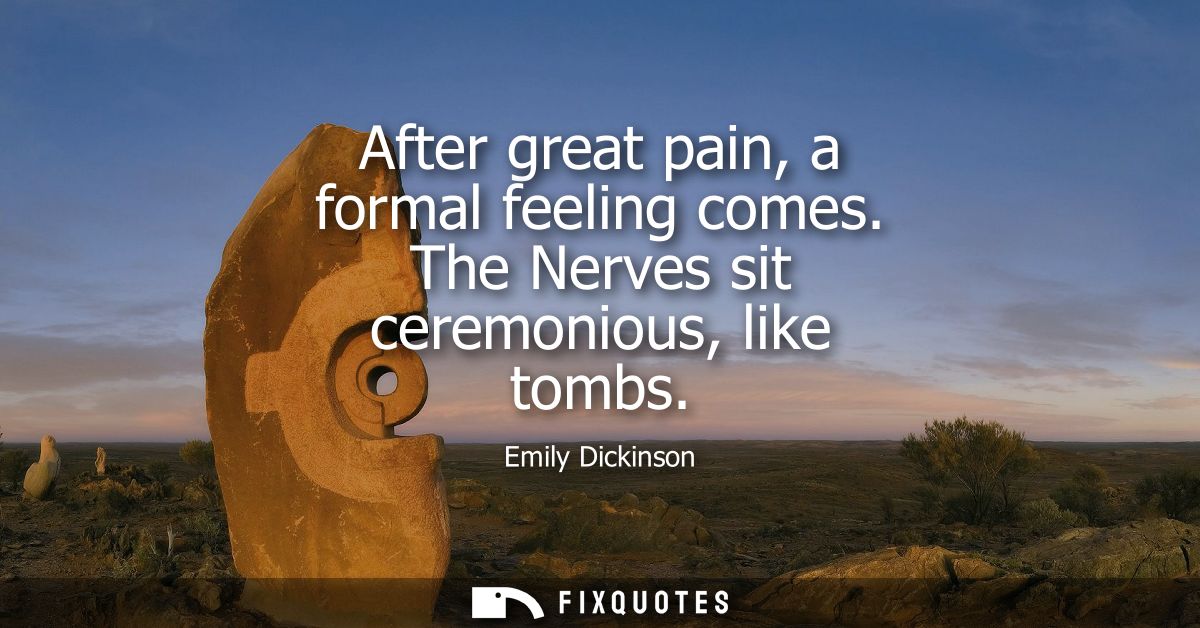
"After great pain, a formal feeling comes. The Nerves sit ceremonious, like tombs"
About this Quote
“The Nerves sit ceremonious, like tombs” is a savage simile because it turns the living body into architecture. Nerves don’t merely go numb; they take on a ritual stillness, a funereal discipline. “Ceremonious” suggests a service, an order of operations: breathe, speak, keep the face arranged. Tombs are both containers and monuments, implying that pain has been sealed inside while also becoming the thing you can’t stop orbiting. The line makes a physical argument: trauma reorganizes the nervous system into something inert, decorative, and haunted.
Context matters. Dickinson writes from a 19th-century world that prized restraint, especially in women; “formality” was social survival. But the poem’s brilliance is that it refuses the sentimental arc where suffering purifies. Here, pain doesn’t ennoble. It petrifies. The subtext is chillingly modern: dissociation as self-defense, the psyche staging a ceremony of calm to keep chaos from breaching the room. Dickinson’s minimalism isn’t delicacy; it’s precision under pressure.
Quote Details
| Topic | Sadness |
|---|---|
| Source | Help us find the source |
| Cite |
Citation Formats
APA Style (7th ed.)
Dickinson, Emily. (2026, January 17). After great pain, a formal feeling comes. The Nerves sit ceremonious, like tombs. FixQuotes. https://fixquotes.com/quotes/after-great-pain-a-formal-feeling-comes-the-31024/
Chicago Style
Dickinson, Emily. "After great pain, a formal feeling comes. The Nerves sit ceremonious, like tombs." FixQuotes. January 17, 2026. https://fixquotes.com/quotes/after-great-pain-a-formal-feeling-comes-the-31024/.
MLA Style (9th ed.)
"After great pain, a formal feeling comes. The Nerves sit ceremonious, like tombs." FixQuotes, 17 Jan. 2026, https://fixquotes.com/quotes/after-great-pain-a-formal-feeling-comes-the-31024/. Accessed 21 Feb. 2026.