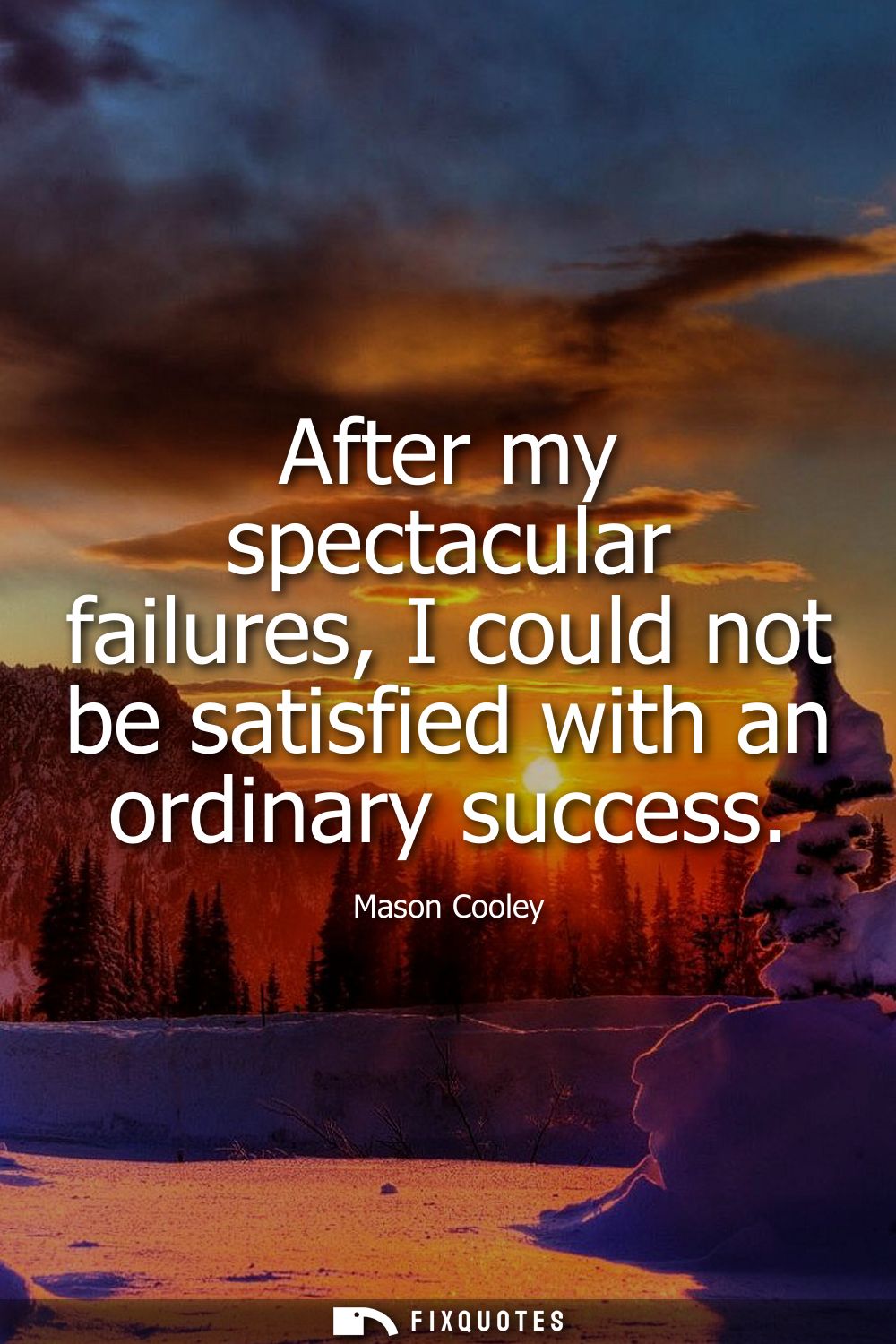
"After my spectacular failures, I could not be satisfied with an ordinary success"
About this Quote
Cooley, an aphorist by temperament, compresses a whole psychology of ambition into a single pivot. The subtext is less “aim high” than “I’m trapped by my own myth.” Spectacular failure can become perversely useful: it grants you a specialness, an excuse, a tragic aura. To accept modest success would be to admit the world is, in fact, mundane - that your catastrophe didn’t make you exceptional, just human. The ego prefers the melodrama, even when it hurts.
There’s also a cultural critique tucked inside. Modern success is rarely measured privately; it’s calibrated against spectacle, against the highlight reel. If your worst moments were operatic, your comeback has to be, too, or it won’t count - to your audience, or to yourself. Cooley exposes the addiction to scale: when everything is a public story, redemption has to go viral.
Quote Details
| Topic | Success |
|---|---|
| Source | Mason Cooley — aphorism: 'After my spectacular failures, I could not be satisfied with an ordinary success.' Source: Wikiquote entry for Mason Cooley. |
| Cite |
Citation Formats
APA Style (7th ed.)
Cooley, Mason. (2026, January 15). After my spectacular failures, I could not be satisfied with an ordinary success. FixQuotes. https://fixquotes.com/quotes/after-my-spectacular-failures-i-could-not-be-165463/
Chicago Style
Cooley, Mason. "After my spectacular failures, I could not be satisfied with an ordinary success." FixQuotes. January 15, 2026. https://fixquotes.com/quotes/after-my-spectacular-failures-i-could-not-be-165463/.
MLA Style (9th ed.)
"After my spectacular failures, I could not be satisfied with an ordinary success." FixQuotes, 15 Jan. 2026, https://fixquotes.com/quotes/after-my-spectacular-failures-i-could-not-be-165463/. Accessed 3 Apr. 2026.