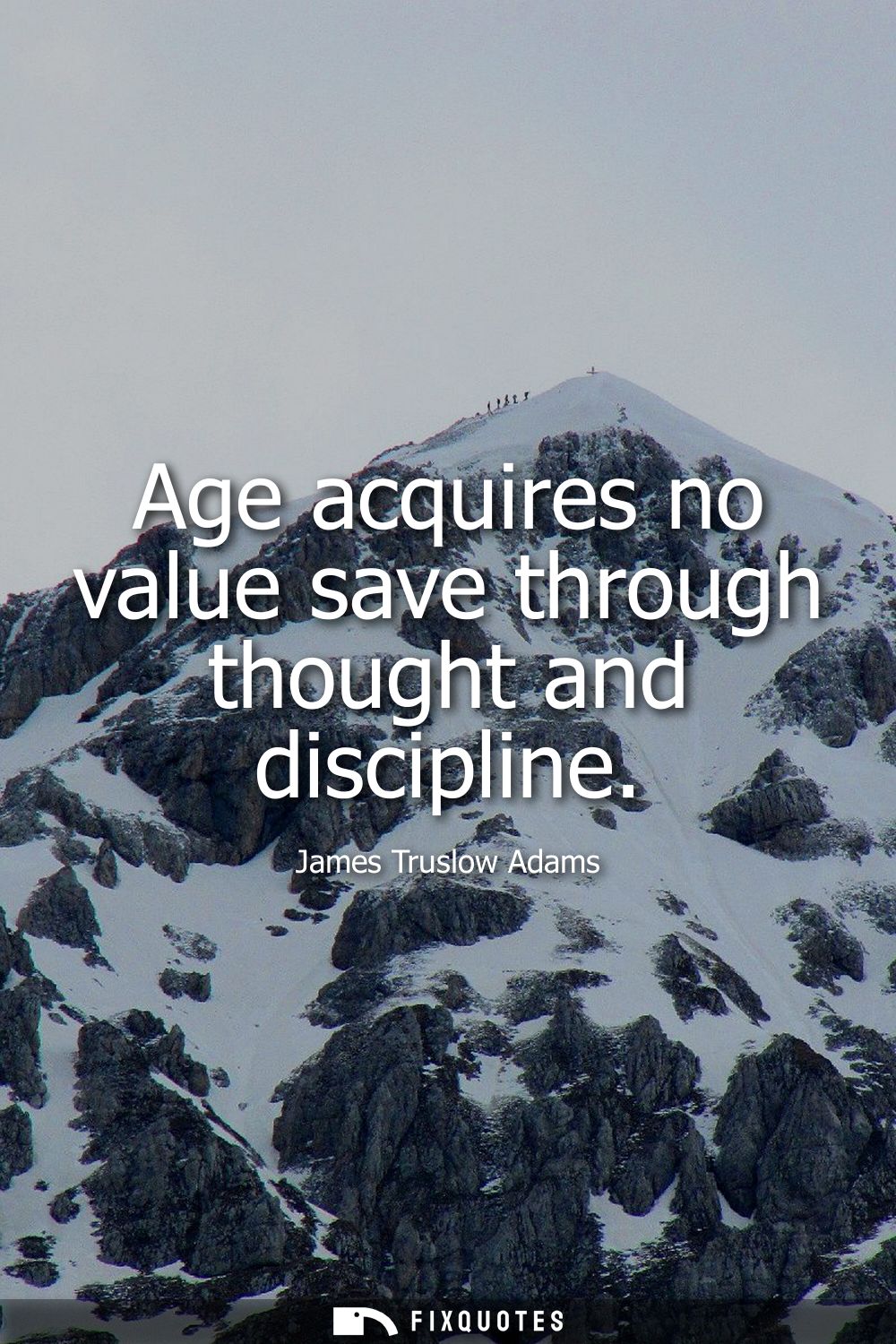
"Age acquires no value save through thought and discipline"
About this Quote
The line refuses the comforting myth that time itself is a credential. For a culture that loves to treat age as automatic authority, Adams offers a colder bargain: years are just raw material, and without deliberate shaping they’re merely accumulation. “Acquires” is the tell. Value isn’t granted by birthdays; it’s earned, almost like interest that only compounds when the principal is managed. And “save” carries a faintly Puritan sting, implying that age without inner work isn’t just neutral but wasted.
Adams, writing as an American historian in the early 20th century, is steeped in a national story that oscillates between self-making optimism and anxiety about decline. The Progressive Era had placed faith in expertise, education, and self-improvement; the interwar period watched that faith get stress-tested by mass politics and disillusionment. In that context, “thought and discipline” reads as an antidote to both complacency and chaos: reflection without rigor becomes chatter, and discipline without reflection becomes obedience. He pairs them to insist on a mature intelligence that is at once inward (thought) and behavioral (discipline).
The subtext is also moral, not merely cognitive. Adams implies that experience doesn’t refine you unless you choose refinement. Age can harden into prejudice as easily as it can deepen into wisdom. His intent is corrective: to strip away reverence for longevity and replace it with reverence for cultivated judgment. The quote works because it flatters no one; it drafts the reader into responsibility.
Adams, writing as an American historian in the early 20th century, is steeped in a national story that oscillates between self-making optimism and anxiety about decline. The Progressive Era had placed faith in expertise, education, and self-improvement; the interwar period watched that faith get stress-tested by mass politics and disillusionment. In that context, “thought and discipline” reads as an antidote to both complacency and chaos: reflection without rigor becomes chatter, and discipline without reflection becomes obedience. He pairs them to insist on a mature intelligence that is at once inward (thought) and behavioral (discipline).
The subtext is also moral, not merely cognitive. Adams implies that experience doesn’t refine you unless you choose refinement. Age can harden into prejudice as easily as it can deepen into wisdom. His intent is corrective: to strip away reverence for longevity and replace it with reverence for cultivated judgment. The quote works because it flatters no one; it drafts the reader into responsibility.
Quote Details
| Topic | Aging |
|---|---|
| Source | Help us find the source |
| Cite |
Citation Formats
APA Style (7th ed.)
Adams, James Truslow. (2026, January 16). Age acquires no value save through thought and discipline. FixQuotes. https://fixquotes.com/quotes/age-acquires-no-value-save-through-thought-and-106228/
Chicago Style
Adams, James Truslow. "Age acquires no value save through thought and discipline." FixQuotes. January 16, 2026. https://fixquotes.com/quotes/age-acquires-no-value-save-through-thought-and-106228/.
MLA Style (9th ed.)
"Age acquires no value save through thought and discipline." FixQuotes, 16 Jan. 2026, https://fixquotes.com/quotes/age-acquires-no-value-save-through-thought-and-106228/. Accessed 6 Mar. 2026.
More Quotes by James
Add to List