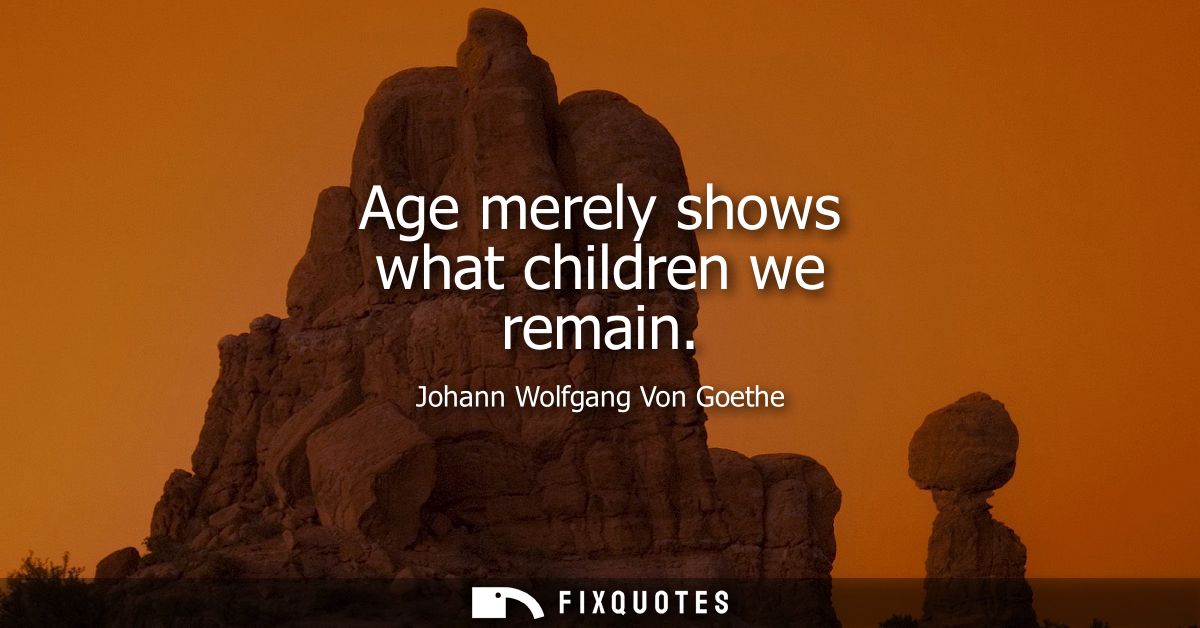
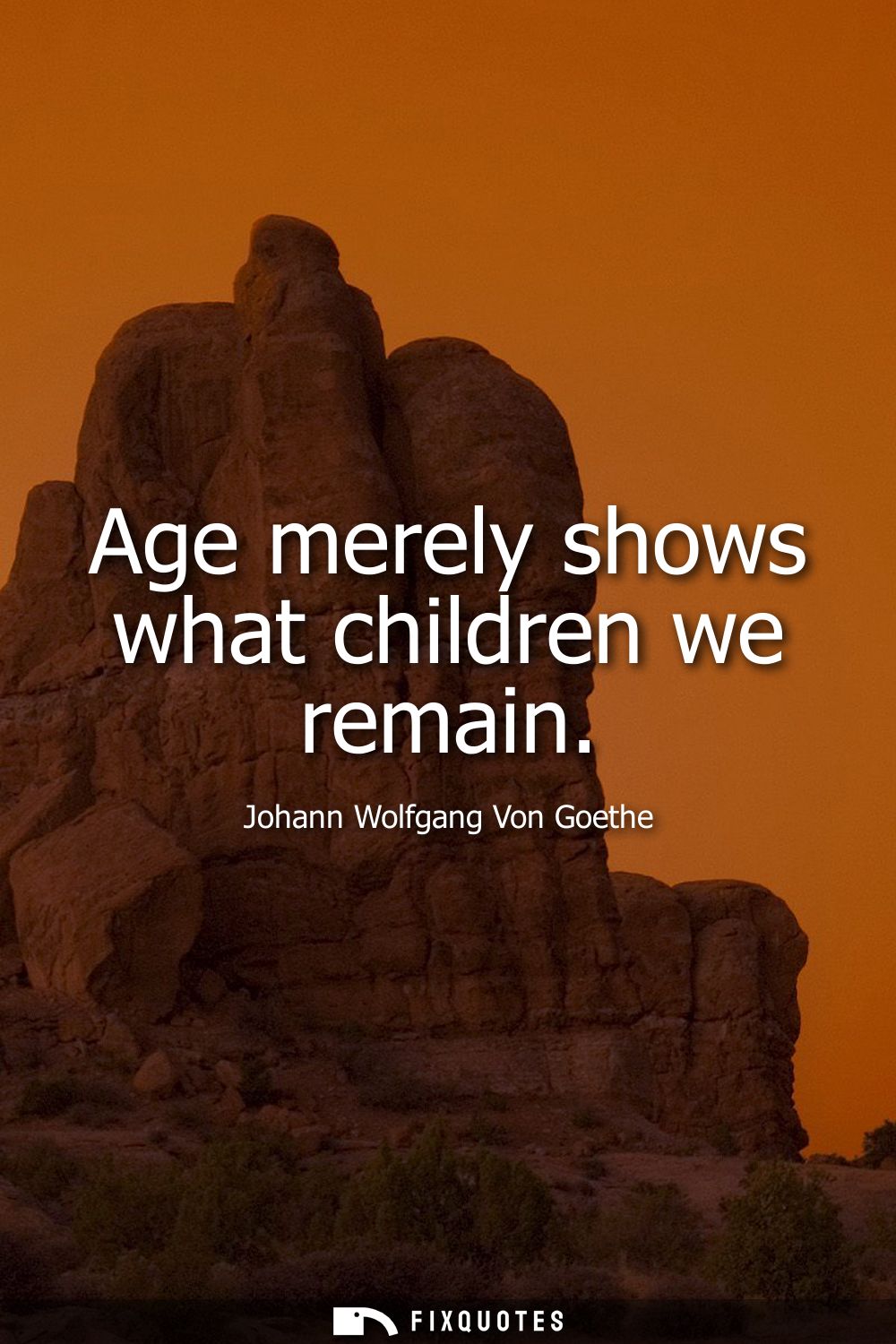
"Age merely shows what children we remain"
About this Quote
Growing older, Goethe suggests, is less a climb toward wisdom than a slow unveiling of the childish machinery that never stops running underneath. The line works because it flips the usual moral storyline of age: instead of maturity refining us into something sturdier, time just strips away the disguises. “Merely” is the knife twist. Age doesn’t transform; it exposes. The provocation isn’t that adults can be immature, but that “adult” is often a costume stitched from manners, status, and self-narration.
Goethe’s intent reads as both consolation and indictment. Consolation, because it grants permission to the reader: your envies, your impulsive wants, your need to be seen aren’t personal failures; they’re part of the baseline human kit. Indictment, because it punctures the smug authority that societies give to elders. If we remain children, then the hierarchies built on age and experience look shakier - less natural order, more theater.
The subtext is psychological before psychology had its modern vocabulary. Goethe, steeped in Sturm und Drang’s emotional candor and later Weimar Classicism’s discipline, understood that selfhood is a negotiation between appetite and form. In that frame, “children” aren’t just playful; they’re raw, needy, and honest about dependency. Age, with its losses and narrowing horizons, can even intensify those traits: grievance hardens, fantasies calcify, old rivalries become origin stories.
Context matters: Goethe lived through revolution, empire, and restoration - eras when “progress” was loudly promised. This sentence is a skeptical counter-melody. History may churn, titles may change, but the creature at the center remains stubbornly young.
Goethe’s intent reads as both consolation and indictment. Consolation, because it grants permission to the reader: your envies, your impulsive wants, your need to be seen aren’t personal failures; they’re part of the baseline human kit. Indictment, because it punctures the smug authority that societies give to elders. If we remain children, then the hierarchies built on age and experience look shakier - less natural order, more theater.
The subtext is psychological before psychology had its modern vocabulary. Goethe, steeped in Sturm und Drang’s emotional candor and later Weimar Classicism’s discipline, understood that selfhood is a negotiation between appetite and form. In that frame, “children” aren’t just playful; they’re raw, needy, and honest about dependency. Age, with its losses and narrowing horizons, can even intensify those traits: grievance hardens, fantasies calcify, old rivalries become origin stories.
Context matters: Goethe lived through revolution, empire, and restoration - eras when “progress” was loudly promised. This sentence is a skeptical counter-melody. History may churn, titles may change, but the creature at the center remains stubbornly young.
Quote Details
| Topic | Aging |
|---|---|
| Source | Help us find the source |
| Cite |
Citation Formats
APA Style (7th ed.)
Goethe, Johann Wolfgang Von. (2026, January 15). Age merely shows what children we remain. FixQuotes. https://fixquotes.com/quotes/age-merely-shows-what-children-we-remain-32088/
Chicago Style
Goethe, Johann Wolfgang Von. "Age merely shows what children we remain." FixQuotes. January 15, 2026. https://fixquotes.com/quotes/age-merely-shows-what-children-we-remain-32088/.
MLA Style (9th ed.)
"Age merely shows what children we remain." FixQuotes, 15 Jan. 2026, https://fixquotes.com/quotes/age-merely-shows-what-children-we-remain-32088/. Accessed 12 Feb. 2026.
More Quotes by Johann
Add to List