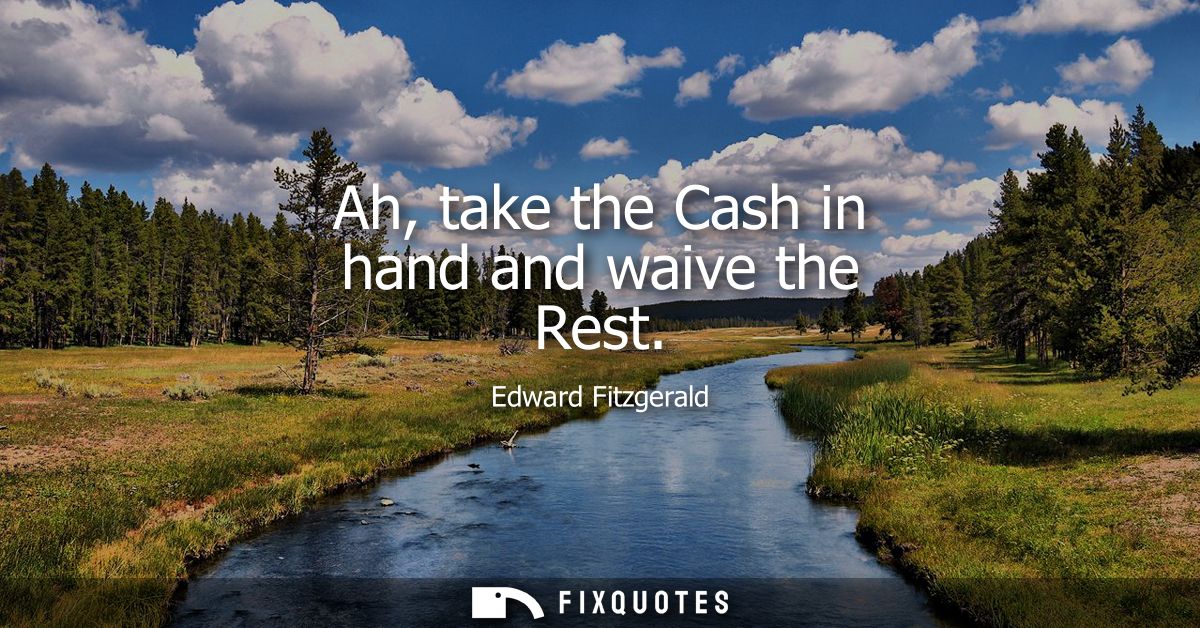
"Ah, take the Cash in hand and waive the Rest"
About this Quote
Cash now, promises later: its the most unsentimental wisdom you can smuggle into a line that sounds like a toast. Fitzgeralds "Ah, take the Cash in hand and waive the Rest" hits with the clipped authority of someone whos watched grand plans curdle into excuses. The diction is bluntly commercial - "Cash", "hand", "waive" - as if lifes biggest questions can be settled at a counter. That is the trick: he imports the language of transaction into the realm of desire and meaning, and suddenly optimism looks like bad credit.
Context matters because Fitzgerald is best known for the Rubaiyat of Omar Khayyam, less a translation than a Victorian remix of Persian skepticism. In that world, metaphysical systems are elaborate IOUs; the future is a promissory note issued by unreliable institutions: fate, religion, empire, even romance. "Ah" signals a weary intimacy, not a sermon. It reads like advice from a friend at closing time, after the speeches have failed and the bill has arrived.
The subtext isnt crude materialism so much as triage. "Cash in hand" stands for what is immediate, tangible, lived - the hour you can actually touch. "The Rest" is everything that asks you to defer: moral points to be tallied later, rewards after death, reputations, hypotheticals. Fitzgerald isnt saying never dream; hes warning that the future is where people stash their evasions. Its a line built to puncture Victorian earnestness with a small, elegant pin, leaving behind not nihilism but a hard-edged permission to be present.
Context matters because Fitzgerald is best known for the Rubaiyat of Omar Khayyam, less a translation than a Victorian remix of Persian skepticism. In that world, metaphysical systems are elaborate IOUs; the future is a promissory note issued by unreliable institutions: fate, religion, empire, even romance. "Ah" signals a weary intimacy, not a sermon. It reads like advice from a friend at closing time, after the speeches have failed and the bill has arrived.
The subtext isnt crude materialism so much as triage. "Cash in hand" stands for what is immediate, tangible, lived - the hour you can actually touch. "The Rest" is everything that asks you to defer: moral points to be tallied later, rewards after death, reputations, hypotheticals. Fitzgerald isnt saying never dream; hes warning that the future is where people stash their evasions. Its a line built to puncture Victorian earnestness with a small, elegant pin, leaving behind not nihilism but a hard-edged permission to be present.
Quote Details
| Topic | Live in the Moment |
|---|---|
| Source | Help us find the source |
| Cite |
Citation Formats
APA Style (7th ed.)
Fitzgerald, Edward. (2026, January 15). Ah, take the Cash in hand and waive the Rest. FixQuotes. https://fixquotes.com/quotes/ah-take-the-cash-in-hand-and-waive-the-rest-145892/
Chicago Style
Fitzgerald, Edward. "Ah, take the Cash in hand and waive the Rest." FixQuotes. January 15, 2026. https://fixquotes.com/quotes/ah-take-the-cash-in-hand-and-waive-the-rest-145892/.
MLA Style (9th ed.)
"Ah, take the Cash in hand and waive the Rest." FixQuotes, 15 Jan. 2026, https://fixquotes.com/quotes/ah-take-the-cash-in-hand-and-waive-the-rest-145892/. Accessed 22 Feb. 2026.
More Quotes by Edward
Add to List