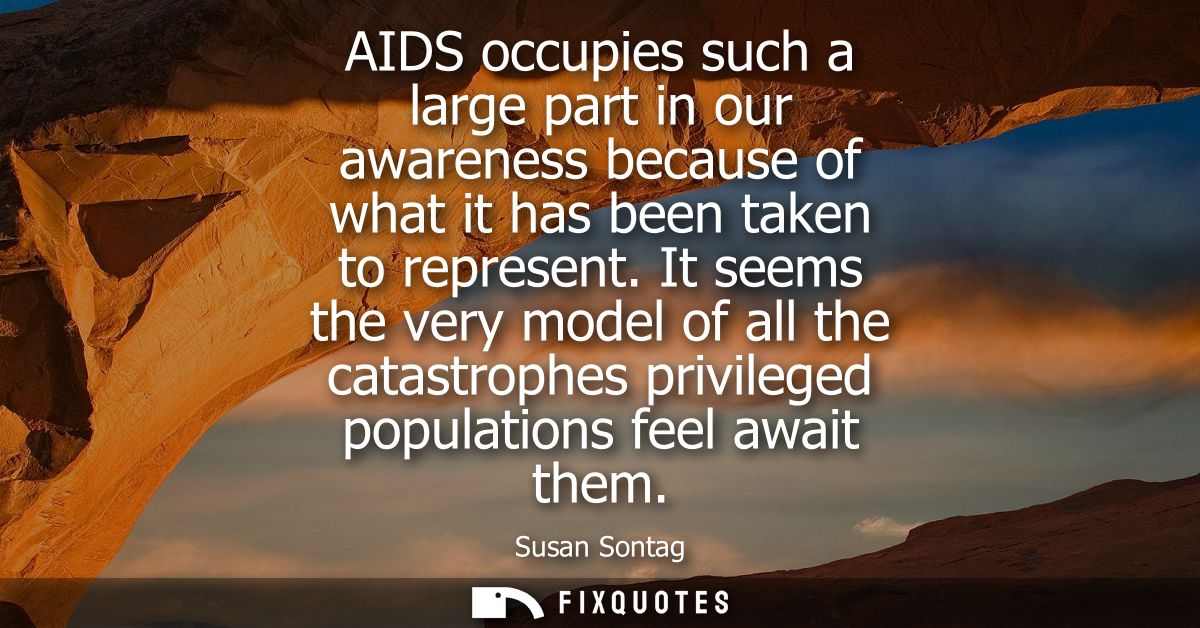
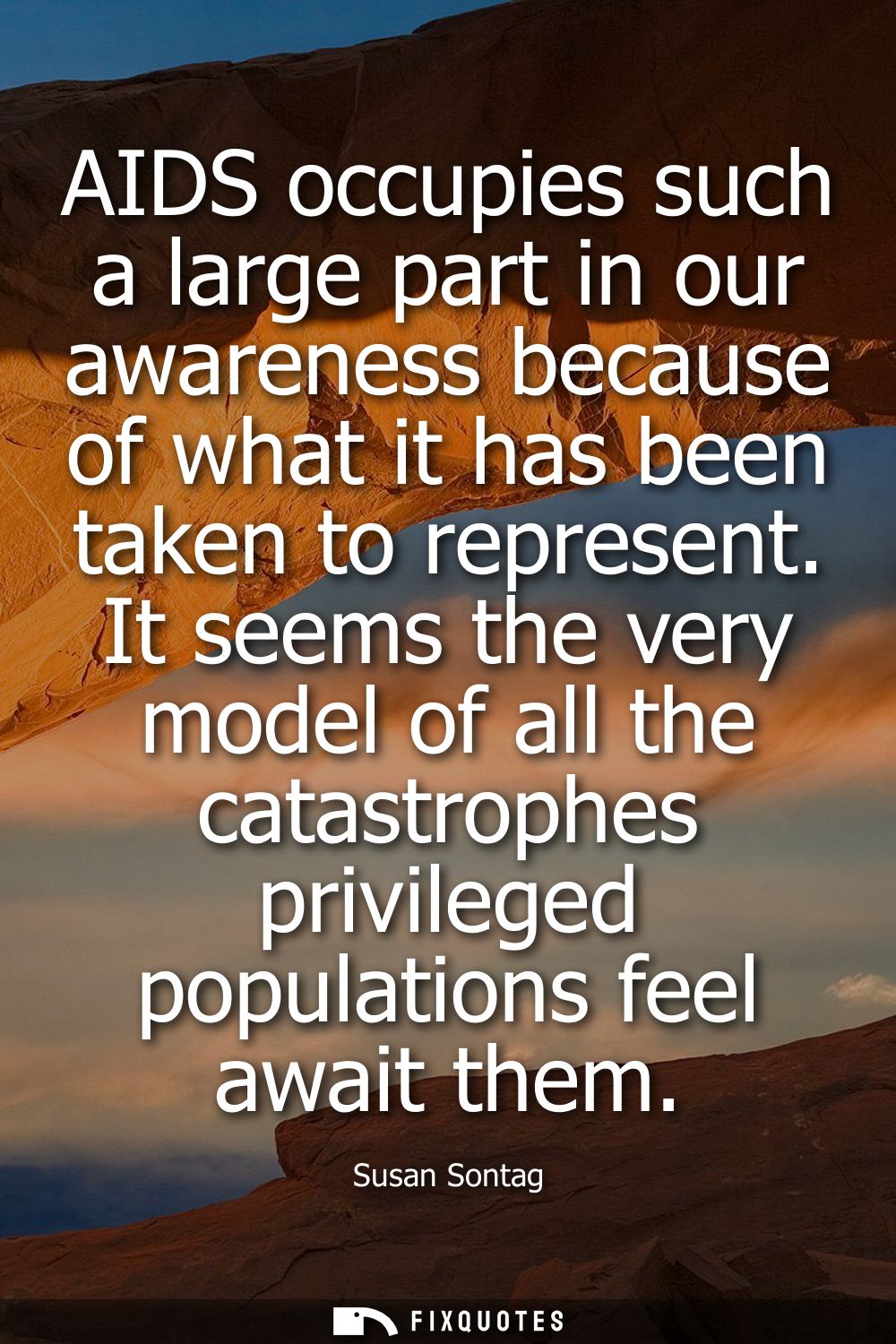
"AIDS occupies such a large part in our awareness because of what it has been taken to represent. It seems the very model of all the catastrophes privileged populations feel await them"
About this Quote
Her phrase “privileged populations” sharpens the target. This isn’t empathy at the center; it’s anxiety management. AIDS becomes a screen onto which the comfortable project their favorite apocalypses: loss of control, moral disorder, foreignness, sexual unruliness, the fear that the protections of class and nation won’t hold. “The very model” is slyly clinical, as if catastrophe were a template you could photocopy. That’s Sontag’s irony: the panic is methodical, almost bureaucratic, less a spontaneous horror than a rehearsed one.
The context is late-20th-century America and Europe, where AIDS was initially framed as a problem of “others” (gay men, Haitians, drug users) until it threatened to become everyone’s problem. Sontag diagnoses how quickly privileged fear turns symbolic, and how symbolism turns political: into stigma, into neglect, into a moralizing public discourse that delays care while inflating dread. She isn’t minimizing catastrophe; she’s indicting the cultural machinery that decides which suffering becomes a spectacle and which remains invisible.
Quote Details
| Topic | Equality |
|---|---|
| Source | Susan Sontag, 'AIDS and Its Metaphors' (essay orig. New York Review of Books 1988; expanded as book, Farrar, Straus & Giroux 1989). |
| Cite |
Citation Formats
APA Style (7th ed.)
Sontag, Susan. (2026, January 15). AIDS occupies such a large part in our awareness because of what it has been taken to represent. It seems the very model of all the catastrophes privileged populations feel await them. FixQuotes. https://fixquotes.com/quotes/aids-occupies-such-a-large-part-in-our-awareness-165864/
Chicago Style
Sontag, Susan. "AIDS occupies such a large part in our awareness because of what it has been taken to represent. It seems the very model of all the catastrophes privileged populations feel await them." FixQuotes. January 15, 2026. https://fixquotes.com/quotes/aids-occupies-such-a-large-part-in-our-awareness-165864/.
MLA Style (9th ed.)
"AIDS occupies such a large part in our awareness because of what it has been taken to represent. It seems the very model of all the catastrophes privileged populations feel await them." FixQuotes, 15 Jan. 2026, https://fixquotes.com/quotes/aids-occupies-such-a-large-part-in-our-awareness-165864/. Accessed 29 Mar. 2026.