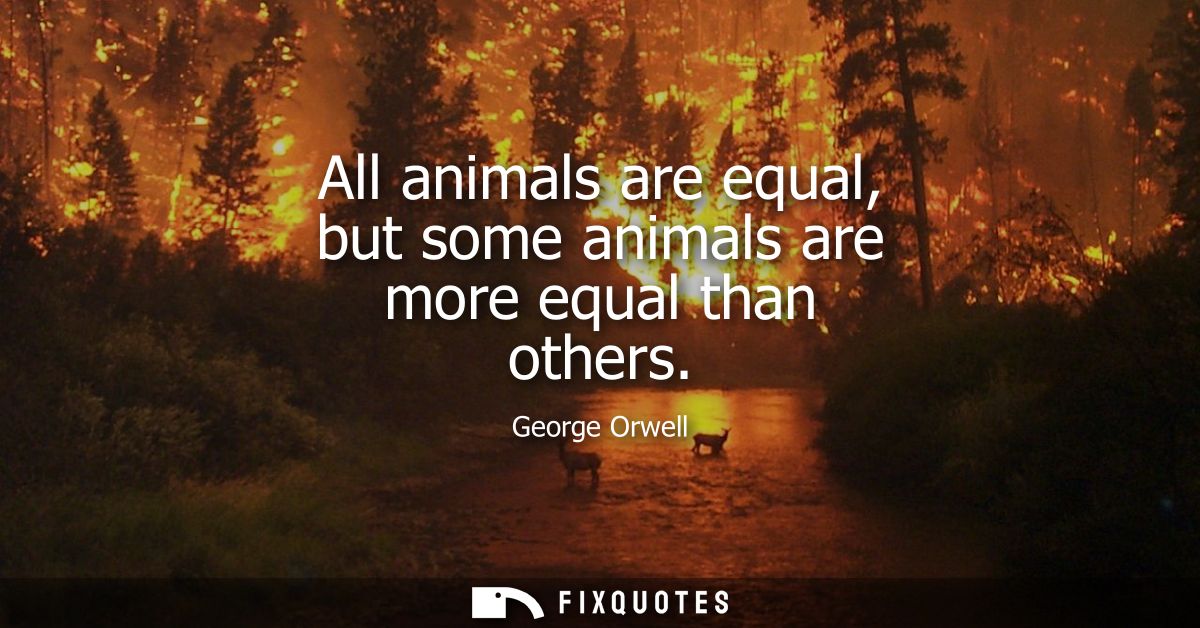
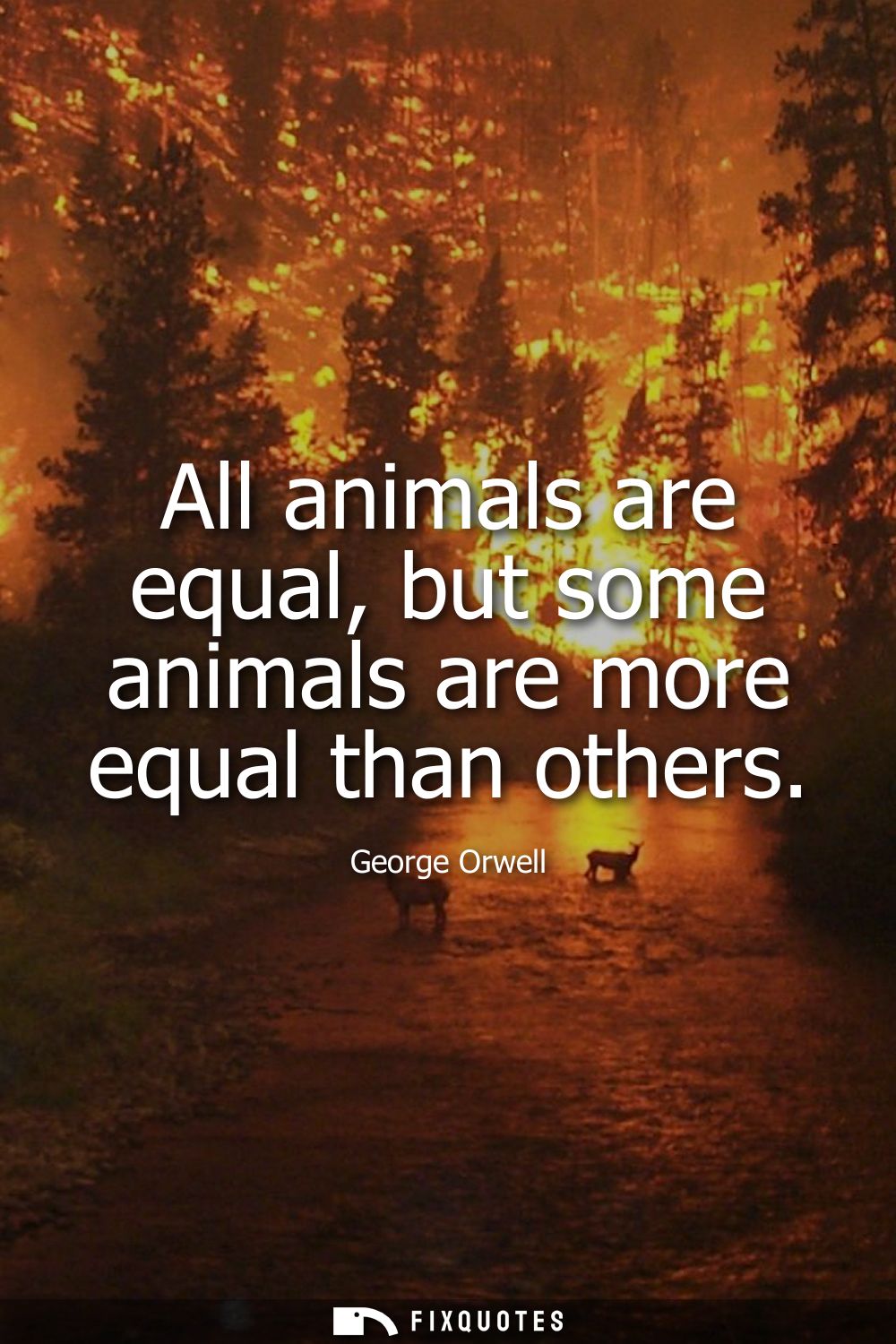
"All animals are equal, but some animals are more equal than others"
About this Quote
Equality gets weaponized here not by denying it outright, but by laundering its language until it means its opposite. Orwell’s line is funny in the bleakest way: a sentence that begins as a moral axiom and ends as a grammatical crime. “More equal” is nonsense, and that’s the point. Once power controls the dictionary, contradiction can pose as common sense. The wit lands because it’s not cleverness for its own sake; it’s a snapshot of how authoritarianism actually speaks - with slogans that keep their reassuring rhythm even after the meaning has rotted out.
In Animal Farm, the pigs’ revolution starts with a clean, egalitarian promise, then slides into hierarchy, privilege, and propaganda. The commandment’s revision is the moment the scam becomes official. It’s not merely that the rulers betray the ideal; they reframe betrayal as fidelity. People aren’t asked to abandon equality. They’re asked to accept a “clarified” version of it, one that just happens to crown the leadership. That’s why the line stings: it captures the psychological bargain of living under a regime that insists it is still righteous.
The context is postwar Orwell - disillusioned with Stalinism, allergic to pieties that excuse cruelty, and obsessed with the politics of language. This sentence compresses his larger warning: tyranny doesn’t always arrive declaring itself. It often arrives carrying a banner that says liberation, then quietly edits the banner while everyone is told to keep cheering.
In Animal Farm, the pigs’ revolution starts with a clean, egalitarian promise, then slides into hierarchy, privilege, and propaganda. The commandment’s revision is the moment the scam becomes official. It’s not merely that the rulers betray the ideal; they reframe betrayal as fidelity. People aren’t asked to abandon equality. They’re asked to accept a “clarified” version of it, one that just happens to crown the leadership. That’s why the line stings: it captures the psychological bargain of living under a regime that insists it is still righteous.
The context is postwar Orwell - disillusioned with Stalinism, allergic to pieties that excuse cruelty, and obsessed with the politics of language. This sentence compresses his larger warning: tyranny doesn’t always arrive declaring itself. It often arrives carrying a banner that says liberation, then quietly edits the banner while everyone is told to keep cheering.
Quote Details
| Topic | Equality |
|---|---|
| Source | Animal Farm — George Orwell, 1945. Appears in the novel's final chapter as the altered commandment: "All animals are equal, but some animals are more equal than others". |
| Cite |
Citation Formats
APA Style (7th ed.)
Orwell, George. (2026, January 18). All animals are equal, but some animals are more equal than others. FixQuotes. https://fixquotes.com/quotes/all-animals-are-equal-but-some-animals-are-more-13777/
Chicago Style
Orwell, George. "All animals are equal, but some animals are more equal than others." FixQuotes. January 18, 2026. https://fixquotes.com/quotes/all-animals-are-equal-but-some-animals-are-more-13777/.
MLA Style (9th ed.)
"All animals are equal, but some animals are more equal than others." FixQuotes, 18 Jan. 2026, https://fixquotes.com/quotes/all-animals-are-equal-but-some-animals-are-more-13777/. Accessed 21 Mar. 2026.
More Quotes by George
Add to List