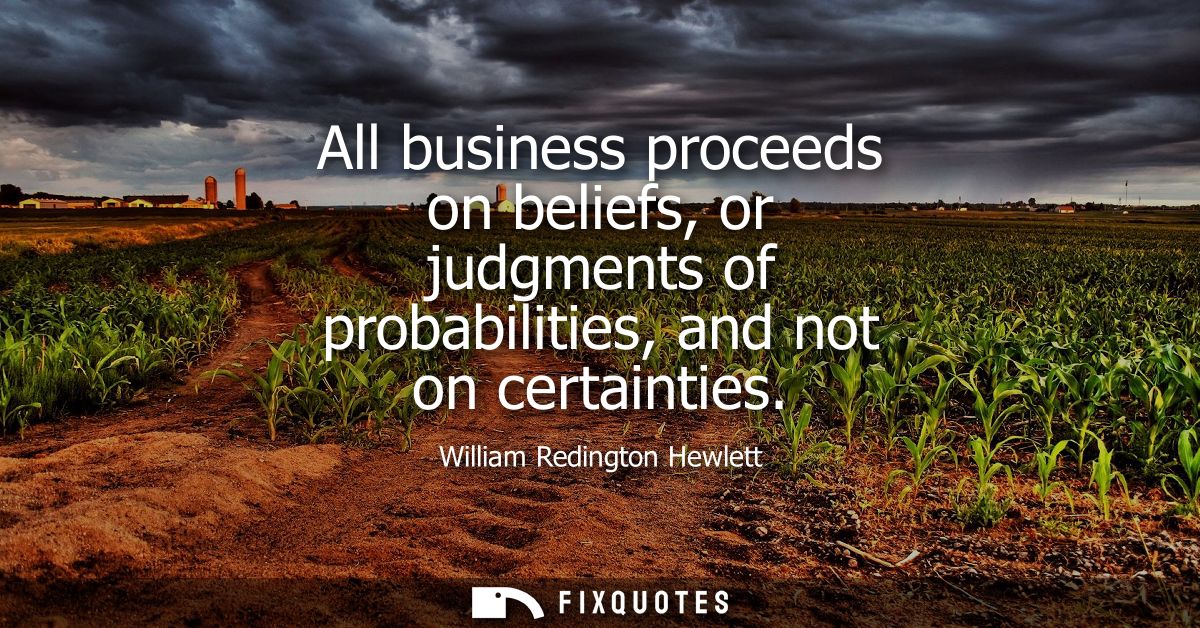
"All business proceeds on beliefs, or judgments of probabilities, and not on certainties"
About this Quote
The intent is managerial realism, but the subtext is also moral: uncertainty isn’t a temporary inconvenience on the way to certainty; it’s the permanent condition of decision-making. That’s a quiet rebuke to executives who demand guarantees from teams, consultants, or markets themselves. In Hewlett’s worldview, the responsible leader isn’t the one who pretends to know, but the one who can act without the narcotic of certainty - and own the consequences.
Contextually, this fits the postwar corporate era Hewlett inhabited, when modern management, operations research, and early computing promised to tame volatility. His sentence reads like a check on that optimism, especially from someone who helped build a company (HP) synonymous with engineering precision. The irony is productive: even in a culture of measurement, the crucial moments hinge on probabilistic courage.
Quote Details
| Topic | Vision & Strategy |
|---|---|
| Source | Help us find the source |
| Cite |
Citation Formats
APA Style (7th ed.)
Hewlett, William Redington. (2026, January 16). All business proceeds on beliefs, or judgments of probabilities, and not on certainties. FixQuotes. https://fixquotes.com/quotes/all-business-proceeds-on-beliefs-or-judgments-of-119380/
Chicago Style
Hewlett, William Redington. "All business proceeds on beliefs, or judgments of probabilities, and not on certainties." FixQuotes. January 16, 2026. https://fixquotes.com/quotes/all-business-proceeds-on-beliefs-or-judgments-of-119380/.
MLA Style (9th ed.)
"All business proceeds on beliefs, or judgments of probabilities, and not on certainties." FixQuotes, 16 Jan. 2026, https://fixquotes.com/quotes/all-business-proceeds-on-beliefs-or-judgments-of-119380/. Accessed 28 Mar. 2026.