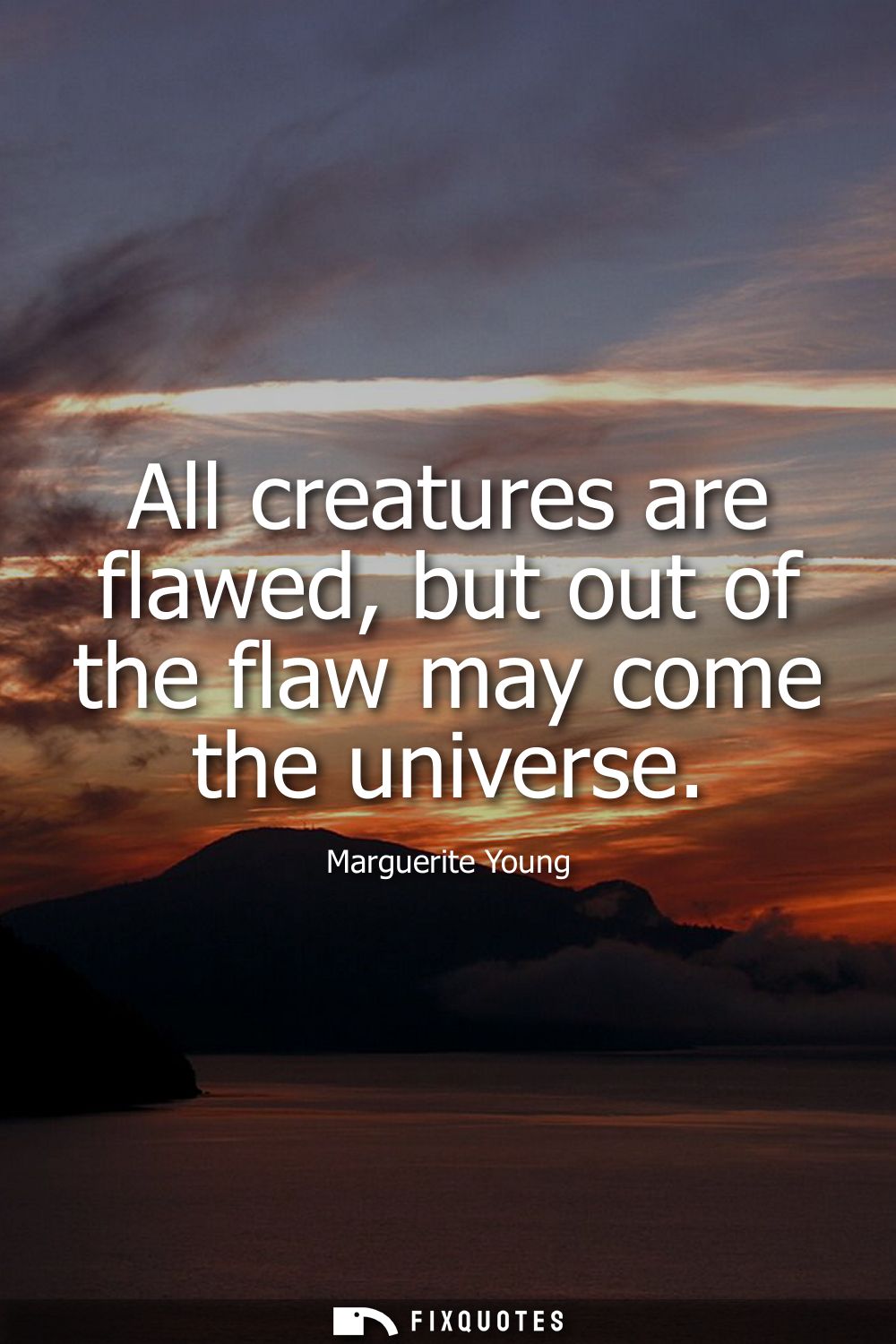
"All creatures are flawed, but out of the flaw may come the universe"
About this Quote
Young’s subtext is distinctly writerly: the flaw is the crack where narrative begins. A flawless character is a mannequin; a flawed one is a plot. Even the syntax enacts it. “Flawed” is static, a label; “may come” is motion, possibility, birth. The universe doesn’t come from virtue, discipline, or mastery - it comes from the messy, unintended, humanly unreliable places where control breaks down and imagination rushes in to patch the gap.
Context matters: Young wrote in an American 20th century steeped in grand systems that promised order - religious certainty, political ideologies, social respectability - and repeatedly produced catastrophe or hypocrisy. Her line sides with the misfit and the marginal not as exceptions to be fixed, but as the engine of creation. It’s also quietly anti-shame. If the universe can be born from a flaw, then error isn’t just survivable; it’s potentially consequential, even holy in its own unsanitary way.
Quote Details
| Topic | Wisdom |
|---|---|
| Source | Help us find the source |
| Cite |
Citation Formats
APA Style (7th ed.)
Young, Marguerite. (2026, January 17). All creatures are flawed, but out of the flaw may come the universe. FixQuotes. https://fixquotes.com/quotes/all-creatures-are-flawed-but-out-of-the-flaw-may-63651/
Chicago Style
Young, Marguerite. "All creatures are flawed, but out of the flaw may come the universe." FixQuotes. January 17, 2026. https://fixquotes.com/quotes/all-creatures-are-flawed-but-out-of-the-flaw-may-63651/.
MLA Style (9th ed.)
"All creatures are flawed, but out of the flaw may come the universe." FixQuotes, 17 Jan. 2026, https://fixquotes.com/quotes/all-creatures-are-flawed-but-out-of-the-flaw-may-63651/. Accessed 12 Feb. 2026.