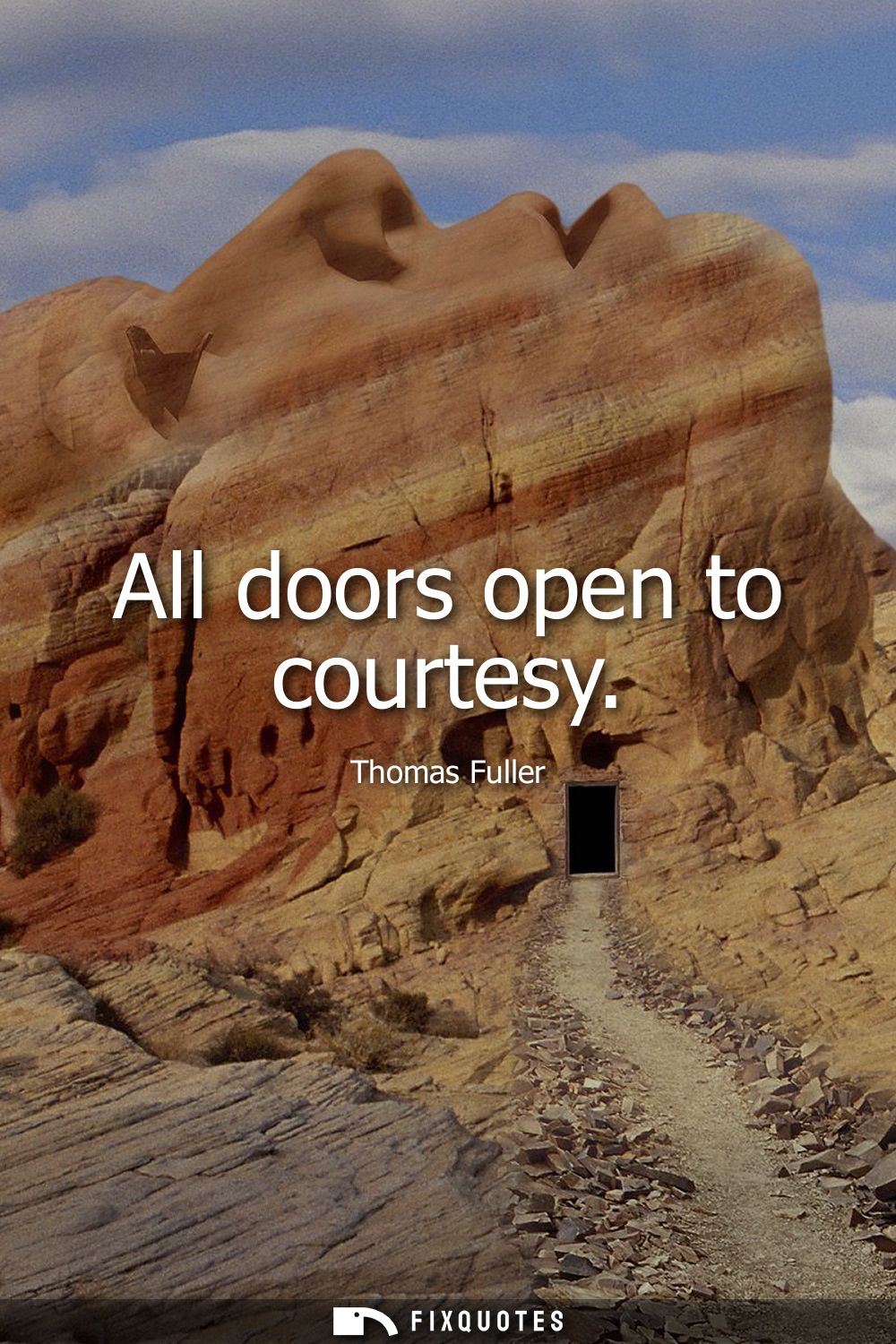
"All doors open to courtesy"
About this Quote
Courtesy is Fuller’s quiet skeleton key: a small, almost untheological virtue that nonetheless moves through the world with the force of policy. “All doors” is a deliberately outsized claim, and that exaggeration is the point. In a 17th-century England shredded by civil war, shifting regimes, and sectarian suspicion, the clergyman’s audience knew how quickly doors could close: to employment, safety, patronage, even basic trust. Fuller offers courtesy not as etiquette for its own sake but as a social technology, a way to pass through contested spaces without triggering the tripwires of pride and faction.
The subtext is gently corrective. Courtesy isn’t merely niceness; it’s a disciplined refusal to escalate. It signals self-control, recognizes another person’s status without surrendering your own, and buys time in tense interactions. That makes it especially useful for a preacher navigating parish politics and power. Fuller’s line also smuggles in a Protestant pragmatism: change hearts if you can, but at minimum keep channels open. You don’t win access by being right; you win it by being bearable.
The craft is in the metaphor. Doors imply gatekeepers, thresholds, and private interiors. Courtesy doesn’t demolish barriers; it persuades someone to unlatch them. Even today, in workplaces and online spaces where disagreement is treated as identity warfare, the sentence lands as a rebuke to performative bluntness. Fuller isn’t romantic about human nature. He’s betting that most people, most days, can be moved by respect more reliably than by argument.
The subtext is gently corrective. Courtesy isn’t merely niceness; it’s a disciplined refusal to escalate. It signals self-control, recognizes another person’s status without surrendering your own, and buys time in tense interactions. That makes it especially useful for a preacher navigating parish politics and power. Fuller’s line also smuggles in a Protestant pragmatism: change hearts if you can, but at minimum keep channels open. You don’t win access by being right; you win it by being bearable.
The craft is in the metaphor. Doors imply gatekeepers, thresholds, and private interiors. Courtesy doesn’t demolish barriers; it persuades someone to unlatch them. Even today, in workplaces and online spaces where disagreement is treated as identity warfare, the sentence lands as a rebuke to performative bluntness. Fuller isn’t romantic about human nature. He’s betting that most people, most days, can be moved by respect more reliably than by argument.
Quote Details
| Topic | Respect |
|---|---|
| Source | Help us find the source |
| Cite |
Citation Formats
APA Style (7th ed.)
Fuller, Thomas. (2026, January 18). All doors open to courtesy. FixQuotes. https://fixquotes.com/quotes/all-doors-open-to-courtesy-2050/
Chicago Style
Fuller, Thomas. "All doors open to courtesy." FixQuotes. January 18, 2026. https://fixquotes.com/quotes/all-doors-open-to-courtesy-2050/.
MLA Style (9th ed.)
"All doors open to courtesy." FixQuotes, 18 Jan. 2026, https://fixquotes.com/quotes/all-doors-open-to-courtesy-2050/. Accessed 27 Mar. 2026.
More Quotes by Thomas
Add to List