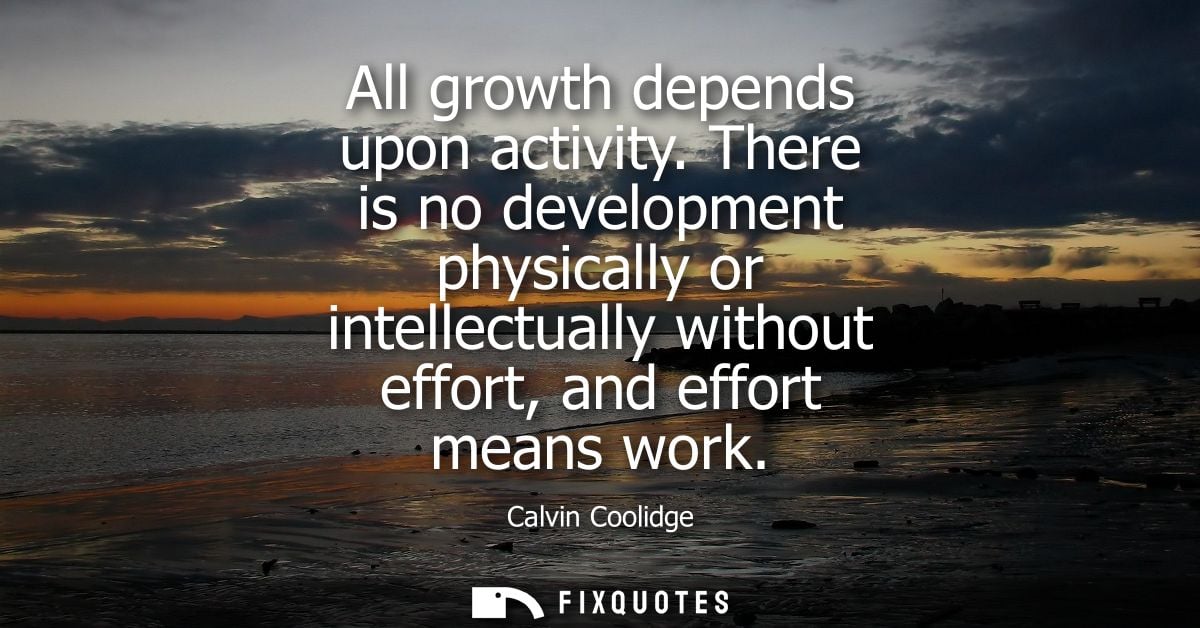
"All growth depends upon activity. There is no development physically or intellectually without effort, and effort means work"
About this Quote
The subtext is as political as it is personal. Coolidge governed in an era that mythologized productivity and treated leisure with suspicion, a decade of booming markets and sharp inequality where the cultural story was that anyone could rise if they simply tried hard enough. By making development hinge on individual exertion, he shifts attention away from institutions, luck, and structural barriers. If growth is always downstream of personal work, then stagnation can be read as personal failure - a comforting idea for a society reluctant to justify public intervention.
Rhetorically, it’s effective because it collapses complex debates into a simple chain of cause and effect. It also pairs the body with the mind, implying that the same ethic should govern both: the gym and the library, the factory floor and the classroom. That fusion flatters an American self-image built on industriousness. It’s motivational, but it’s also a quiet argument against entitlement - a presidential endorsement of austerity in the language of character.
Quote Details
| Topic | Work Ethic |
|---|---|
| Source | Help us find the source |
| Cite |
Citation Formats
APA Style (7th ed.)
Coolidge, Calvin. (2026, January 17). All growth depends upon activity. There is no development physically or intellectually without effort, and effort means work. FixQuotes. https://fixquotes.com/quotes/all-growth-depends-upon-activity-there-is-no-30350/
Chicago Style
Coolidge, Calvin. "All growth depends upon activity. There is no development physically or intellectually without effort, and effort means work." FixQuotes. January 17, 2026. https://fixquotes.com/quotes/all-growth-depends-upon-activity-there-is-no-30350/.
MLA Style (9th ed.)
"All growth depends upon activity. There is no development physically or intellectually without effort, and effort means work." FixQuotes, 17 Jan. 2026, https://fixquotes.com/quotes/all-growth-depends-upon-activity-there-is-no-30350/. Accessed 13 Feb. 2026.