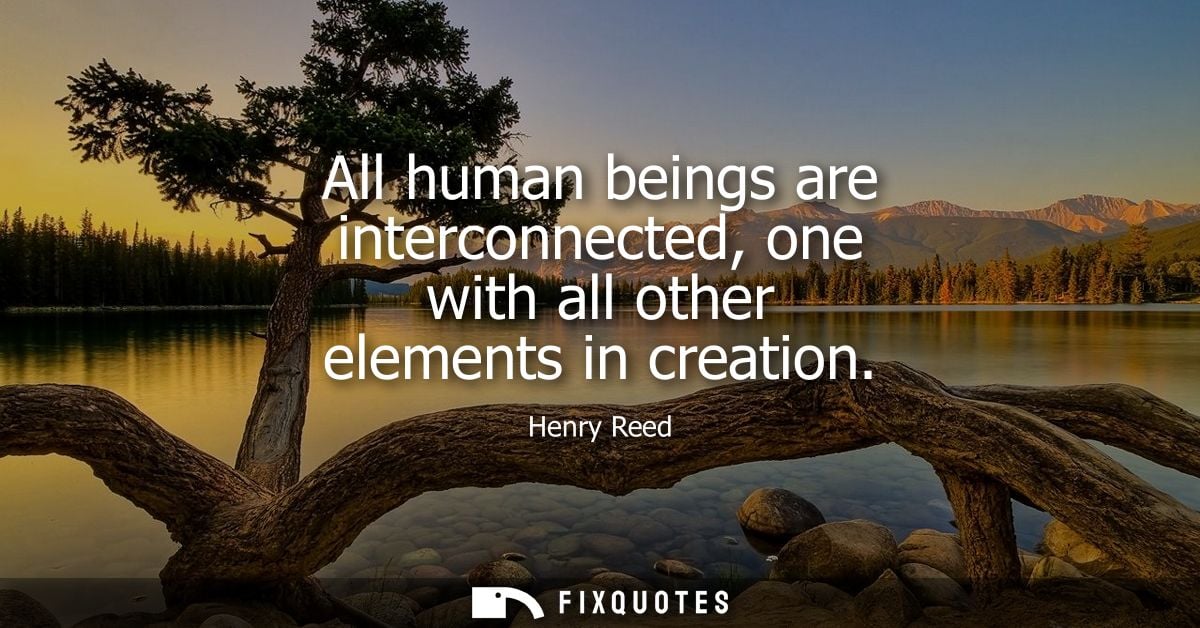
"All human beings are interconnected, one with all other elements in creation"
About this Quote
The subtext is pressure. Interconnection isn't only a cozy New Age glow; it's an accountability structure. In a world built on tidy boundaries - nation, class, self - Reed dissolves the walls and leaves you with consequences. Harm doesn't stay local. Privilege doesn't stay private. Even the fantasy of autonomy starts to look like a literary device.
Context matters here. Reed, a mid-century poet shaped by war-era Britain, wrote in a time when mass conflict and modern bureaucracy exposed how quickly individual lives can be swept into systems: rationing, bombing, propaganda, institutional routines. That historical backdrop gives this line its edge. It's not just pastoral unity; it's a recognition that the mechanisms linking us can be brutal as well as beautiful.
"Creation" is the final pivot: a capacious, slightly archaic term that smuggles ethics into ontology. Whether you read it spiritually or ecologically, Reed is widening the circle of belonging until the human is no longer the measure of everything - and that's the point.
Quote Details
| Topic | Wisdom |
|---|---|
| Source | Help us find the source |
| Cite |
Citation Formats
APA Style (7th ed.)
Reed, Henry. (2026, January 17). All human beings are interconnected, one with all other elements in creation. FixQuotes. https://fixquotes.com/quotes/all-human-beings-are-interconnected-one-with-all-59854/
Chicago Style
Reed, Henry. "All human beings are interconnected, one with all other elements in creation." FixQuotes. January 17, 2026. https://fixquotes.com/quotes/all-human-beings-are-interconnected-one-with-all-59854/.
MLA Style (9th ed.)
"All human beings are interconnected, one with all other elements in creation." FixQuotes, 17 Jan. 2026, https://fixquotes.com/quotes/all-human-beings-are-interconnected-one-with-all-59854/. Accessed 2 Apr. 2026.