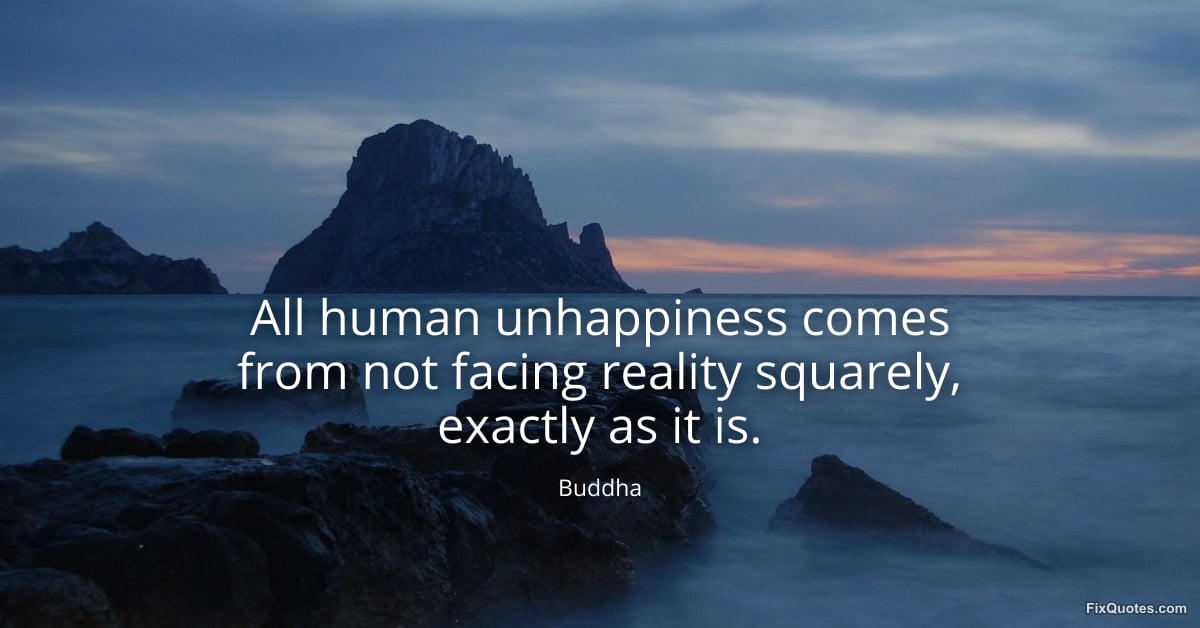
"All human unhappiness comes from not facing reality squarely, exactly as it is"
About this Quote
That is why the sentence still lands. It relocates unhappiness from the world to our relationship with the world. The problem is not merely that life contains loss, aging, illness, and death; the problem is that we keep trying to negotiate with those facts, prettify them, or pretend they apply to other people. The word "exactly" matters most here. It strips away comforting distortion - ego, fantasy, denial, attachment - and insists that suffering feeds on the gap between what is and what we desperately want to be true.
In the context of the Buddha's teaching, this is less a rebuke than a diagnosis. The Four Noble Truths begin with the blunt recognition that suffering is built into ordinary existence. The path forward starts not with escape but with perception: seeing impermanence, craving, and self-deception without flinching. That makes the quote sound almost clinical, but its force is moral as well. To face reality squarely is to stop blaming the world for failing to honor our illusions.
What gives the line its power is its austerity. It offers no sentimental loophole. Freedom begins where self-deception ends.
Quote Details
| Topic | Truth |
|---|---|
| Source | Help us find the source |
| Cite |
Citation Formats
APA Style (7th ed.)
Buddha. (2026, March 10). All human unhappiness comes from not facing reality squarely, exactly as it is. FixQuotes. https://fixquotes.com/quotes/all-human-unhappiness-comes-from-not-facing-185903/
Chicago Style
Buddha. "All human unhappiness comes from not facing reality squarely, exactly as it is." FixQuotes. March 10, 2026. https://fixquotes.com/quotes/all-human-unhappiness-comes-from-not-facing-185903/.
MLA Style (9th ed.)
"All human unhappiness comes from not facing reality squarely, exactly as it is." FixQuotes, 10 Mar. 2026, https://fixquotes.com/quotes/all-human-unhappiness-comes-from-not-facing-185903/. Accessed 3 Apr. 2026.