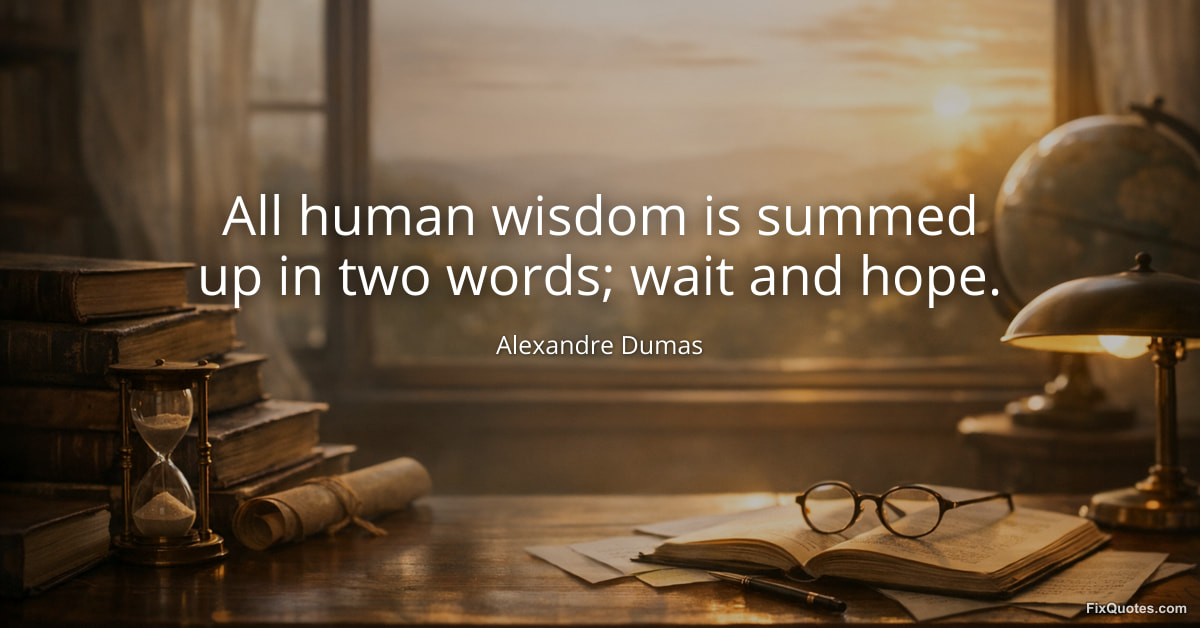
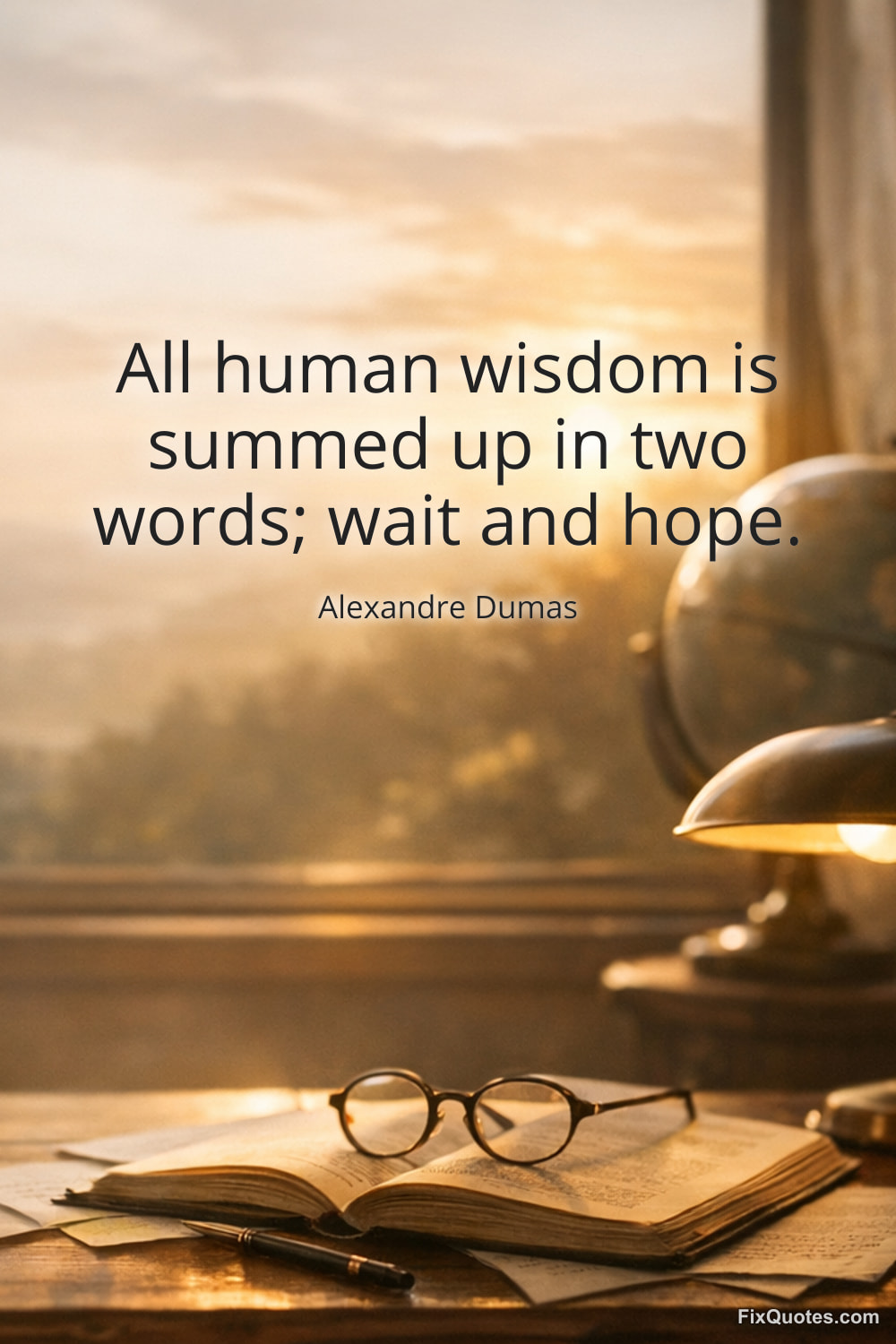
"All human wisdom is summed up in two words; wait and hope"
About this Quote
Dumas distills the grand machinery of his adventure epics into a deceptively modest prescription: stall your impulse to act, and refuse the psychic surrender that follows disappointment. "Wait and hope" isn’t passive so much as tactical. In Dumas’s world, fate is rarely mystical; it’s bureaucratic. Justice arrives by delay, inheritance by paperwork, revenge by timing. The line flatters patience as a form of intelligence, a way of cooperating with reality’s slow gears instead of grinding yourself against them.
The subtext is harder-edged than it looks. Waiting can be a discipline, but it can also be a cage. In 19th-century France - a society rocked by revolution, restoration, and sudden reversals of fortune - telling people to wait is politically loaded. It suggests survival through volatility: keep your head down, conserve your strength, let regimes change and debts come due. Hope, paired with waiting, becomes a kind of emotional rationing. You don’t deny suffering; you budget for it.
It also works rhetorically because of its compression. Two blunt verbs, no ornament, no theology. Wisdom isn’t a library; it’s a stance. Dumas, the dramatist, knows that audiences crave momentum, yet he offers the opposite as the secret engine of plot: suspense. Waiting is how stories create pressure; hope is how characters stay readable while time does its violence. The phrase lands because it acknowledges the insult of powerlessness and still insists you can choose your posture inside it.
The subtext is harder-edged than it looks. Waiting can be a discipline, but it can also be a cage. In 19th-century France - a society rocked by revolution, restoration, and sudden reversals of fortune - telling people to wait is politically loaded. It suggests survival through volatility: keep your head down, conserve your strength, let regimes change and debts come due. Hope, paired with waiting, becomes a kind of emotional rationing. You don’t deny suffering; you budget for it.
It also works rhetorically because of its compression. Two blunt verbs, no ornament, no theology. Wisdom isn’t a library; it’s a stance. Dumas, the dramatist, knows that audiences crave momentum, yet he offers the opposite as the secret engine of plot: suspense. Waiting is how stories create pressure; hope is how characters stay readable while time does its violence. The phrase lands because it acknowledges the insult of powerlessness and still insists you can choose your posture inside it.
Quote Details
| Topic | Hope |
|---|---|
| Source | Verified source: Le Comte de Monte-Cristo (Alexandre Dumas, 1846)
Evidence: – Attendre et espérer! (Feuilleton 140 (final installment), ends with “– Attendre et espérer!”). This line is the closing of the novel’s original newspaper serialization (roman-feuilleton) in the Journal des débats, dated 15 janvier 1846. That is the earliest clearly-dated primary-publication evidence I can verify online for the quote in Dumas’s own text. The longer, commonly-circulated English form (“…all human wisdom is summed up in these two words; wait and hope”) corresponds to the French passage spoken/written at the end of the book: “...toute la sagesse humaine sera dans ces deux mots : « Attendre et espérer ! »” as shown in the French text (Wikisource transcription) and in many English translations. For the overall first publication run of the novel in the Journal des débats (28 août 1844 – 15 janvier 1846), see the Bibliothèque nationale de France’s Gallica note. Other candidates (1) The Wisdom of the Great (Sam Majdi, 2012) compilation95.0% ... All human wisdom is summed up in two words, — wait and hope. There are virtues which become crimes by exaggeratio... |
| Cite |
Citation Formats
APA Style (7th ed.)
Dumas, Alexandre. (2026, February 16). All human wisdom is summed up in two words; wait and hope. FixQuotes. https://fixquotes.com/quotes/all-human-wisdom-is-summed-up-in-two-words-wait-97181/
Chicago Style
Dumas, Alexandre. "All human wisdom is summed up in two words; wait and hope." FixQuotes. February 16, 2026. https://fixquotes.com/quotes/all-human-wisdom-is-summed-up-in-two-words-wait-97181/.
MLA Style (9th ed.)
"All human wisdom is summed up in two words; wait and hope." FixQuotes, 16 Feb. 2026, https://fixquotes.com/quotes/all-human-wisdom-is-summed-up-in-two-words-wait-97181/. Accessed 31 Mar. 2026.
More Quotes by Alexandre
Add to List