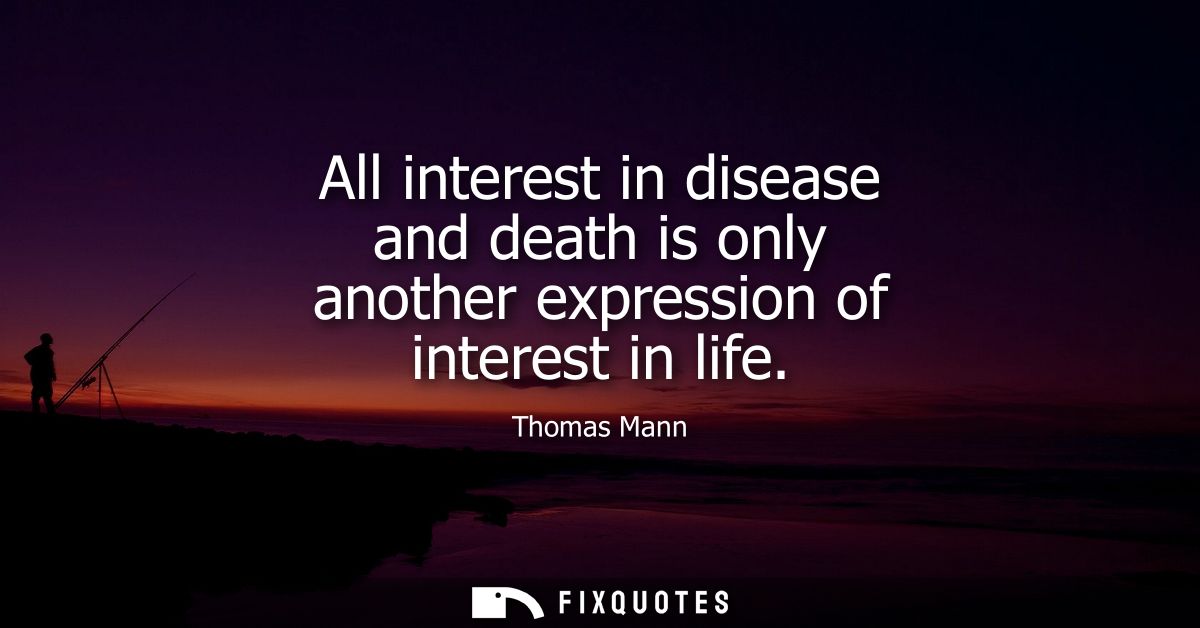
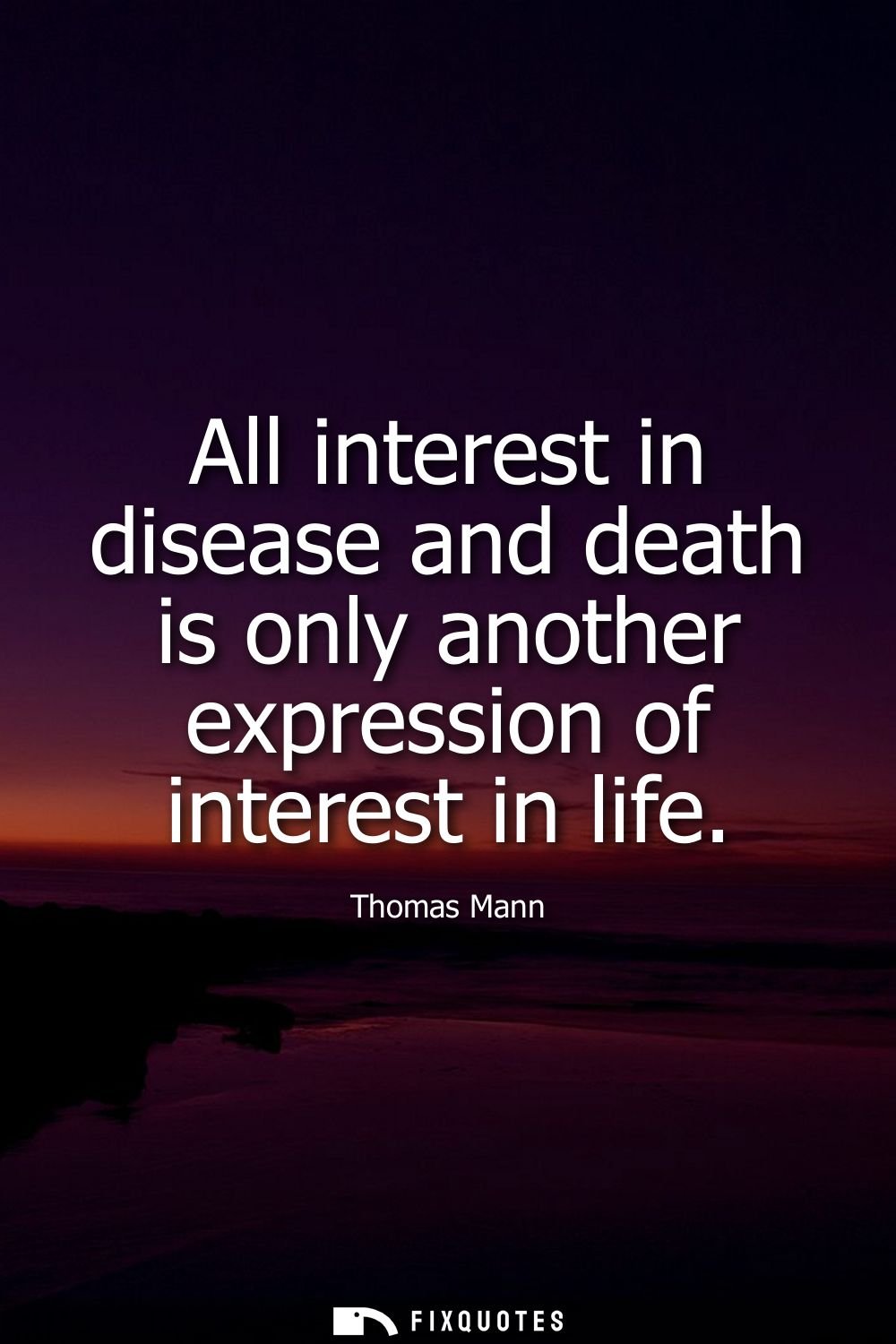
"All interest in disease and death is only another expression of interest in life"
About this Quote
The intent feels characteristically Mann: cool, analytic, slightly provocative. He takes what polite society treats as indecent curiosity and reframes it as an existential appetite. That reframing does cultural work. It lets the “serious” modern mind admit what it’s drawn to: hospitals, funerals, epidemics, the slow-motion drama of decline. Not because we love the spectacle of suffering, but because these scenes force a confrontation with value. What mattered? What was postponed? What was real?
Context matters because Mann is a writer who repeatedly stages illness as a social and philosophical laboratory. In The Magic Mountain, the sanatorium isn’t just a setting; it’s a pressure cooker where time dilates, ideology festers, desire sharpens, and Europe’s prewar complacency looks terminal. Disease becomes a narrative technology: it isolates characters from routine and exposes the hidden architecture of their lives.
The subtext is almost cynical: our so-called “interest” is rarely altruistic. We peer at mortality the way we peer at a fire - not to be burned, but to feel heat. In Mann’s hands, that impulse isn’t shameful; it’s human, and maybe the most honest version of attention we can manage.
Quote Details
| Topic | Mortality |
|---|---|
| Source | Help us find the source |
| Cite |
Citation Formats
APA Style (7th ed.)
Mann, Thomas. (2026, January 18). All interest in disease and death is only another expression of interest in life. FixQuotes. https://fixquotes.com/quotes/all-interest-in-disease-and-death-is-only-another-3929/
Chicago Style
Mann, Thomas. "All interest in disease and death is only another expression of interest in life." FixQuotes. January 18, 2026. https://fixquotes.com/quotes/all-interest-in-disease-and-death-is-only-another-3929/.
MLA Style (9th ed.)
"All interest in disease and death is only another expression of interest in life." FixQuotes, 18 Jan. 2026, https://fixquotes.com/quotes/all-interest-in-disease-and-death-is-only-another-3929/. Accessed 1 Apr. 2026.