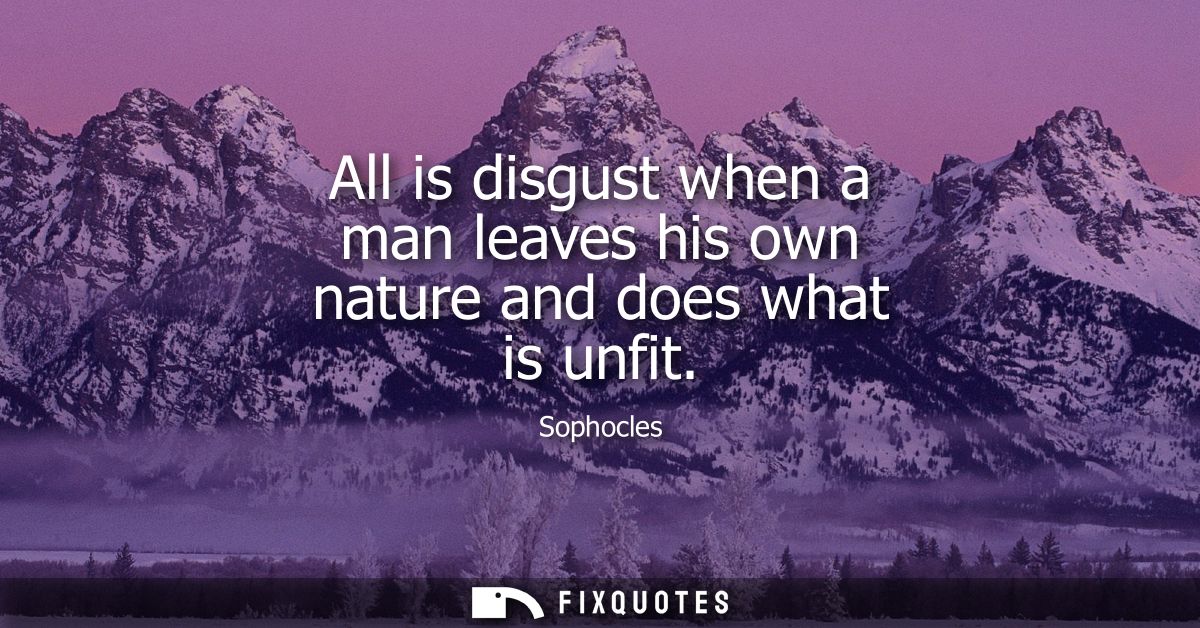
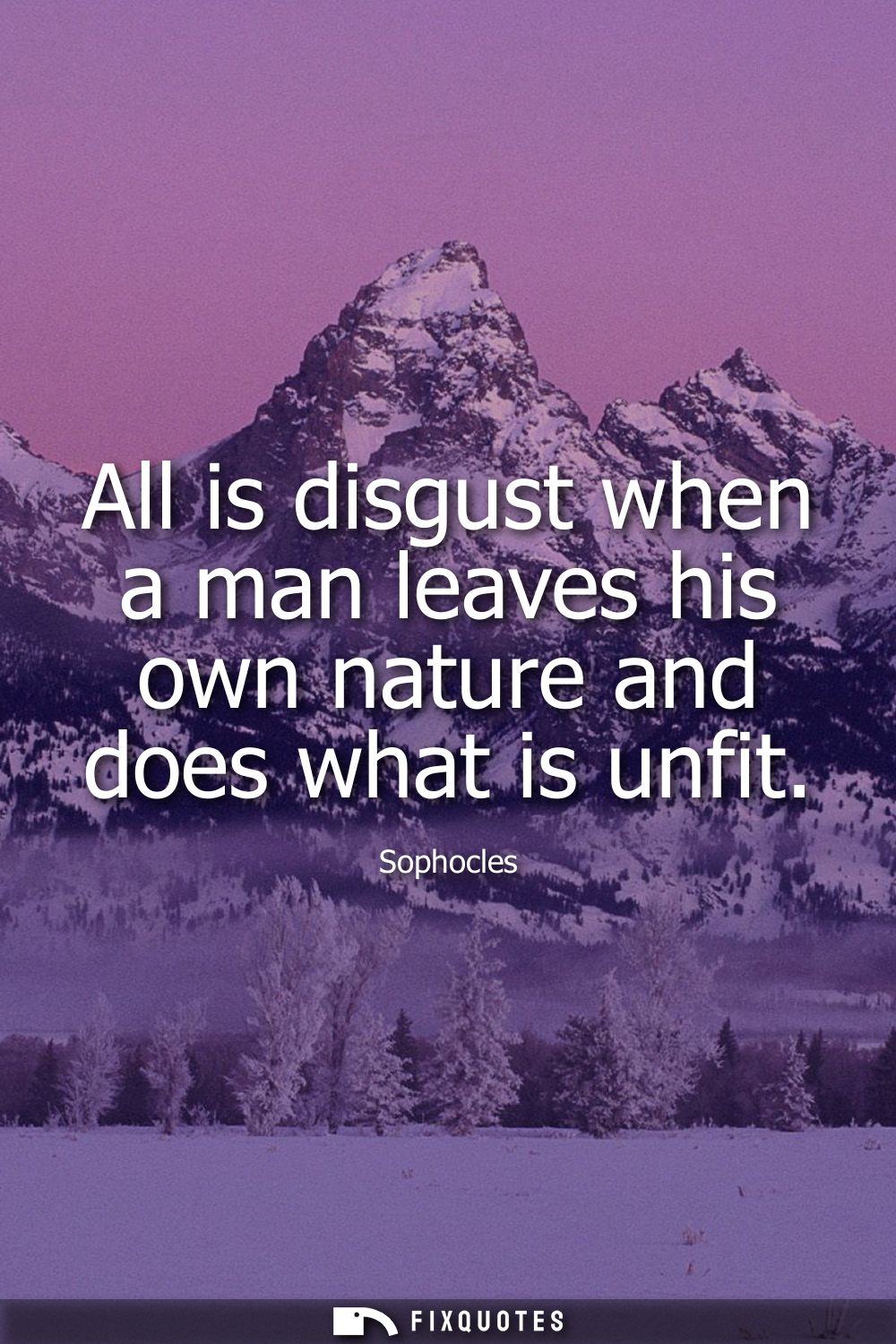
"All is disgust when a man leaves his own nature and does what is unfit"
About this Quote
Disgust is the moral alarm Sophocles trusts most: not a squeamish reaction to dirt, but the body’s verdict when a person steps outside the limits of what they are. “Leaves his own nature” doesn’t flatter the modern idea of self-invention; it warns that there’s a shape to human life, a set of fitting actions, and that violating it doesn’t merely cause harm - it contaminates the whole world of feeling. “All is disgust” is totalizing on purpose. Once the breach happens, the stain spreads: relationships, rituals, even language take on the sour taste of something out of joint.
In Greek tragedy, this isn’t self-help advice about authenticity. It’s a civic and religious claim. Sophocles writes in a culture where the polis runs on boundaries: between citizen and exile, human and divine, permissible pride and hubris. To do “what is unfit” is to violate to prepon - what is appropriate - and that appropriateness is not personal preference but a public grammar. Disgust functions as the chorus’s emotional shorthand for pollution (miasma), the sense that a wrong act doesn’t stay private; it radiates.
The subtext is a warning about self-justification. Tragic figures rarely think they’re villains; they think they’re exceptions. Sophocles punctures that fantasy by treating moral transgression as self-betrayal: the punishment begins internally, as revulsion. The line’s sting is its refusal to negotiate. Once you abandon your nature, the world stops feeling like home - and that queasy recognition is the first, clearest form of judgment.
In Greek tragedy, this isn’t self-help advice about authenticity. It’s a civic and religious claim. Sophocles writes in a culture where the polis runs on boundaries: between citizen and exile, human and divine, permissible pride and hubris. To do “what is unfit” is to violate to prepon - what is appropriate - and that appropriateness is not personal preference but a public grammar. Disgust functions as the chorus’s emotional shorthand for pollution (miasma), the sense that a wrong act doesn’t stay private; it radiates.
The subtext is a warning about self-justification. Tragic figures rarely think they’re villains; they think they’re exceptions. Sophocles punctures that fantasy by treating moral transgression as self-betrayal: the punishment begins internally, as revulsion. The line’s sting is its refusal to negotiate. Once you abandon your nature, the world stops feeling like home - and that queasy recognition is the first, clearest form of judgment.
Quote Details
| Topic | Ethics & Morality |
|---|---|
| Source | Help us find the source |
| Cite |
Citation Formats
APA Style (7th ed.)
Sophocles. (2026, January 17). All is disgust when a man leaves his own nature and does what is unfit. FixQuotes. https://fixquotes.com/quotes/all-is-disgust-when-a-man-leaves-his-own-nature-34825/
Chicago Style
Sophocles. "All is disgust when a man leaves his own nature and does what is unfit." FixQuotes. January 17, 2026. https://fixquotes.com/quotes/all-is-disgust-when-a-man-leaves-his-own-nature-34825/.
MLA Style (9th ed.)
"All is disgust when a man leaves his own nature and does what is unfit." FixQuotes, 17 Jan. 2026, https://fixquotes.com/quotes/all-is-disgust-when-a-man-leaves-his-own-nature-34825/. Accessed 12 Feb. 2026.
More Quotes by Sophocles
Add to List