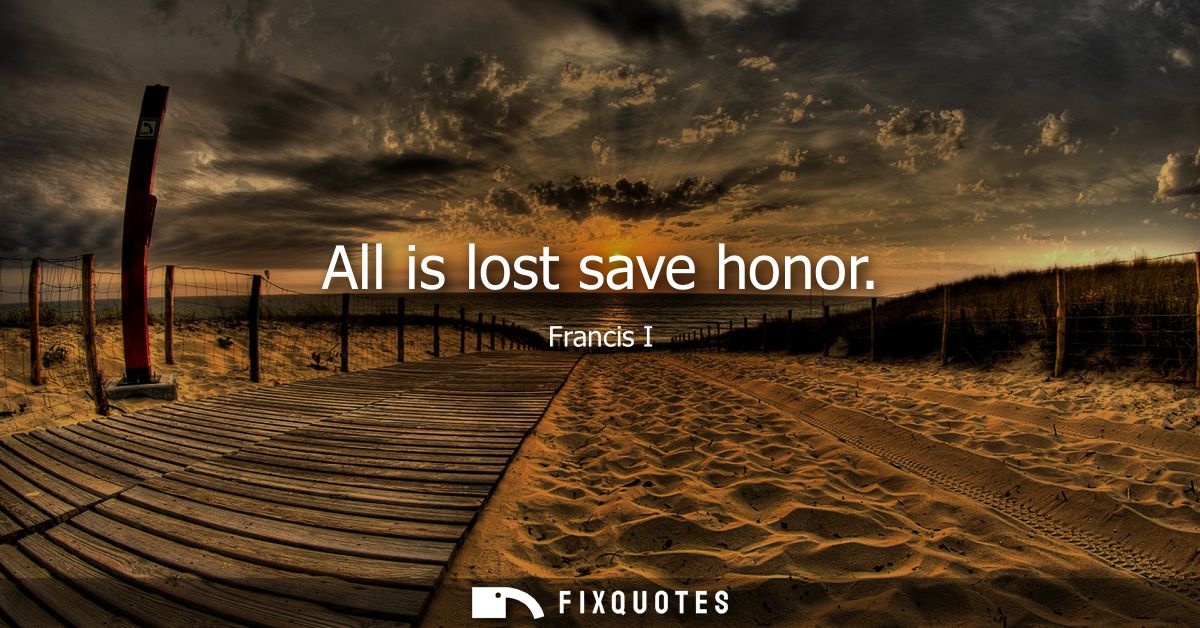
"All is lost save honor"
About this Quote
A king collapses an entire military disaster into a single usable asset: dignity. "All is lost save honor" is crisis PR distilled to six words, a line Francis I reportedly sent to his mother after the crushing defeat at Pavia in 1525, when he was captured by Charles V's forces. The genius is in the compression. "All" admits catastrophe without itemizing it: troops dead, alliances broken, ransom looming, the humiliating image of a monarch in chains. Then "save" performs the pivot, turning loss into selection. If everything must be taken, he decides what cannot be confiscated.
The subtext is shrewd. Honor isn't just personal virtue here; it's political currency. Early modern monarchy ran on legitimacy, and legitimacy ran on reputation. By declaring honor intact, Francis tries to keep the French court, his nobles, and foreign partners from reading Pavia as divine judgment or dynastic failure. He also pre-empts internal dissent: if the king remains honorable, loyalty remains a moral obligation, not merely a strategic bet.
There's emotional theater, too. The phrasing courts sympathy while avoiding self-pity, a careful blend of vulnerability and command. Even "lost" works double-duty: it signals real defeat, but also frames the event as fortune's reversal rather than incompetence. In a world where rulers were expected to embody the state, the line is a survival tactic. Captivity threatens to reduce Francis to a bargaining chip; this sentence insists he's still an author, still a sovereign mind, ruling at least the narrative when he can't rule the battlefield.
The subtext is shrewd. Honor isn't just personal virtue here; it's political currency. Early modern monarchy ran on legitimacy, and legitimacy ran on reputation. By declaring honor intact, Francis tries to keep the French court, his nobles, and foreign partners from reading Pavia as divine judgment or dynastic failure. He also pre-empts internal dissent: if the king remains honorable, loyalty remains a moral obligation, not merely a strategic bet.
There's emotional theater, too. The phrasing courts sympathy while avoiding self-pity, a careful blend of vulnerability and command. Even "lost" works double-duty: it signals real defeat, but also frames the event as fortune's reversal rather than incompetence. In a world where rulers were expected to embody the state, the line is a survival tactic. Captivity threatens to reduce Francis to a bargaining chip; this sentence insists he's still an author, still a sovereign mind, ruling at least the narrative when he can't rule the battlefield.
Quote Details
| Topic | Honesty & Integrity |
|---|---|
| Source | Later attribution: They Never Said It (Paul F. Boller Jr., John George, 1990) modern compilationISBN: 9780199879168 · ID: pZpXkPNgR2cC
Evidence:
... Francis I ( 1494–1547 ) ALL - IS - LOST QUOTE " All is lost save honor . " After losing the Battle of Pavia in 1525 , France's Francis I was imprisoned by the victor , Spain's Charles V , and in a letter to his mother , Louise of Savoy ... |
| Cite |
Citation Formats
APA Style (7th ed.)
France, Francis I of. (2026, February 10). All is lost save honor. FixQuotes. https://fixquotes.com/quotes/all-is-lost-save-honor-51093/
Chicago Style
France, Francis I of. "All is lost save honor." FixQuotes. February 10, 2026. https://fixquotes.com/quotes/all-is-lost-save-honor-51093/.
MLA Style (9th ed.)
"All is lost save honor." FixQuotes, 10 Feb. 2026, https://fixquotes.com/quotes/all-is-lost-save-honor-51093/. Accessed 25 Mar. 2026.
More Quotes by Francis
Add to List