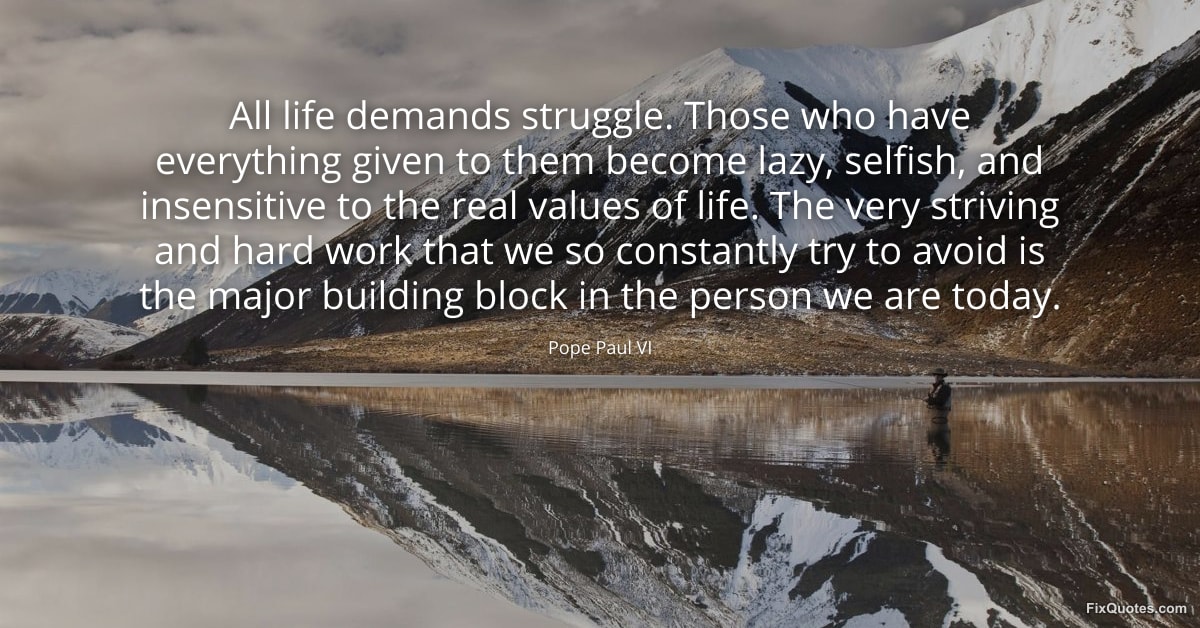
"All life demands struggle. Those who have everything given to them become lazy, selfish, and insensitive to the real values of life. The very striving and hard work that we so constantly try to avoid is the major building block in the person we are today"
About this Quote
The intent is partly disciplinary. “Those who have everything given to them” isn’t just a warning about spoiled heirs; it’s a diagnosis of an emerging consumer society where convenience becomes a kind of spiritual anesthesia. Paul VI pushes against the idea that progress equals less friction. In his framing, friction is formative. Struggle is not romanticized as pain-for-pain’s-sake, but reclassified as the training ground for “real values” - a phrase that quietly invokes Christian virtues like humility, patience, and solidarity without naming them outright.
The subtext is a defense of agency. “The very striving...we so constantly try to avoid” points a finger at universal avoidance while also offering an absolution: you don’t have to be heroic; you have to be willing. That’s classic ecclesial rhetoric at its most effective: it meets modern self-protectiveness where it lives, then turns it into a call to responsibility.
Context matters because Paul VI was a leader trying to keep the Church credible amid modernity’s promises. This quote insists that the human person can’t be engineered into goodness by abundance. You have to contend with life to be capable of love, restraint, and meaning.
Quote Details
| Topic | Perseverance |
|---|---|
| Source | Help us find the source |
| Cite |
Citation Formats
APA Style (7th ed.)
VI, Pope Paul. (2026, January 15). All life demands struggle. Those who have everything given to them become lazy, selfish, and insensitive to the real values of life. The very striving and hard work that we so constantly try to avoid is the major building block in the person we are today. FixQuotes. https://fixquotes.com/quotes/all-life-demands-struggle-those-who-have-109443/
Chicago Style
VI, Pope Paul. "All life demands struggle. Those who have everything given to them become lazy, selfish, and insensitive to the real values of life. The very striving and hard work that we so constantly try to avoid is the major building block in the person we are today." FixQuotes. January 15, 2026. https://fixquotes.com/quotes/all-life-demands-struggle-those-who-have-109443/.
MLA Style (9th ed.)
"All life demands struggle. Those who have everything given to them become lazy, selfish, and insensitive to the real values of life. The very striving and hard work that we so constantly try to avoid is the major building block in the person we are today." FixQuotes, 15 Jan. 2026, https://fixquotes.com/quotes/all-life-demands-struggle-those-who-have-109443/. Accessed 8 Apr. 2026.