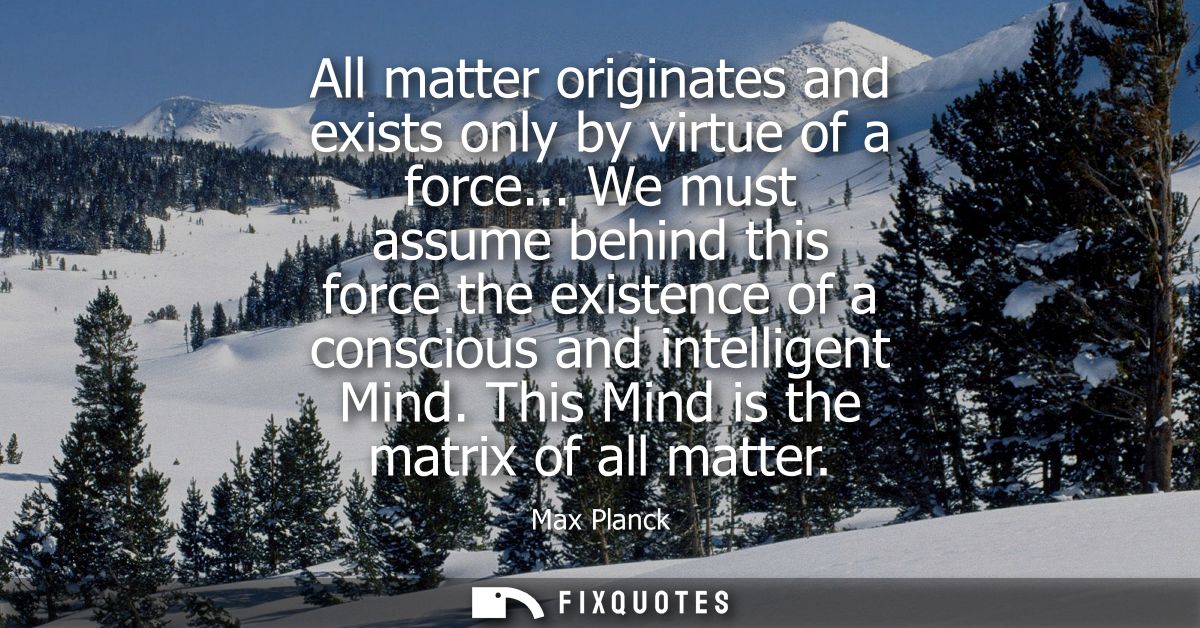
"All matter originates and exists only by virtue of a force... We must assume behind this force the existence of a conscious and intelligent Mind. This Mind is the matrix of all matter"
About this Quote
The intent is less “science proves God” than “science can’t avoid first principles.” Planck is pushing back against the era’s swaggering materialism - the idea that piling up mechanisms will eventually dissolve meaning. By calling Mind the “matrix,” he borrows the language of structure and generation: matter is not primary; it’s an output, a pattern sustained by something deeper. It’s a scientist’s version of the ancient reversal: spirit precedes substance.
The subtext is also defensive. Early 20th-century physics produced unsettling indeterminacy; “conscious and intelligent” functions like a stabilizer, a way to keep the cosmos from feeling like a random number generator. It’s notable he frames this as an “assumption,” not a theorem. The authority here comes from ethos: if a figure like Planck grants metaphysical language permission, the audience is invited to stop treating it as unserious.
Context matters: Planck lived through world wars, cultural collapse, and the unraveling of certainties. This line reads as a refusal to let modernity’s most powerful tool - science - be drafted into a purely nihilistic worldview.
Quote Details
| Topic | Truth |
|---|---|
| Source | Later attribution: The Power of Vital Force (Rajshree Patel, 2021) modern compilationISBN: 9781401956349 · ID: JnwmEAAAQBAJ
Evidence:
... All matter originates and exists only by virtue of a force .... We must assume behind this force the existence of a conscious and intelligent Mind . This Mind is the matrix of all matter . MAX PLANCK , QUANTUM PHYSICIST AND NOBEL ... |
| Cite |
Citation Formats
APA Style (7th ed.)
Planck, Max. (2026, March 29). All matter originates and exists only by virtue of a force... We must assume behind this force the existence of a conscious and intelligent Mind. This Mind is the matrix of all matter. FixQuotes. https://fixquotes.com/quotes/all-matter-originates-and-exists-only-by-virtue-24034/
Chicago Style
Planck, Max. "All matter originates and exists only by virtue of a force... We must assume behind this force the existence of a conscious and intelligent Mind. This Mind is the matrix of all matter." FixQuotes. March 29, 2026. https://fixquotes.com/quotes/all-matter-originates-and-exists-only-by-virtue-24034/.
MLA Style (9th ed.)
"All matter originates and exists only by virtue of a force... We must assume behind this force the existence of a conscious and intelligent Mind. This Mind is the matrix of all matter." FixQuotes, 29 Mar. 2026, https://fixquotes.com/quotes/all-matter-originates-and-exists-only-by-virtue-24034/. Accessed 2 Apr. 2026.