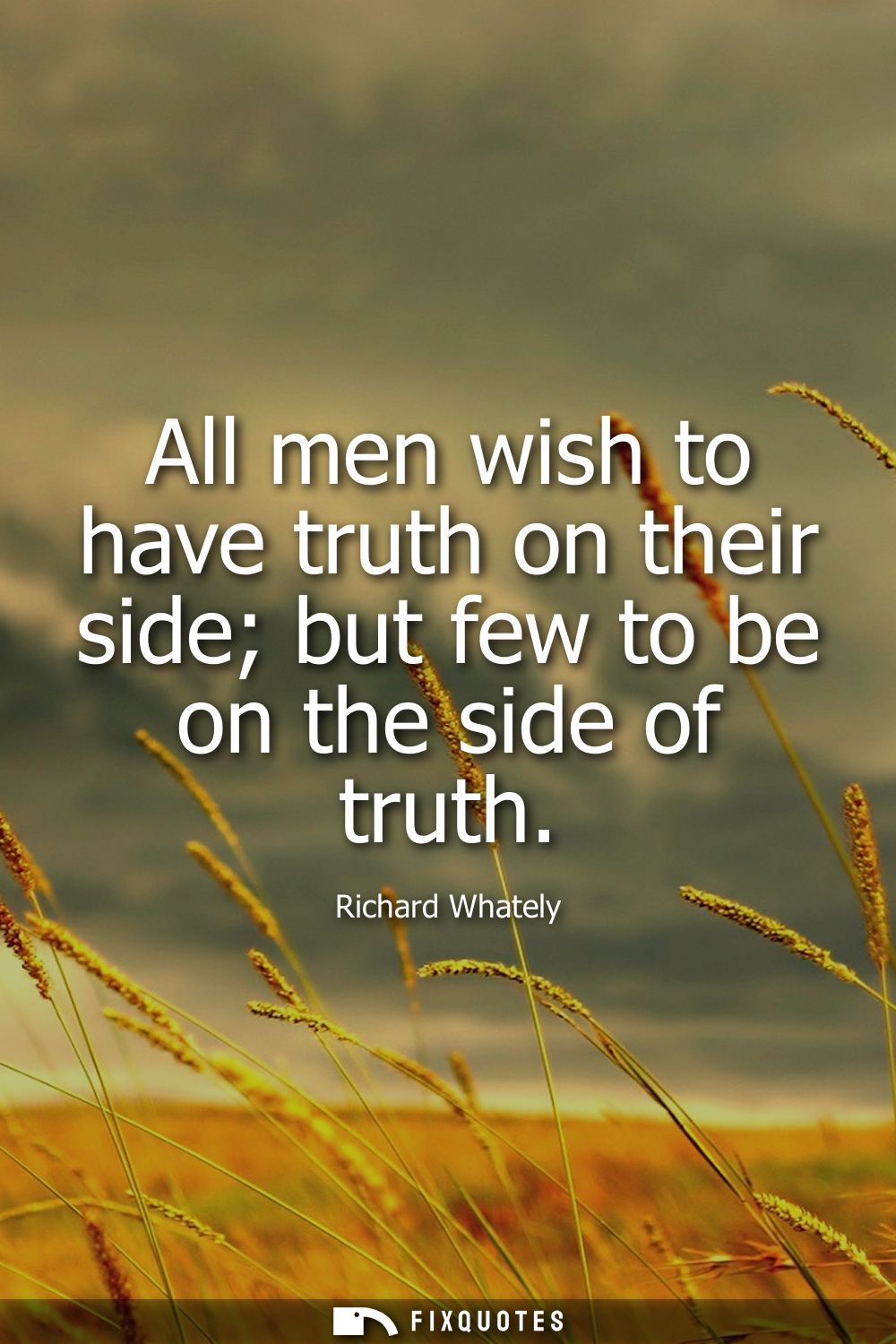
"All men wish to have truth on their side; but few to be on the side of truth"
About this Quote
The line works because it exposes a psychological loophole most people prefer not to notice. “Truth on their side” frames truth as a loyal ally, a hired gun. It flatters the ego and keeps the self intact: I was right all along. “On the side of truth” flips the relationship. Now you’re the one who must move, not the facts. Whately’s syntax stages that reversal, turning a common aspiration into a moral stress test.
Context matters: Whately was an Anglican thinker steeped in logic and rhetoric, writing in a Britain where public argument was expanding through newspapers, reform debates, and religious controversy. In that world, persuasion could easily outrun sincerity. He isn’t merely scolding hypocrisy; he’s diagnosing how debate becomes a theater of self-justification. The subtext is austere: most of us love truth as a weapon, not as a judge.
It’s also a quiet warning to any era with “teams” of opinion. You can win arguments and still lose reality. Whately’s punchline is that integrity isn’t claiming truth; it’s consenting to be corrected by it.
Quote Details
| Topic | Truth |
|---|---|
| Source | Later attribution: Famous and Infamous Quotes (Raymond a. Grillo, 2013) modern compilationISBN: 9781480901742 · ID: EZsCAgAAQBAJ
Evidence:
... All men wish to have truth on their side , but few to be on the side of truth . " - Richard Whately , British Theologian ( 1787-1863 ) " An old error is more popular than a new truth . " German Proverb " It is better to be silent and ... |
| Cite |
Citation Formats
APA Style (7th ed.)
Whately, Richard. (2026, February 23). All men wish to have truth on their side; but few to be on the side of truth. FixQuotes. https://fixquotes.com/quotes/all-men-wish-to-have-truth-on-their-side-but-few-90764/
Chicago Style
Whately, Richard. "All men wish to have truth on their side; but few to be on the side of truth." FixQuotes. February 23, 2026. https://fixquotes.com/quotes/all-men-wish-to-have-truth-on-their-side-but-few-90764/.
MLA Style (9th ed.)
"All men wish to have truth on their side; but few to be on the side of truth." FixQuotes, 23 Feb. 2026, https://fixquotes.com/quotes/all-men-wish-to-have-truth-on-their-side-but-few-90764/. Accessed 29 Mar. 2026.