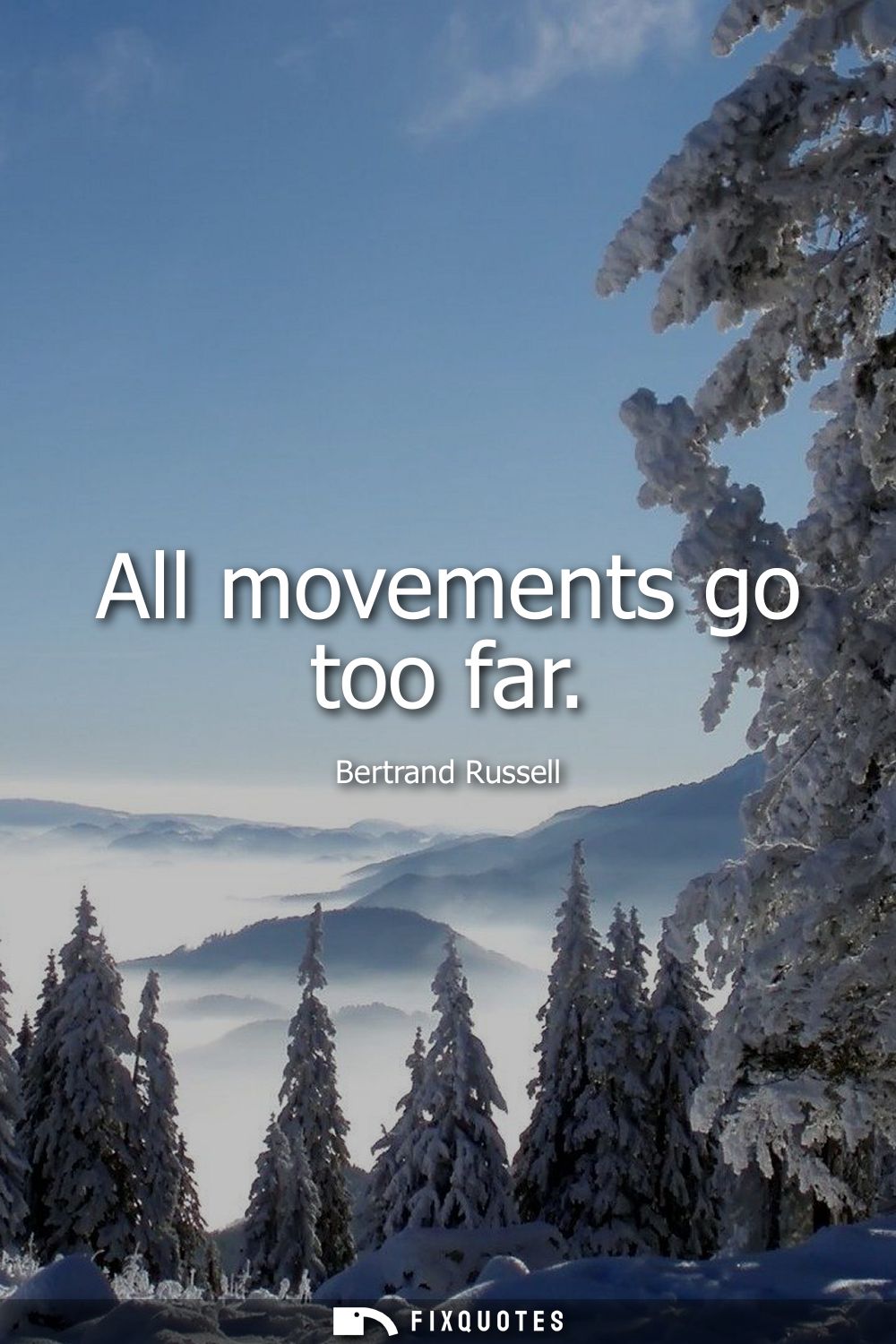
"All movements go too far"
About this Quote
“All movements go too far” is Russell at his most bracingly anti-romantic: a philosopher watching political passion harden into a substitute religion. The line looks like a shrug, but it’s really a warning about how moral energy mutates once it’s organized. Movements begin as a protest against genuine harm; they gather converts by simplifying a messy world into a single, legible injustice; then they keep coherence by treating nuance as betrayal. Russell’s intent isn’t to sneer at reform, but to expose the structural temptation baked into collective action: if you stop at “enough,” you risk losing momentum, donors, headlines, and the intoxicating clarity of being right.
The subtext is psychological. Individuals can afford mixed feelings; movements can’t. A crowd needs slogans, villains, and a story with clean edges. That pressure rewards escalation. What starts as a demand for dignity becomes a demand for purity. The movement’s original aims get replaced by the movement’s need to persist, and the loudest factions win because moderation doesn’t mobilize as efficiently as outrage. Russell, a lifelong advocate of reason, is diagnosing a drift from argument to identity: once belonging becomes the point, disagreement becomes heresy.
Context matters: Russell lived through suffrage battles, world wars, Bolshevism and fascism, and later the Cold War and nuclear brinkmanship. He supported causes, even radical ones, but distrusted absolutism wherever it appeared. The sentence is a compact defense of liberal skepticism: not “do nothing,” but “don’t confuse righteousness with infallibility,” especially when the megaphone turns a critique into a crusade.
The subtext is psychological. Individuals can afford mixed feelings; movements can’t. A crowd needs slogans, villains, and a story with clean edges. That pressure rewards escalation. What starts as a demand for dignity becomes a demand for purity. The movement’s original aims get replaced by the movement’s need to persist, and the loudest factions win because moderation doesn’t mobilize as efficiently as outrage. Russell, a lifelong advocate of reason, is diagnosing a drift from argument to identity: once belonging becomes the point, disagreement becomes heresy.
Context matters: Russell lived through suffrage battles, world wars, Bolshevism and fascism, and later the Cold War and nuclear brinkmanship. He supported causes, even radical ones, but distrusted absolutism wherever it appeared. The sentence is a compact defense of liberal skepticism: not “do nothing,” but “don’t confuse righteousness with infallibility,” especially when the megaphone turns a critique into a crusade.
Quote Details
| Topic | Wisdom |
|---|---|
| Source | Help us find the source |
| Cite |
Citation Formats
APA Style (7th ed.)
Russell, Bertrand. (2026, January 17). All movements go too far. FixQuotes. https://fixquotes.com/quotes/all-movements-go-too-far-30115/
Chicago Style
Russell, Bertrand. "All movements go too far." FixQuotes. January 17, 2026. https://fixquotes.com/quotes/all-movements-go-too-far-30115/.
MLA Style (9th ed.)
"All movements go too far." FixQuotes, 17 Jan. 2026, https://fixquotes.com/quotes/all-movements-go-too-far-30115/. Accessed 27 Mar. 2026.
More Quotes by Bertrand
Add to List