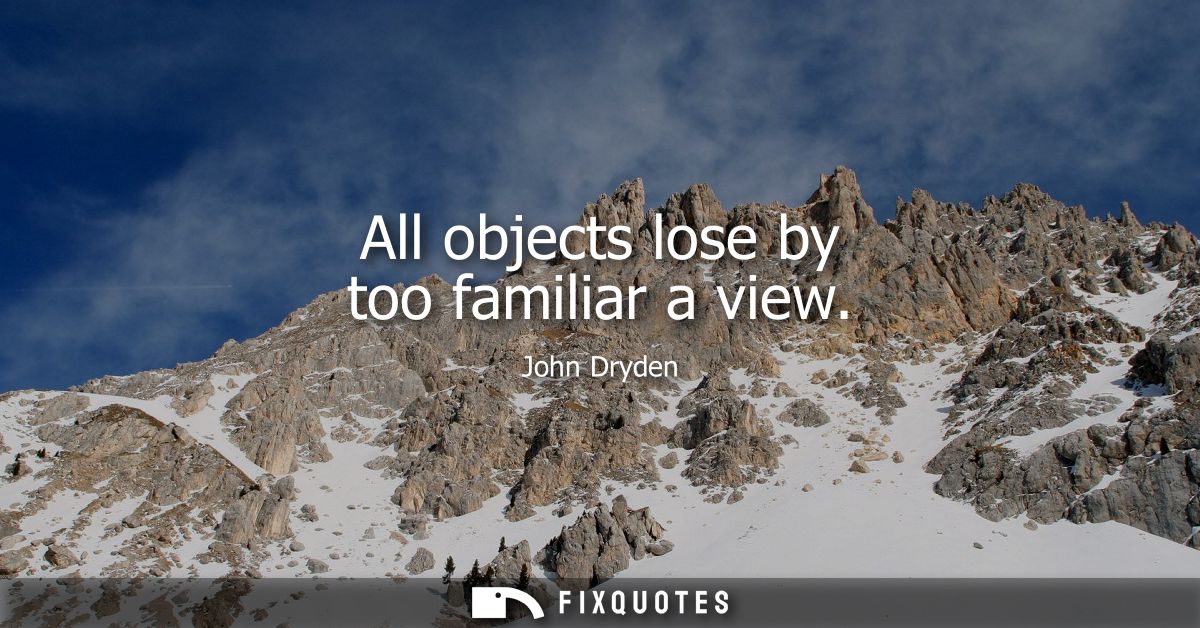
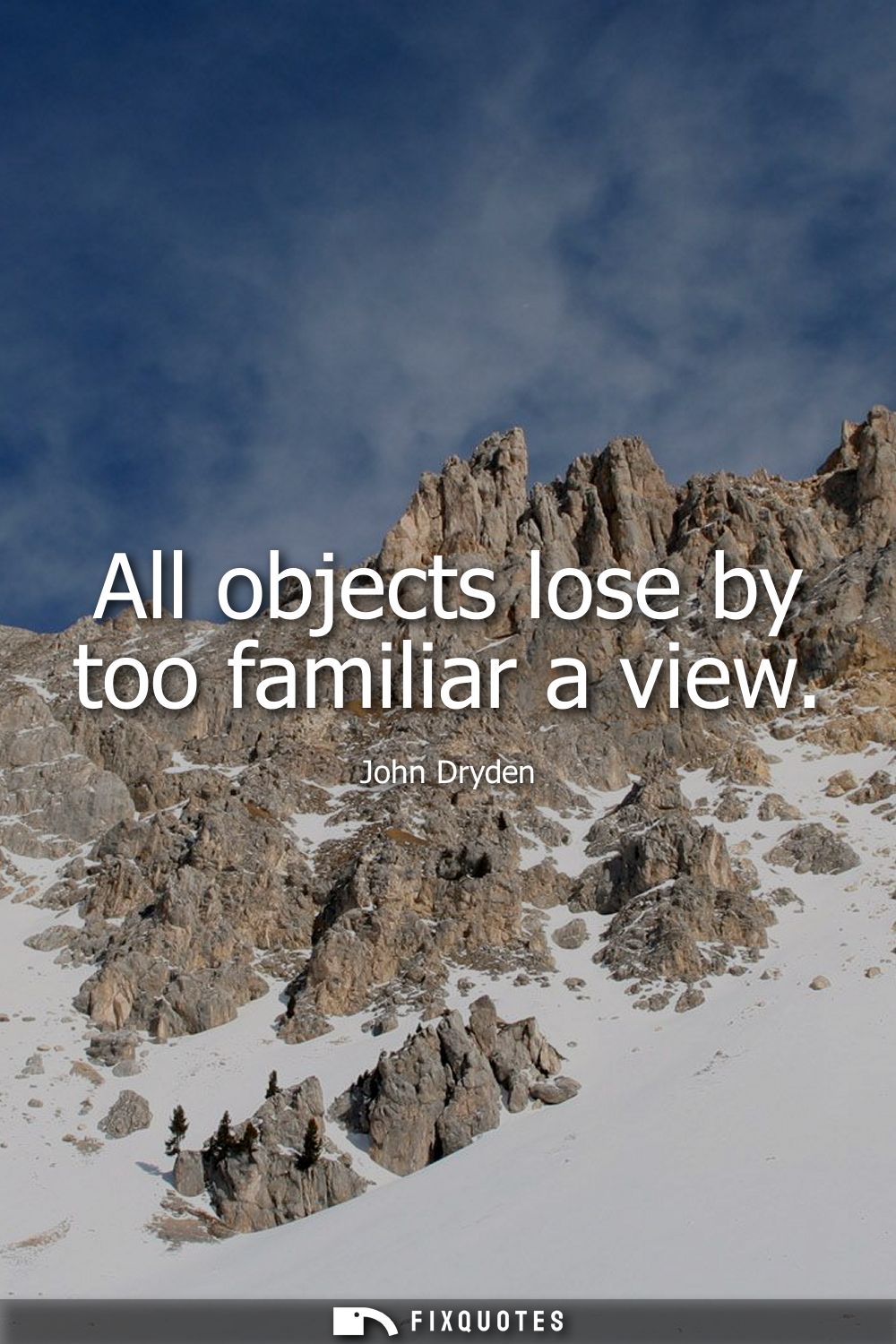
"All objects lose by too familiar a view"
About this Quote
Familiarity, Dryden suggests, is a kind of slow vandalism: not the dramatic smashing of idols, but the quiet rubbing-off of their shine. "All objects lose by too familiar a view" isn’t a romantic complaint about boredom so much as a hard-nosed observation about attention. The more routinely you look, the less you actually see. The mind stops paying the full price of perception and starts substituting shortcuts: labels, habits, the blunt comfort of "I already know this."
Dryden is writing as a Restoration poet, in a culture newly obsessed with surfaces, taste, and public performance. In that world, value is inseparable from presentation; novelty is a social currency. The line reads like aesthetic advice - keep some distance, preserve the aura - but it also carries a sly social warning. People, too, are "objects" in the economy of reputation. Overexposure makes them legible, and legibility is dangerous: once you can predict someone, you can dismiss them.
What makes the sentence work is its cold generality. "All objects" is mercilessly broad, turning a personal insight into a law of optics and psychology. "Too familiar" is the knife twist: the problem isn’t intimacy, it’s excess - attention without reverence. Dryden’s subtext is that admiration is a managed experience. Wonder requires framing, scarcity, a little controlled ignorance. Seen too closely, even greatness risks looking like mere material.
Dryden is writing as a Restoration poet, in a culture newly obsessed with surfaces, taste, and public performance. In that world, value is inseparable from presentation; novelty is a social currency. The line reads like aesthetic advice - keep some distance, preserve the aura - but it also carries a sly social warning. People, too, are "objects" in the economy of reputation. Overexposure makes them legible, and legibility is dangerous: once you can predict someone, you can dismiss them.
What makes the sentence work is its cold generality. "All objects" is mercilessly broad, turning a personal insight into a law of optics and psychology. "Too familiar" is the knife twist: the problem isn’t intimacy, it’s excess - attention without reverence. Dryden’s subtext is that admiration is a managed experience. Wonder requires framing, scarcity, a little controlled ignorance. Seen too closely, even greatness risks looking like mere material.
Quote Details
| Topic | Wisdom |
|---|---|
| Source | Help us find the source |
| Cite |
Citation Formats
APA Style (7th ed.)
Dryden, John. (2026, January 15). All objects lose by too familiar a view. FixQuotes. https://fixquotes.com/quotes/all-objects-lose-by-too-familiar-a-view-151592/
Chicago Style
Dryden, John. "All objects lose by too familiar a view." FixQuotes. January 15, 2026. https://fixquotes.com/quotes/all-objects-lose-by-too-familiar-a-view-151592/.
MLA Style (9th ed.)
"All objects lose by too familiar a view." FixQuotes, 15 Jan. 2026, https://fixquotes.com/quotes/all-objects-lose-by-too-familiar-a-view-151592/. Accessed 5 Mar. 2026.
More Quotes by John
Add to List