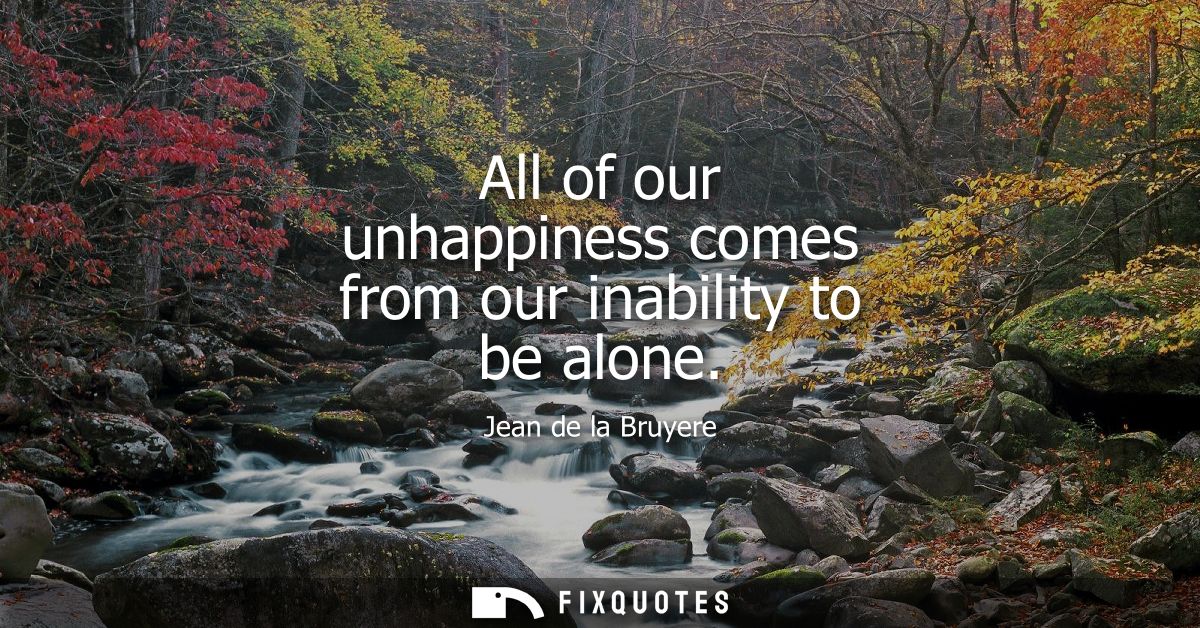
"All of our unhappiness comes from our inability to be alone"
About this Quote
A seventeenth-century moralist doesn’t lob a line like this to comfort you; he’s indicting you. La Bruyere’s aphorism is engineered to sting because it reframes “unhappiness” not as bad luck, unjust rulers, or fragile nerves, but as a social dependency so basic we barely register it. The target is the restless courtly world he knew: a culture of salons, patronage, gossip, and performance, where solitude wasn’t a wellness practice but a failure of status. If you can’t be alone, you’re always auditioning, always bargaining for attention, always vulnerable to the crowd’s verdict.
The intent is diagnostic, almost clinical. “Inability” suggests a skill deficit, not a circumstance. Being alone is treated as a capacity like judgment or taste: something the mature cultivate and the shallow lack. The subtext is harsher: our need for company often isn’t love of others but flight from ourselves. When silence arrives, the mind has no audience to charm and no noise to hide behind; it has to meet its own boredom, regret, envy, or emptiness head-on.
The line works because it collapses a sprawling catalog of misery into one humiliating source: cowardice in the face of interior life. It also carries a political edge. A populace unable to tolerate solitude is easy to steer with spectacle, scandal, and constant chatter. In La Bruyere’s world, that meant court intrigue and social theater; in ours, it reads like a prophecy about the attention economy. The cruelty is the point: if unhappiness is learned dependence, then happiness demands the unglamorous discipline of self-company.
The intent is diagnostic, almost clinical. “Inability” suggests a skill deficit, not a circumstance. Being alone is treated as a capacity like judgment or taste: something the mature cultivate and the shallow lack. The subtext is harsher: our need for company often isn’t love of others but flight from ourselves. When silence arrives, the mind has no audience to charm and no noise to hide behind; it has to meet its own boredom, regret, envy, or emptiness head-on.
The line works because it collapses a sprawling catalog of misery into one humiliating source: cowardice in the face of interior life. It also carries a political edge. A populace unable to tolerate solitude is easy to steer with spectacle, scandal, and constant chatter. In La Bruyere’s world, that meant court intrigue and social theater; in ours, it reads like a prophecy about the attention economy. The cruelty is the point: if unhappiness is learned dependence, then happiness demands the unglamorous discipline of self-company.
Quote Details
| Topic | Loneliness |
|---|---|
| Source | Later attribution: Who Am I Without You? (Christina G. Hibbert, 2015) modern compilationISBN: 9781626251441 · ID: UMqnBgAAQBAJ
Evidence:
... All of our unhappiness comes from our inability to be alone . -Jean de la Bruyere In chapters 1 and 2 , I emphasized , “ You're not alone ” and “ You need support . ” Now I'm saying , " Set up boundaries . " It sounds inconsistent , but ... |
| Cite |
Citation Formats
APA Style (7th ed.)
Bruyère, Jean de La. (2026, March 6). All of our unhappiness comes from our inability to be alone. FixQuotes. https://fixquotes.com/quotes/all-of-our-unhappiness-comes-from-our-inability-2661/
Chicago Style
Bruyère, Jean de La. "All of our unhappiness comes from our inability to be alone." FixQuotes. March 6, 2026. https://fixquotes.com/quotes/all-of-our-unhappiness-comes-from-our-inability-2661/.
MLA Style (9th ed.)
"All of our unhappiness comes from our inability to be alone." FixQuotes, 6 Mar. 2026, https://fixquotes.com/quotes/all-of-our-unhappiness-comes-from-our-inability-2661/. Accessed 2 Apr. 2026.
More Quotes by Jean
Add to List