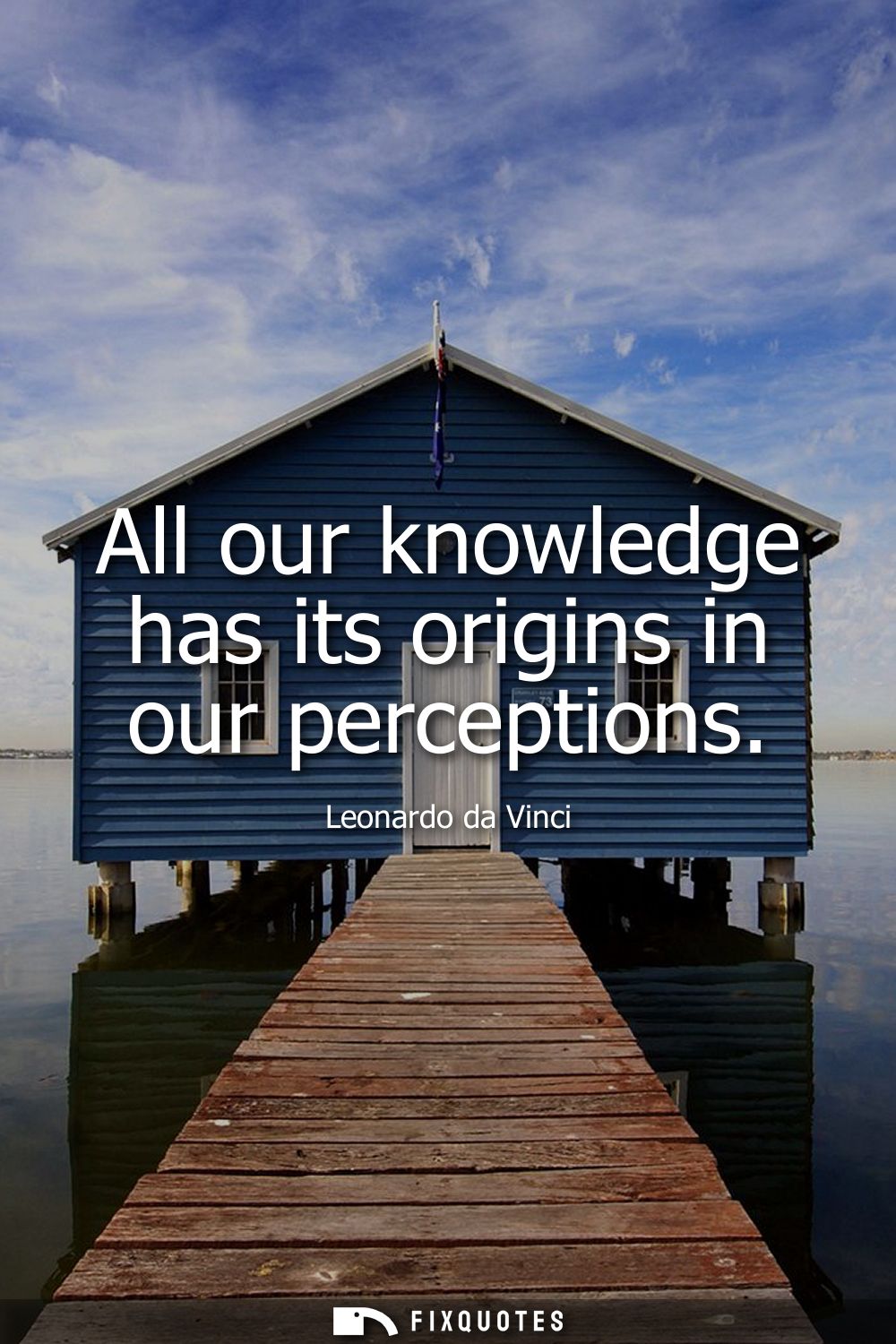
"All our knowledge has its origins in our perceptions"
About this Quote
Leonardo is sneaking a manifesto into a sentence that looks almost modest. “All our knowledge” is a sweeping claim, but he anchors it in the most practical place possible: perception. For an artist-engineer who lived by looking harder than everyone else, this isn’t airy philosophy; it’s a method. The line elevates the eye (and by extension the hand) as an instrument of truth at a time when Europe was renegotiating its relationship with authority, tradition, and inherited dogma. Renaissance humanism is in the background, but so is the workshop: pigments, anatomy studies, gears, water flow. Knowledge begins where the body meets the world.
The subtext is a quiet demotion of secondhand certainty. If perception is the origin, then book learning and received wisdom become downstream products, not the source. That’s a provocative stance in an era when scholastic argumentation could outrank observation, and when “because Aristotle said so” still had weight. Leonardo’s notebooks are full of this suspicion: he tests, sketches, rechecks, and refuses to outsource reality.
It also contains a warning. Perception is powerful, but it’s not pure; it can be trained, fooled, corrected. The sentence flatters empiricism while admitting its fragility, which is why it feels modern: it anticipates both science’s reliance on observation and art’s obsession with how seeing is shaped by light, perspective, and bias. Leonardo isn’t just praising the senses. He’s insisting that the disciplined act of looking is the beginning of thinking.
The subtext is a quiet demotion of secondhand certainty. If perception is the origin, then book learning and received wisdom become downstream products, not the source. That’s a provocative stance in an era when scholastic argumentation could outrank observation, and when “because Aristotle said so” still had weight. Leonardo’s notebooks are full of this suspicion: he tests, sketches, rechecks, and refuses to outsource reality.
It also contains a warning. Perception is powerful, but it’s not pure; it can be trained, fooled, corrected. The sentence flatters empiricism while admitting its fragility, which is why it feels modern: it anticipates both science’s reliance on observation and art’s obsession with how seeing is shaped by light, perspective, and bias. Leonardo isn’t just praising the senses. He’s insisting that the disciplined act of looking is the beginning of thinking.
Quote Details
| Topic | Knowledge |
|---|---|
| Source | Verified source: Thoughts on Art and Life (Leonardo da Vinci, 1906)
Evidence: All our knowledge is the offspring of our perceptions.. This is a primary-source translation of Leonardo da Vinci’s notebook material (i.e., Leonardo’s own writings, not a modern quote compilation). In this edition the line appears as item "35." under the heading "Vain Knowledge" in the Project Gutenberg text. Note that the commonly-circulated modern wording “has its origins in our perceptions” is a paraphrase/variant; this 1906 publication prints “is the offspring of our perceptions.” Also, the same sentence is widely cross-referenced to J. P. Richter’s earlier English compilation/translation of Leonardo’s writings (commonly cited as *The Literary Works of Leonardo da Vinci*, 1883; and also issued as *The Notebooks of Leonardo da Vinci*, with an 1888 date on some editions). I was able to verify the exact sentence in *Thoughts on Art and Life* directly, but I could not directly open/quote the corresponding page image from Richter’s 1883/1888 volumes within this session to confirm the *first* publication page number. Other candidates (1) Mechanisms, Symbols, and Models Underlying Cognition (José Mira, José R. Álvarez, 2005) compilation95.0% ... Leonardo da Vinci who wrote: “All our knowledge has its origins in our perceptions”. However, there are many kind... |
| Cite |
Citation Formats
APA Style (7th ed.)
Vinci, Leonardo da. (2026, February 28). All our knowledge has its origins in our perceptions. FixQuotes. https://fixquotes.com/quotes/all-our-knowledge-has-its-origins-in-our-22356/
Chicago Style
Vinci, Leonardo da. "All our knowledge has its origins in our perceptions." FixQuotes. February 28, 2026. https://fixquotes.com/quotes/all-our-knowledge-has-its-origins-in-our-22356/.
MLA Style (9th ed.)
"All our knowledge has its origins in our perceptions." FixQuotes, 28 Feb. 2026, https://fixquotes.com/quotes/all-our-knowledge-has-its-origins-in-our-22356/. Accessed 24 Mar. 2026.
More Quotes by Leonardo
Add to List