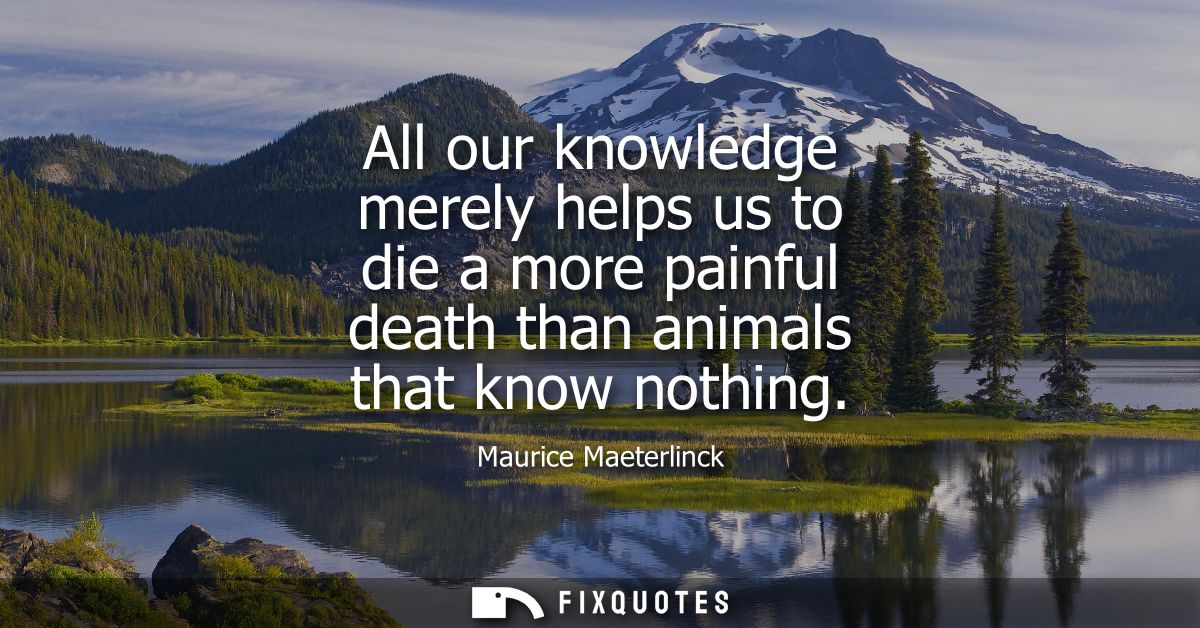
"All our knowledge merely helps us to die a more painful death than animals that know nothing"
About this Quote
The intent is provocation with a velvet glove. By comparing humans to “animals that know nothing,” he strips away the flattering story that consciousness is an upgrade. Animals, he implies, are spared the uniquely human torment of anticipation: the ability to rehearse loss, to predict the end, to turn mortality into a daily mental event. Knowledge doesn’t just inform; it multiplies dread. We don’t simply die; we narrate ourselves toward death, collecting evidence the whole way.
The subtext is also a critique of intellectual vanity. “All our knowledge” reads like a sweeping indictment of the library as coping mechanism: we study, classify, and philosophize partly to gain control, yet the payoff is an exquisitely detailed awareness of how little control we have. In Maeterlinck’s theater, meaning often hovers out of reach, and this line imports that atmosphere into a single jab: the mind’s finest achievement may be the ability to suffer with precision.
Quote Details
| Topic | Knowledge |
|---|---|
| Source | Help us find the source |
| Cite |
Citation Formats
APA Style (7th ed.)
Maeterlinck, Maurice. (2026, January 16). All our knowledge merely helps us to die a more painful death than animals that know nothing. FixQuotes. https://fixquotes.com/quotes/all-our-knowledge-merely-helps-us-to-die-a-more-137237/
Chicago Style
Maeterlinck, Maurice. "All our knowledge merely helps us to die a more painful death than animals that know nothing." FixQuotes. January 16, 2026. https://fixquotes.com/quotes/all-our-knowledge-merely-helps-us-to-die-a-more-137237/.
MLA Style (9th ed.)
"All our knowledge merely helps us to die a more painful death than animals that know nothing." FixQuotes, 16 Jan. 2026, https://fixquotes.com/quotes/all-our-knowledge-merely-helps-us-to-die-a-more-137237/. Accessed 30 Mar. 2026.