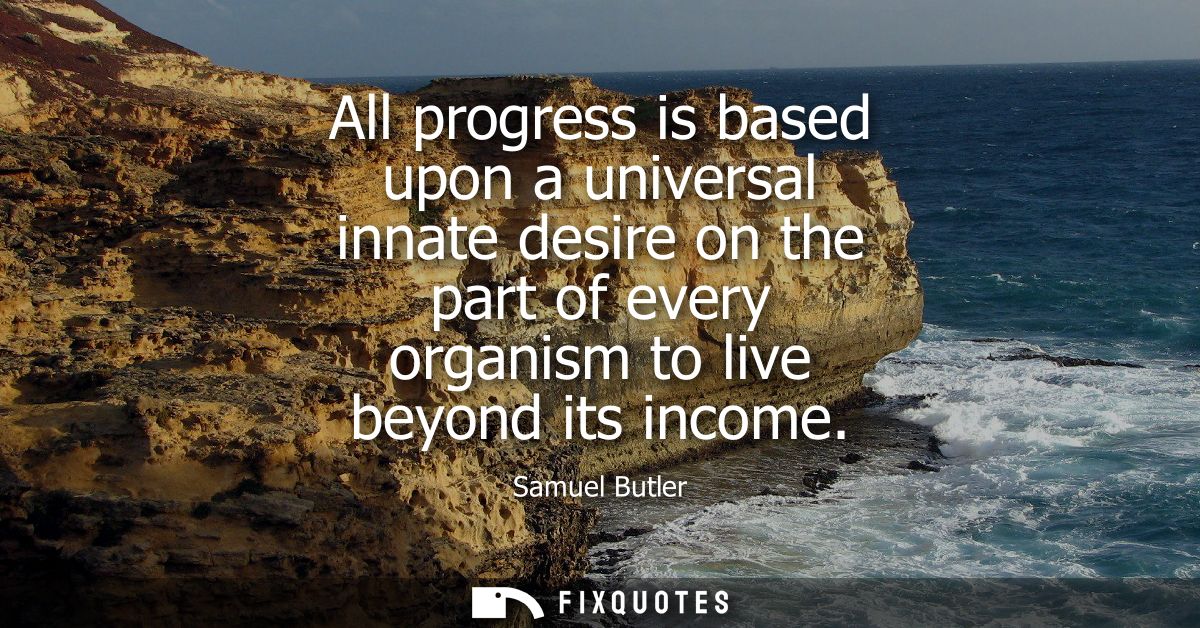
"All progress is based upon a universal innate desire on the part of every organism to live beyond its income"
About this Quote
Butler smuggles a Victorian moral lecture into an economic one-liner, then flips the verdict. “Live beyond its income” is the phrase of scolding accountants and anxious parents; he bolts it onto “every organism” and suddenly thrift looks less like virtue than a biological fantasy. The joke is that the very impulse society condemns as irresponsible spending is, in Butler’s framing, the engine of evolution and invention. Progress happens because life refuses to balance its books.
The intent is twofold: puncture sanctimony and reframe ambition. Butler writes in an era obsessed with self-help rectitude, industrial discipline, and Darwin’s aftershocks. When he calls the desire “universal” and “innate,” he’s borrowing the authority of science to defend what looks like moral failure. That’s the subtextual sting: capitalism and propriety demand restraint, but nature rewards overreach. The organism that stays neatly within its “income” (energy, resources, inherited traits) doesn’t transform; it merely persists until conditions change and it can’t.
There’s also a sly critique of progress narratives themselves. By describing advancement as overspending, Butler hints that innovation is rarely clean or “earned” in the way polite society likes to imagine. It’s debt, risk, leverage, the wager that tomorrow will pay for today’s hunger. The line flatters human aspiration and indicts it at once: our breakthroughs are driven by the same restless dissatisfaction that can wreck a household budget, or a planet.
The intent is twofold: puncture sanctimony and reframe ambition. Butler writes in an era obsessed with self-help rectitude, industrial discipline, and Darwin’s aftershocks. When he calls the desire “universal” and “innate,” he’s borrowing the authority of science to defend what looks like moral failure. That’s the subtextual sting: capitalism and propriety demand restraint, but nature rewards overreach. The organism that stays neatly within its “income” (energy, resources, inherited traits) doesn’t transform; it merely persists until conditions change and it can’t.
There’s also a sly critique of progress narratives themselves. By describing advancement as overspending, Butler hints that innovation is rarely clean or “earned” in the way polite society likes to imagine. It’s debt, risk, leverage, the wager that tomorrow will pay for today’s hunger. The line flatters human aspiration and indicts it at once: our breakthroughs are driven by the same restless dissatisfaction that can wreck a household budget, or a planet.
Quote Details
| Topic | Motivational |
|---|
More Quotes by Samuel
Add to List