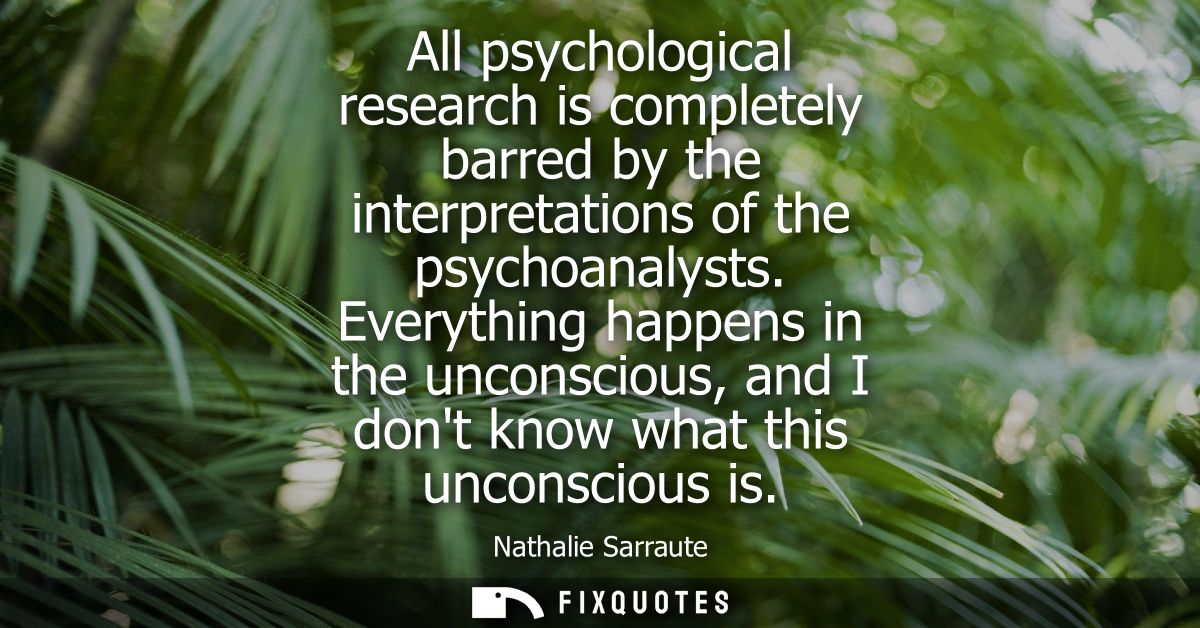
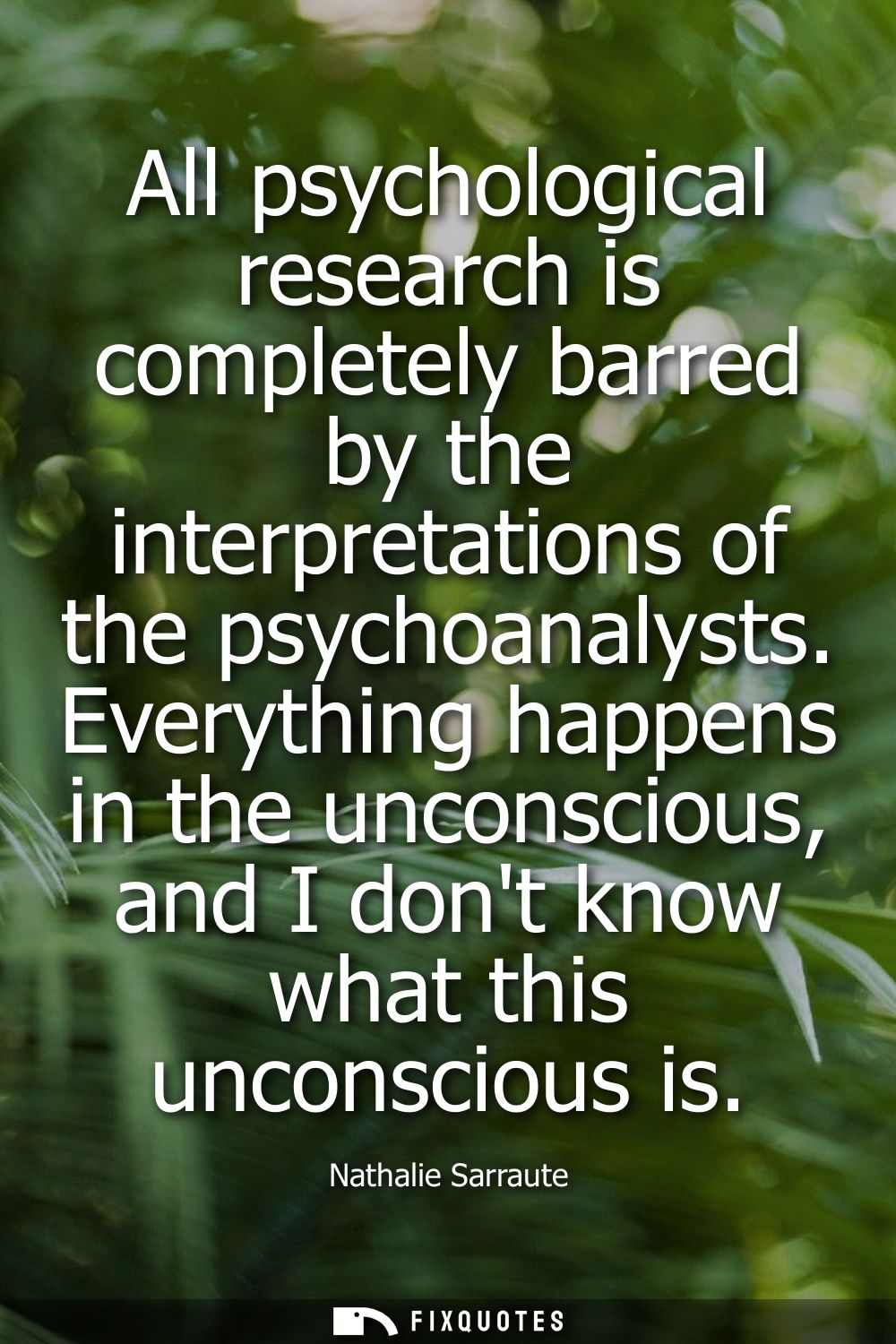
"All psychological research is completely barred by the interpretations of the psychoanalysts. Everything happens in the unconscious, and I don't know what this unconscious is"
About this Quote
Her second sentence is the lethal turn. “And I don’t know what this unconscious is” performs a lawyerly cross-examination: define your terms. The tone matters - not mystical, not reverent, but impatiently empirical. She’s pointing at the conceptual slippage psychoanalysis can trade on: “the unconscious” as a catch-all that absorbs contradictions, like a legal fiction that can’t be falsified because it’s always just offstage. If any objection can be refiled as “resistance,” the theory becomes self-sealing.
Context sharpens it. Sarraute, a key figure of the nouveau roman, was obsessed with the half-formed micro-movements beneath speech - what she called “tropisms.” She cared about interiority, but distrusted grand explanatory narratives. Coming from law, she’s attuned to how interpretive authority works: who gets to name motives, whose story counts as evidence. The subtext is a warning about cultural power disguised as insight: psychoanalysis as a priesthood of interpretation, turning messy human experience into tidy doctrine, while claiming the only key to the locked room it also insists exists.
Quote Details
| Topic | Deep |
|---|---|
| Source | Help us find the source |
| Cite |
Citation Formats
APA Style (7th ed.)
Sarraute, Nathalie. (2026, January 15). All psychological research is completely barred by the interpretations of the psychoanalysts. Everything happens in the unconscious, and I don't know what this unconscious is. FixQuotes. https://fixquotes.com/quotes/all-psychological-research-is-completely-barred-169053/
Chicago Style
Sarraute, Nathalie. "All psychological research is completely barred by the interpretations of the psychoanalysts. Everything happens in the unconscious, and I don't know what this unconscious is." FixQuotes. January 15, 2026. https://fixquotes.com/quotes/all-psychological-research-is-completely-barred-169053/.
MLA Style (9th ed.)
"All psychological research is completely barred by the interpretations of the psychoanalysts. Everything happens in the unconscious, and I don't know what this unconscious is." FixQuotes, 15 Jan. 2026, https://fixquotes.com/quotes/all-psychological-research-is-completely-barred-169053/. Accessed 31 Mar. 2026.