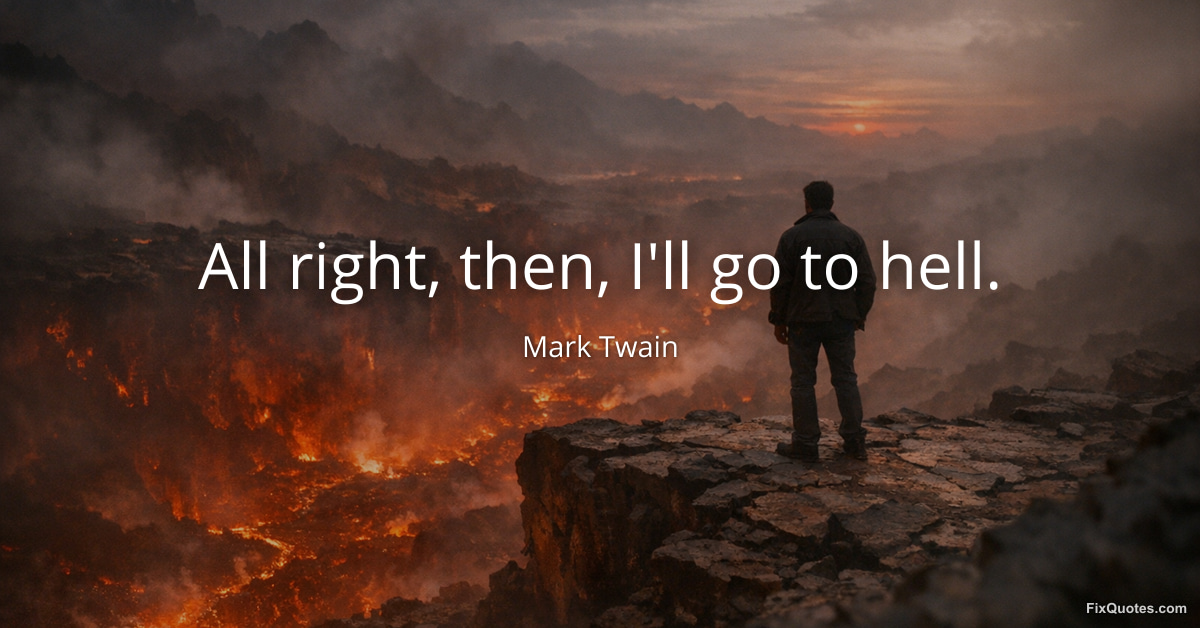
"All right, then, I'll go to hell"
About this Quote
A clean, explosive line like "All right, then, I'll go to hell" is Twain at his most subversive: the punch lands because it treats damnation not as a metaphysical terror, but as a moral administrative fee he is willing to pay. The sentence is short, colloquial, almost bored with the drama people expect from a declaration about eternity. That flatness is the point. Twain turns the supposed weight of religious consequence into a shrug, and in doing so exposes how often "salvation" is being used as social control rather than spiritual truth.
In context, it evokes the hinge-moment logic Twain loved to dramatize: a character recognizes that doing the right thing, as conscience defines it, may put them at odds with the official rules. The subtext is a brutal indictment of any moral system that demands cruelty in exchange for righteousness. If helping someone, protecting a friend, refusing to betray the vulnerable earns you hell, then hell becomes a badge of integrity and heaven starts to look corrupt.
It also works as American satire: the frontier plain-spokenness, the refusal to speak in pieties, the insistence that morality is measured in acts, not slogans. Twain lets the reader feel the social and theological pressure behind the threat of hell, then punctures it with one decisive, human sentence. The line dares you to notice the real scandal: not that someone would risk damnation, but that a culture would call decency a sin.
In context, it evokes the hinge-moment logic Twain loved to dramatize: a character recognizes that doing the right thing, as conscience defines it, may put them at odds with the official rules. The subtext is a brutal indictment of any moral system that demands cruelty in exchange for righteousness. If helping someone, protecting a friend, refusing to betray the vulnerable earns you hell, then hell becomes a badge of integrity and heaven starts to look corrupt.
It also works as American satire: the frontier plain-spokenness, the refusal to speak in pieties, the insistence that morality is measured in acts, not slogans. Twain lets the reader feel the social and theological pressure behind the threat of hell, then punctures it with one decisive, human sentence. The line dares you to notice the real scandal: not that someone would risk damnation, but that a culture would call decency a sin.
Quote Details
| Topic | Ethics & Morality |
|---|---|
| Source | Verified source: Adventures of Huckleberry Finn (Tom Sawyer's Comrade) (Mark Twain, 1885)ID: zuvXAAAAMAAJ
Evidence: Mark Twain. It was a close place . I took it up , and held it in my hand . I was a trembling , because I'd got to ... All right , then , I'll go to hell " -and tore it up . It was awful thoughts , and awful words , but they was said ... Other candidates (1) Adventures of Huckleberry Finn (Mark Twain, 1884)97.1% "All right, then, I'll go to hell", and tore it up. (Chapter XXXI, page 321 (1884 edition PDF page 344 / printed page... |
| Cite |
Citation Formats
APA Style (7th ed.)
Twain, Mark. (2026, March 16). All right, then, I'll go to hell. FixQuotes. https://fixquotes.com/quotes/all-right-then-ill-go-to-hell-24870/
Chicago Style
Twain, Mark. "All right, then, I'll go to hell." FixQuotes. March 16, 2026. https://fixquotes.com/quotes/all-right-then-ill-go-to-hell-24870/.
MLA Style (9th ed.)
"All right, then, I'll go to hell." FixQuotes, 16 Mar. 2026, https://fixquotes.com/quotes/all-right-then-ill-go-to-hell-24870/. Accessed 29 Mar. 2026.
More Quotes by Mark
Add to List